Fundación Endesa LED lighting for Santa María church, Medina de Rioseco
Written by ISP Integration editorial teamCategory: SUCCESS STORIES
Published:
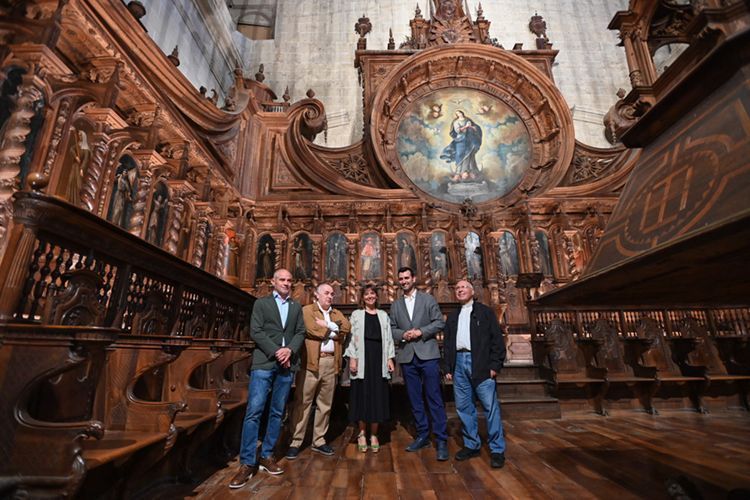
The lighting highlights the interior beauty of the Church of Santa María, specifically the “Sistine Chapel of Castile”.
Thanks to the use of the latest artistic lighting technologies, the project has reduced energy consumption by 66 per cent compared with traditional lighting.
The Church of Santa María in the town of Medina de Rioseco, in the province of Valladolid, now has one more attraction to offer its visitors: the newly unveiled artistic lighting of its most emblematic spaces: the choir, the church grille and the Benavente Chapel.
The latest technologies have been implemented in these spaces, following criteria of energy efficiency, environmental protection, and the conservation and protection of the illuminated works of art.
At the beginning of the 20th century, the writer and intellectual Eugenio D’ors described the Benavente Chapel as the “Sistine Chapel of Castilian art”, a term which, together with “Sistine Chapel of Castile”, eventually became the popular name for this jewel of the Spanish Renaissance.
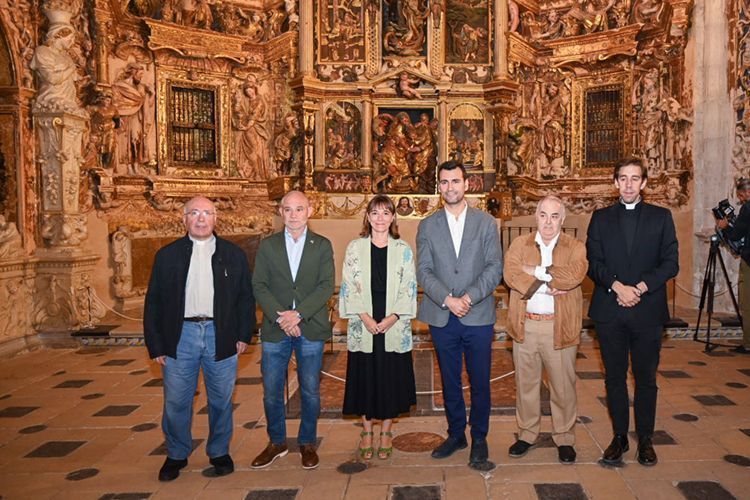
At the inauguration of this artistic lighting project, the mayor of Medina de Rioseco, David Esteban, expressed his gratitude for gaining a new ally such as Endesa in safeguarding Rioseco's heritage. He also stressed that:
The intervention marks a before and after in the way the Sistine Chapel of Castile, the choir stalls and the grille are shown, leaving the residents who gathered for the inauguration of the new lighting open-mouthed.
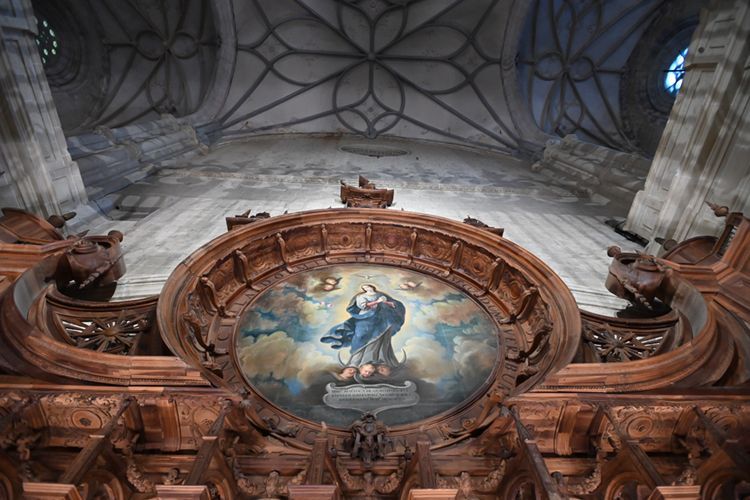
For his part, the president of the Association for the Restoration and Conservation of Churches of Medina de Rioseco, Antonio Santamaría, underlined the importance of artistic lighting projects of this kind, “with which we contribute to the conservation and dissemination of heritage, highlighting its value and improving the visitor experience, objectives shared by this Association. For all these reasons we are very grateful to Fundación Endesa for carrying it out". Fundación Endesa was represented by its head of artistic lighting, Marta Tobías, who highlighted that:
With this project we are doing something we are proud of: illuminating the highlights of our heritage through innovation and the latest technologies applied to the use of light. But we are not only bringing light to emblematic spaces; we are also shedding new light on the talent and work of the many masters who have filled our monuments with art. With projects like this we want to bring our history closer to the whole of society, with a unique cultural experience based on sustainability, efficiency and the conservation and care of the works. We are thus showcasing our past while doing our bit to look after the environment and, therefore, our future.
In this regard, the lighting project for the three spaces, chapel, grille and choir, has been carried out following sustainability and efficiency criteria, promoting energy savings. In total, 34 lighting points requiring 0.4 kW have been installed in the Benavente Chapel, and 14 lighting points and 6 LED lines with a total power of 0.58 kW in the choir; the total power required by the two spaces (0.98 kW) is equivalent to the consumption of a household iron.
The artistic lighting of the Benavente Chapel has been designed on two levels, using compact LED projectors: a first, general level has been achieved by lighting the vault, creating an enveloping light throughout the chapel by reflection. For the second level, accent lighting has been applied to the most outstanding features, avoiding the monotony of general lighting.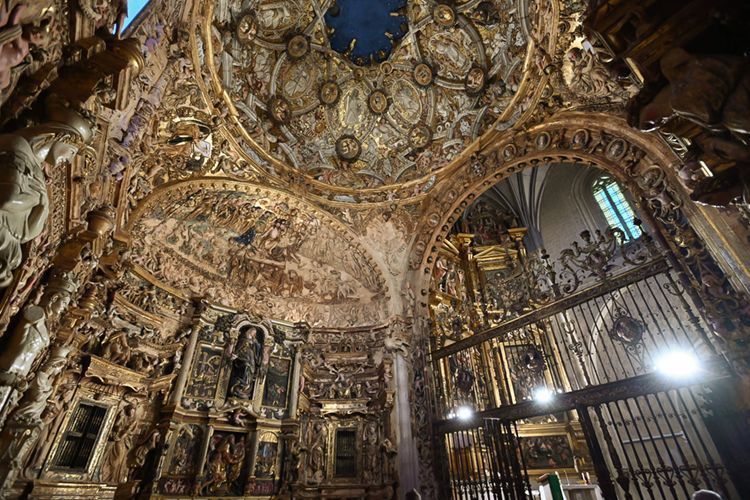 In the Baroque-style choir, meanwhile, the choir stalls are lit with adjustable-beam LED projectors, while the Renaissance grille, considered one of the masterpieces of Spanish ironwork, is lit from the outside, also with LED projectors.
The use of this type of high-efficiency lamp has been key to the project's energy savings. Conventional lighting would have required 6,437 kWh/year, whereas with the lighting installed consumption will be only 2,146 kWh/year, a reduction of 66 per cent.
This lighting joins the three others that Fundación Endesa has carried out in the province of Valladolid to date: the Cathedral and Archbishop's Palace of Valladolid and the Monastery of Santa María de Valbuena de Duero. In total, 82 have been carried out across Castilla y León, notably the recently inaugurated interior artistic lighting project called ‘Stella’ at Burgos Cathedral.
The latter draws on light, innovation and sustainability to tell the historical, social and theological story of the Cathedral, and lets visitors enjoy a unique immersive experience of light, sound and video mapping, discovering the monument as never before. The initiative is part of the events organised by the Fundación VIII Centenario de la Catedral. Burgos 2021 to commemorate the 800th anniversary of the cathedral last year.
You may also like
LEDVANCE cuts street lighting energy by up to 75%
Vokkero keeps the Ura Bere Bidean crew connected
Biamp Vocia: a paging system running for over ten years
31 Million Pixels Revolutionise Simulation
Genelec provides sound for a mini-golf venue in Germany
A journey through imagery, interaction and architecture
A new look for the Barcelona Metro with Soltec
Invisible Technology, Great Experiences
Fewer loudspeakers, greater clarity in the classroom
Communication in critical situations with UDE

The Value of Sound in Hospitality and Retail
Acoustics designed for sports and events

Platform for remote projector control

Real-time information for British Airways

Crestron turns the classroom into Wall Street
Church finds its voice with OPTIMUS
Integrated audio for fine dining environments
Networked audio for multifunctional spaces
Coordinates police alerts and emergencies
Sony technology to inspire architects
25 Barco projectors bring an AI museum to life
Anolis Illuminates the Natural Water Cycle

Aetria for Antarctic Exploration
Outdoor Displays for All Weather Conditions
Premium audio serving retail and hospitality
Immersive AV engineering to bring history to life
INFiLED LED at the World's Tallest Hotel
From live sound to home with L-Acoustics
Hikvision improves flood response
Premium audio drives retail performance
A digital canvas for the heart of Seattle
Atmospheres of light in the Qatari desert
Martin Audio brings sonic energy until dawn
Bilbao Brings Fans Together Through Digital Signage

A Sound Atmosphere Tailored for Retail
Universidad Europea Boosts Learning with Nureva
A Camp Nou designed for frictionless operation
HYRISS Technology in Residential Environments
HYRISS technology in residential environments
From isolated systems to smart security
ONGC’s Operational Brain Strengthens with Datapath
DATALAND, the new museum of AI arts
Frankfurt unveils the first native DooH terminal
Invisible audio to reinvent retail environments
Image, sound and space: a new interpretation
AV integration projects in Barcelona
Strategic reinforcement in the LED lighting area
Advanced hybrid education with Shure ecosystem
Multi-zone audio integration in a historic hotel in Lyon
Networked audio optimizes hotel spaces in Barcelona
Hyperclassroom in Granada with professional audio
Collaborative workplace for the future
Mariano Bula Stadium transformed with Optimus

More precise medical imaging with Barco technology
Video mapping enhances Salamanca Cathedral
Outdoor mounting for harsh environments
Uniguest drives a new digital era in stadiums
Crestron home control in the mirror