













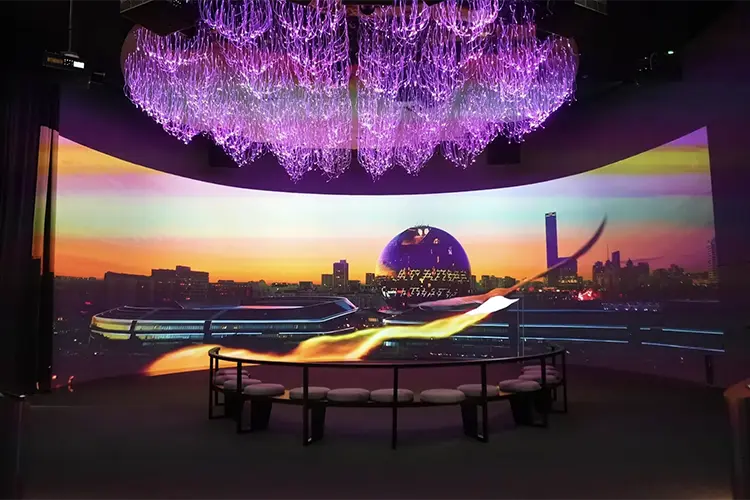
The ALEM AI Center in Astana uses projection technology to create an immersive journey dedicated to artificial intelligence.
The ALEM AI International Center for Artificial Intelligence, located in Astana, Kazakhstan, has opened its doors as a venue designed to bring artificial intelligence closer to the public through immersive experiences. The visitor journey combines projection, interactive installations and audiovisual content to showcase the evolution and applications of this technology.
The project features a projection system built around Barco technology, incorporating I600 and G100 Series projectors installed throughout the venue to meet the specific requirements of each exhibition space.
Designed as a multifunctional center, ALEM AI brings together spaces for education, research and experimentation. Its facilities include an interactive exhibition on the history of artificial intelligence, an immersive cinema, robotics zones, children's areas and a range of art installations.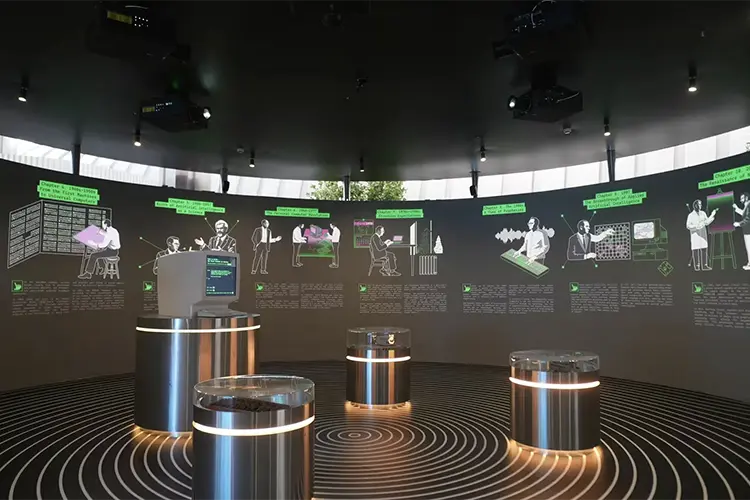 Unlike a conventional museum, the visitor journey has been designed to encourage interaction through visual and multimedia experiences, making projection one of the exhibition's primary storytelling tools.
A project spanning more than 4,500 square meters
Pitch, together with SILA SVETA, designed more than 4,500 square meters of exhibition space, including the Museum of Singularity, immersive tunnels, the AI Cinema, startup areas and educational spaces.
One of the project's main challenges was the architecture of the EXPO 2017 pavilion, whose radial design introduces abundant natural light and geometrically complex projection surfaces. To address these conditions, system integrator Asimetrik KZ, working in collaboration with Sound Creations, developed a projection system capable of maintaining high image quality throughout the exhibition spaces.
A projection system tailored to every space
The installation combines professional laser phosphor DLP projectors from the Barco I600 and G100 Series, configured according to the specific requirements of each area.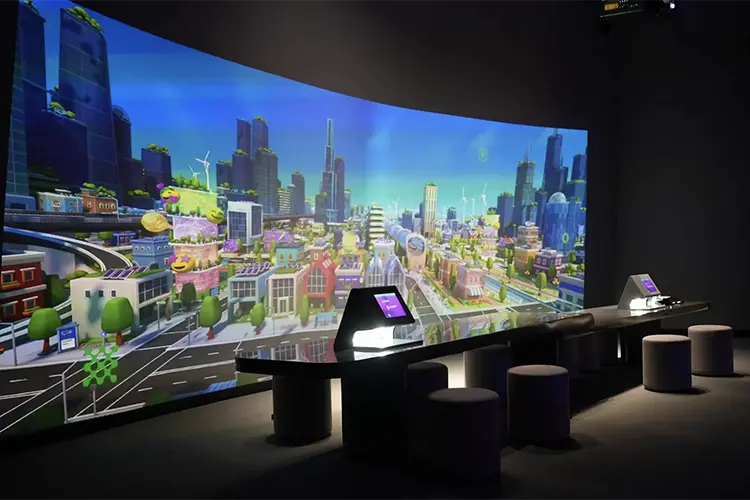 The I600-4K projectors are used in areas such as the Museum of Singularity and the AI Cinema, where high-resolution imagery and accurate color reproduction are essential. Meanwhile, the G100 Series provides the brightness required in spaces exposed to higher levels of natural light.
The system also incorporates a range of lenses, from ultra-short-throw optics to mid-throw zoom lenses, allowing each projection to be precisely adapted to different architectural surfaces while preserving image geometry.
A space designed to evolve
The audiovisual infrastructure has been designed to support continuous content updates as artificial intelligence evolves, enabling new experiences to be introduced without modifying the technical installation.
As a result, projection technology has become an integral part of the exhibition journey, helping create an immersive environment that combines education, interaction and audiovisual storytelling within a single space.