










Frankfurt’s Terminal 3 has been conceived with an integrated DooH network from the very beginning.
With the opening of Fraport’s Terminal 3, Media Frankfurt has deployed one of Germany’s most integrated airport advertising networks: 2,500sqm of advertising space designed from the outset under a digital-first strategy.
Frankfurt Airport saw the first aircraft depart from its new Terminal 3 on April 22, marking the official start of operations after more than a decade of construction. In the coming weeks, a total of 57 airlines will gradually relocate to the new terminal, more than half of them operating intercontinental routes.
With a total investment of nearly four billion euros, Terminal 3 ranks among the largest privately financed construction projects in Europe.
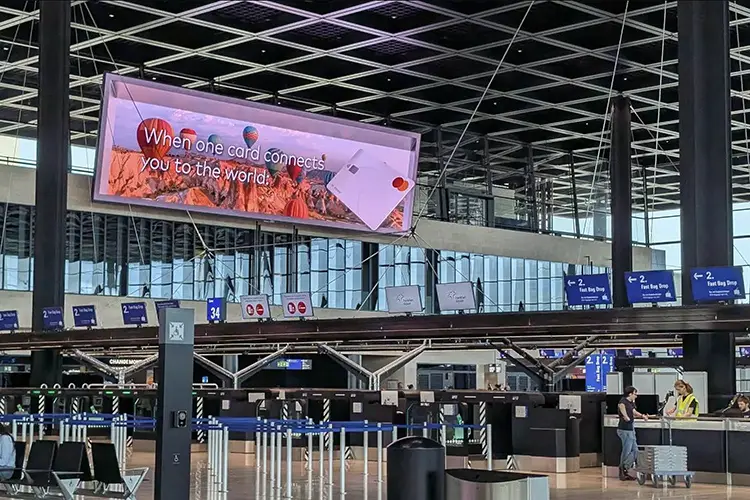
Beyond its architecture, one aspect stands out in particular: the full integration of digital-out-of-home (DooH). With around 230 advertising assets covering a total of 2,500sqm — most of them digital — the terminal incorporates a large-scale advertising network embedded into the building’s design more consistently than at any other German airport.
A holistic concept instead of standalone screens
The concept is led by Media Frankfurt, the airport’s exclusive marketing partner since 1971. The company is a joint venture between Fraport and outdoor advertising specialists Ströer and JCDecaux. Because Media Frankfurt oversaw the complete development of the network, out-of-home advertising accompanies passengers throughout their journey: from check-in to the boarding gate.
Upon entering the check-in area, passengers are greeted by the Digital Check-in Icons: two large LED screens measuring 120sqm each, supplied by M-Cube. Visible from almost every angle, they are complemented by adjacent promotional areas. At launch, Kia is using this premium location to showcase its EV2 model.
A branded LED stage at the retail heart
The retail zone — the airport’s central marketplace — is also defined by two prominent 60sqm digital surfaces. The LED technology was supplied by LG, while planning and integration were handled by Ben Hur. Positioned at a lower height, these displays feature a finer 2.5mm pixel pitch to improve image detail.
Media Frankfurt markets these assets under the name Digital Plaza Stars, with Honda and Lumas already among the first advertisers.
 |
 |
On the way to the boarding gates, passengers are guided by 98-inch Samsung displays — six located in Pier J and four in Pier H — offered as a connected network. Additional advertising inventory is also available through the Gate TVs.
Static outdoor advertising also plays a role, including a lightbox with adjustable illumination and flexible promotional areas currently used by Honda to present its Prelude hybrid coupé. The offering is completed by 41 static advertising placements distributed along the jet bridges.
Further expansion planned
The DooH experience continues in the baggage claim area, where each carousel features four 98-inch Samsung screens. In addition, the areas above the carousels offer new expansion opportunities, with two large-format welcome posters planned for the next phase.
Together, these surfaces will exceed 300sqm, becoming the airport’s largest static indoor advertising spaces, visible from much of the baggage claim hall.
 All advertising inventory can be booked through Media Frankfurt, both directly and programmatically, including the large LED screens. Through the company’s Skyconnect platform, brands can also launch airport campaigns across the DACH region.
However, the digital-first approach remains the defining element within the Skyconnect network: in this case, DooH was not retrofitted afterwards, but conceived as a central element of the terminal’s design from the very beginning.