









AV over IP is transforming audiovisual distribution and requiring new skills in networking, synchronization and interoperability.
Traditional switching matrices are giving way to network infrastructure, and audiovisual projects now incorporate concepts that, until recently, belonged primarily to the IT domain: synchronization, multicast, VLANs, redundancy and open standards. This evolution presents new challenges and requires integrators to expand their technical expertise.
From dedicated cabling to network infrastructure
For years, distributing video throughout a building meant installing point-to-point cabling and specifying a switching matrix with a fixed number of inputs and outputs. AV over IP changes this approach: audiovisual sources and destinations connect to network infrastructure through encoders, decoders and other devices, while switches and control platforms manage signal distribution.
In practical terms, systems can be expanded by adding new input and output points without replacing a central matrix, provided the infrastructure has sufficient capacity and the necessary capabilities.
Furthermore, AV over IP does not necessarily mean using an existing corporate network. Depending on project requirements, an installation may operate over a dedicated, shared or hybrid network.
One example of these possibilities is the Bloomberg Trading Suite at Manchester Metropolitan University, integrated by Roche AV Pro using Crestron technology. The facility recreates a financial trading environment with 35 dual-screen workstations and an instructor's station equipped with touchscreen control.
With Crestron DM NVX forming a central part of the audiovisual distribution system, each workstation can operate independently or display the instructor's content, while financial market information is distributed throughout the room with low latency.
This type of architecture makes it possible to manage multiple sources and destinations more flexibly than certain traditional configurations, particularly when future expansion or changes in content distribution are anticipated.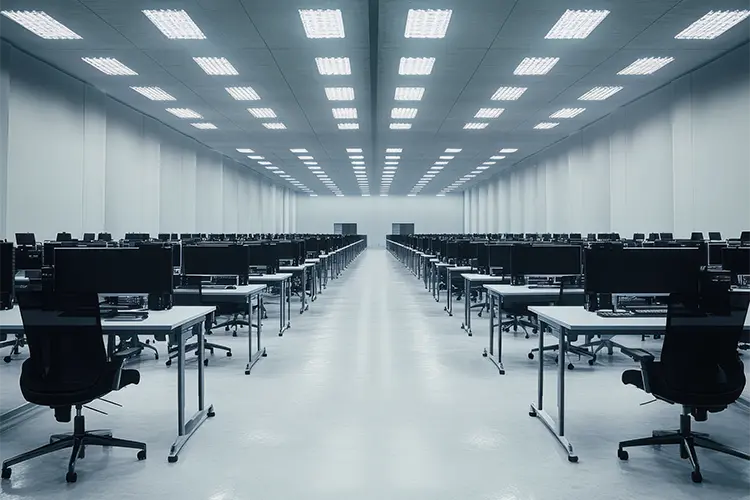
What integrators need to master now
This shift opens up new possibilities, but it also raises technical requirements. Implementing AV over IP means addressing network engineering considerations that previously played a more limited role in many audiovisual projects.
NETGEAR, among other manufacturers specializing in network infrastructure for audiovisual applications, has focused on simplifying these configurations through managed switches, AV-specific profiles and management tools.
Behind this automation, several fundamental concepts remain essential for integrators to understand.
- Synchronization. In AV over IP architectures requiring precise synchronization, devices must share a common timing reference. Protocols such as PTP (IEEE 1588) distribute this reference and are fundamental to technologies such as AES67 and SMPTE ST 2110. The configuration of the PTP grandmaster clock, synchronization domains and compatible network devices must be tailored to each system's requirements. Not all AV over IP solutions use the same synchronization mechanism, so interoperability must be verified for each project.
- Multicast. A single audiovisual stream can be distributed to multiple receivers without necessarily generating a separate transmission from the sender for each destination. To take advantage of this capability, switches must manage multicast traffic correctly, typically through features such as IGMP Snooping. When distribution extends across different subnets, Layer 3 multicast routing mechanisms such as PIM-SM may be required. Configuration must be adapted to the network topology and the characteristics of the audiovisual protocol being used.
- Segmentation. VLANs provide logical separation between different types of traffic, while Quality of Service (QoS) policies help prioritize communications that are particularly sensitive to latency and packet loss. However, these tools are no substitute for proper capacity planning. Link capacity, simultaneous streams, switch queues and potential congestion must be assessed during the design phase, particularly when AV shares infrastructure with other corporate services.
- Redundancy. In critical installations, service continuity requires identifying and minimizing single points of failure. Depending on the architecture, redundant switches and links, technologies such as MLAG, independent transport paths and alternative synchronization sources may be used. Redundancy must cover audiovisual traffic as well as control and synchronization services. Having multiple switches does not, by itself, guarantee that a system will continue operating under every failure scenario.
Network infrastructure manufacturers are responding by increasingly automating these tasks. Preconfigured profiles and AV-specific management tools can simplify operations such as VLAN assignment, multicast configuration and QoS policy implementation, although networking expertise remains necessary to validate overall system performance.
Openstandards versus closed ecosystems
Interoperability is another major issue facing the industry.
IPMX, developed to facilitate the transport and control of professional media over IP networks, represents an important step towards audiovisual systems based on open standards.
In August 2026, at a certification event held at the EBU headquarters in Geneva under the AIMS-managed programme, the Macnica ME10 Gateway Kit achieved IPMX certification as both a sender and receiver.
The solution is designed to support the development of IPMX-compatible products and supports HDMI 2.0 video up to 4K60p, JPEG XS compression, NMOS-based control and PoE+ power over Gigabit Ethernet. Its announced specifications include latency of less than one frame, subject to the solution's operating conditions.
For integrators, the importance of these certifications lies in the ability to combine equipment from different manufacturers under verified interoperability requirements.
Nevertheless, it is important to distinguish between technologies serving different purposes. IPMX, AES67 and SMPTE ST 2110 are all related to audiovisual transport over IP, but they are not equivalent and do not automatically guarantee full interoperability between every device implementing them.
At the same time, proprietary ecosystems retain a significant market presence because they offer integrated end-to-end solutions, with configuration, control and support tools developed specifically for their equipment.
The choice between open architectures and proprietary solutions depends on factors such as planned scalability, device compatibility, technical support availability and the expertise of the team responsible for the installation.
Control and management are also part of the design
IP connectivity does more than change signal distribution. It also expands the possibilities for monitoring, configuring and maintaining audiovisual systems.
One example is the Q-SYS Verified plugin developed for Sharp and NEC displays, which enables certain display control and diagnostic functions to be integrated into the Q-SYS environment.
Supported operations include powering displays on and off, selecting inputs, adjusting volume and brightness, and retrieving operational information, depending on the compatible models.
Meanwhile, Hikvision has developed a ProAV offering that brings together various display and audio solutions with management tools. This ecosystem includes platforms such as HikCentral and HikMedio, designed to address different administration and operational requirements.
Integrating devices and platforms makes it possible to centralize certain functions, although the precise scope depends on individual product compatibility and the chosen architecture.
The value of these capabilities becomes particularly apparent after an installation has been handed over.
In buildings with numerous rooms, corporate campuses or systems distributed across multiple locations, the ability to check equipment status, modify configurations or identify issues remotely can reduce site visits and simplify maintenance.
This growing complexity is also driving demand for technical support services for integrators.
AVPro Global, for example, offers AVPro Design Services, a specialist support offering covering various activities related to system design, application engineering, programming and consulting for audiovisual projects, including IP-based installations.
These services reflect a broader trend: designing an AV installation can no longer be limited to selecting displays, processors and distribution systems. Network architecture, management tools and future maintenance requirements are now part of the initial decision-making process.
In the control room, there is little room for failure
AV over IP has also expanded into environments where availability and reliability are particularly important.
Aboard the polar research vessel RRS Sir David Attenborough, operated by the British Antarctic Survey, Datapath has deployed its Aetria platform to manage and distribute visual information in a demanding operational environment.
The installation includes 11 workstations, VSN video wall controllers and Aligo devices for transmitting and receiving signals using KVM over IP technology.
The architecture also incorporates two Aetria Network Managers configured to provide high availability, with the aim of maintaining management functions in the event of certain failures.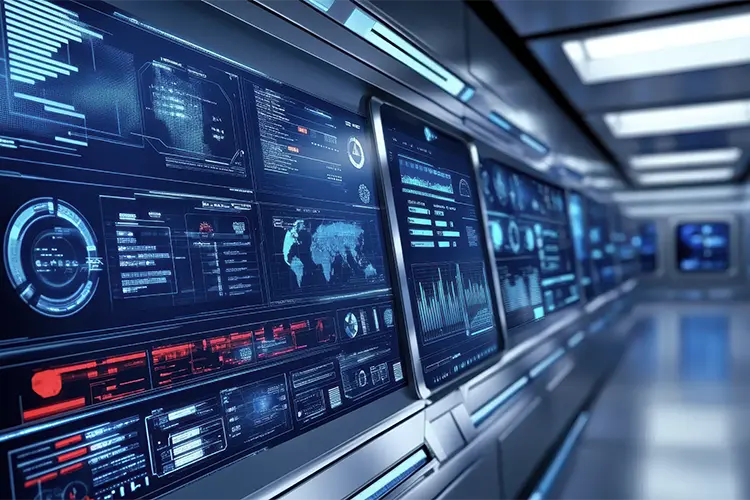 The project also highlights an important aspect of deployment planning. Due to the vessel's restricted docking schedule, the system was initially prepared at the British Antarctic Survey's facilities.
This phase allowed technicians to become familiar with the platform before completing its installation on board.
The project demonstrates that, in critical environments, system design does not end with hardware selection. Commissioning plans, operator training and recovery procedures are also essential.
Achanging professional skill set
The evolution of AV over IP has direct implications for the skills required by industry professionals.
Audiovisual integration increasingly involves tasks related to switch configuration, IP addressing, transport protocols, network security, programming and remote monitoring.
This convergence is also reflected in the new professionals entering the industry.
Among the recipients of scholarships announced in 2026 by the AVIXA Foundation are students from disciplines such as computer science who are interested in networked audiovisual systems and the technological infrastructure that supports them.
The boundary between AV and IT is becoming less distinct, but that does not mean the two disciplines are interchangeable.
Audiovisual integrators still need specialist knowledge of signals, image quality, acoustics, latency, synchronization and user experience. These skills are now complemented by network design and troubleshooting capabilities that are essential to ensuring installation performance.
In projects of a certain complexity, collaboration between audiovisual specialists and IT professionals is no longer a secondary consideration but an increasingly standard part of the engineering process.
Key considerations for the next project
The transition to AV over IP requires certain decisions to be incorporated from the earliest design stages:
- Involve the client's IT department from the outset. Network architecture, security policies and maintenance responsibilities should be defined before installation begins.
- Determine synchronization requirements. Where required by the system, clock sources, PTP domains and failure recovery mechanisms must be established.
- Design multicast traffic management correctly. IGMP functionality, routing between subnets where applicable, and actual link capacity must be verified.
- Plan segmentation and quality of service. VLANs and QoS policies should form part of a design that accounts for bandwidth and simultaneous streams.
- Provide redundancy at critical points. Availability must be assessed comprehensively, including signal transport, control, power and synchronization.
- Evaluate actual interoperability. Open standards such as IPMX, AES67 and SMPTE ST 2110 offer integration opportunities, but specific compatibility between devices must be verified.
- Include remote management and maintenance in the proposal. Monitoring, documentation and diagnostic procedures deliver value throughout the system's operational life.
AV over IP is not simply about replacing a switching matrix with network switches. It involves moving much of the intelligence behind audiovisual distribution into network infrastructure whose configuration, capacity and availability determine the performance of the overall system.
For integrators, the challenge is to combine traditional audio and video expertise with an increasingly detailed understanding of IP networks. Infrastructure is no longer simply a means of transport; it becomes an essential part of the audiovisual system itself.
 Instagram
 Facebook
 LinkedIn
 X