Fundación Telefónica exhibition ‘The Great Imagination’
Written by ISP Integration editorial teamCategory: SUCCESS STORIES
Published:

‘The Great Imagination. Stories of the Future’, an exhibition offering a reflection on how we imagine the future.
Understanding how the future was imagined in the past and why, seeing how these ideas still shape the way we imagine it, and rethinking how we can venture new futures from the present moment. In a century beset by multiple crises whose outcome may be crucial to the history of our planet, is it still valid to speculate about idealised futures like those imagined in the past? What alternative futures can we imagine in response to the challenges we face?
From today’s most popular series to film, literature and even advertising, our culture is saturated with images of the future. Each era has had its own particular vision of the future, shaped to a large extent by the context that fed it.
The exhibition, curated by futures design expert Jorge Camacho, presents projects ranging from the first utopias of the 16th century to the most recent speculations, taking in the whole imaginary that spread from the Industrial Revolution onwards and on which we still draw to a great extent. The exhibition is structured in four main sections: Present Futures, Before the Future, The Great Imagination and Four Alternatives: The World in 2050.
Present Futures
We are currently living through a genuine explosion of interest in the future; an explosion that is not only quantitative but also qualitative, and which invites us to ask why, how and for whom we generate these images of the future. Over recent decades, this drive to give shape to our hopes and fears has been expressed in an ever-wider variety of disciplines and media, from literature and film to series, architecture, design and advertising.
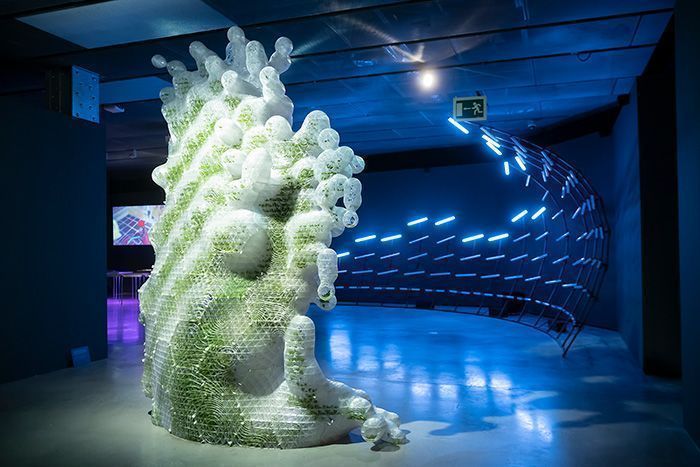
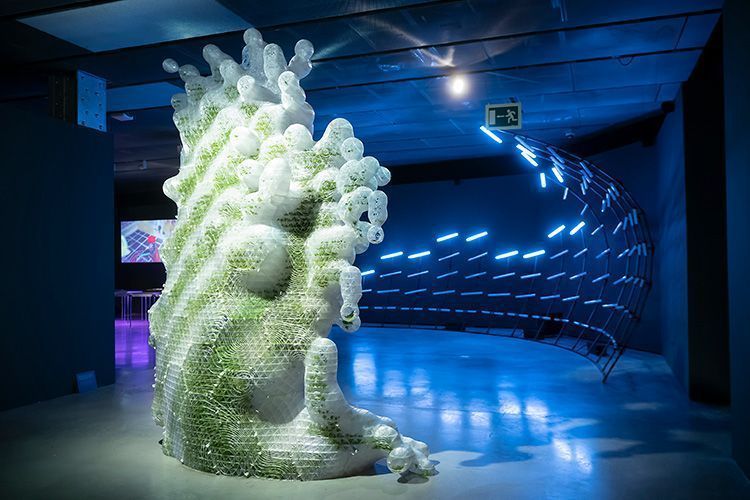
The first section, entitled ‘Present Futures’, covers the period from 2010 to 2021, with a selection of contemporary pieces that address some of the recurring themes in current projections of the future: the boundary between the physical and the virtual, coexistence with robots and artificial intelligence, space colonisation and the need to develop rewilding strategies. This section includes works such as NurturPod 2017 by foresight professor Stuart Candy, the sculpture Hortus XL by ecoLogic Studio, images from The Frozen Neighborhoods by Olalekan Jeyifous and the projection Seoul City Machine by Liam Young. A large three-dimensional data visualisation sculpture created by Domestic Data Streamers shows how interest in the concept of the future varies from one era to another. Based on Google Trends data, it shows the number of articles and news stories including the term “future” published between 2008 and 2021.
Before the Future
The fact that humans have a kind of innate capacity for foresight does not mean that we have always produced images of the future in the sense that we do now. At the dawn of modernity, utopian tales and satire could be considered the most immediate precursors of the futurist imagination. Even in the 17th century it is still difficult to find narratives that actually refer to the future. Inspired by the discovery of unknown territories such as the American continent, distant islands with fantastic worlds allowed various authors to project models of ideal societies. In this section, visitors will find unique editions of Thomas More’s Utopia, Francis Bacon’s New Atlantis, Tommaso Campanella’s The City of the Sun and Jonathan Swift’s Gulliver’s Travels, each interpreted through the eyes of the 2016 National Illustration Award winner, Javier Sáez Castán.
It was not until the 18th century that the first truly futurist tales emerged: Samuel Madden’s Memoirs of the Twentieth Century (1733) and, in particular, Louis-Sébastien Mercier’s The Year 2440 (1771) began a new paradigm by imagining a future time connected chronologically and causally with their present. The so-called uchronias of the 18th century opened the door to 250 years of imaginative explosion oriented towards the future. Some bibliographic gems from the Piero Gondolo della Riva Collection can be seen in this section, together with an installation entitled Chronology of the Future, which shows the years in which landmark comics, literature and films set the future.
The Great Imagination
Is it a coincidence that this futurist explosion was unleashed precisely as cities grew, mobility increased exponentially and communication technologies blossomed? Does the futurist imagination flourish thanks to a context of material progress, or is it precisely the outburst of creative fantasy that drives and guides the countless innovations appearing at this time? This question, which is at the heart of much of the exhibition, stems from the concept of the Great Acceleration coined by the Earth sciences, which describes the exponential growth of human activity in the second half of the 20th century, whose origin is usually traced back to the mid-18th century. The Great Imagination suggests a feedback process between, on the one hand, the acceleration of socio-economic and environmental change and, on the other, the proliferation of stories and concerns about the future during the same period.
The city and its architecture, mobility and transport, automated living, telecommunications and the conquest of space are once again some of the themes around which popular fictions from the 19th century to the 1980s are grouped, echoing the first part of the exhibition. The verticality of ever taller buildings and the overpopulation of cities on the verge of collapse are captured in images ranging from Erich Kettelhut’s and Otto Hunte’s drawings for the film Metropolis in the 1920s to Ridley Scott’s Blade Runner in the 1980s. Imagination applied to transport is reflected in illustrations ranging from Albert Robida’s reveries of Parisian skies full of flying cars (1893) to Norman Bel Geddes’ drawings of car-filled cities for Futurama.
The vision of automated homes already appears in films such as Segundo de Chomón’s The Electric Hotel (1908) and Buster Keaton’s The Electric House (1922); fantasies of communication devices combining voice and moving images became popular as early as the late 1870s with the idea of the telephonoscope, and come surprisingly close to today’s smartphones in films such as 2001: A Space Odyssey (1968). The role of technology in education is already raised in Jean-Marc Côté’s In the Year 2000 (1899), and online learning seems to be just around the corner in 1960s advertising. It was perhaps in the second half of the 20th century that the aspiration to a modern, comfortable life reached its peak and, it must be said, its greatest degree of innocence. Even in the 1960s, images of a future 21st century were still speculating about radical technological transformations in our homes without considering the possibility that women might be freed from their traditional roles in the domestic economy.
Dystopias
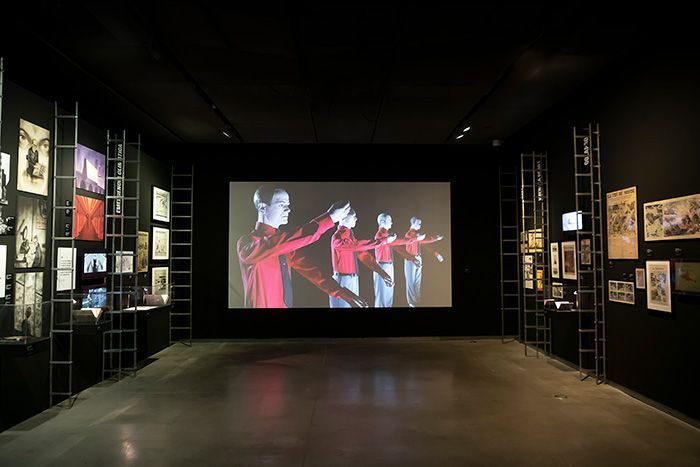
If futurist fiction was born with the uchronias of the 18th century, projecting the dreams of modernity into a future time, it reached its climax during the 20th century as the nightmares of modernity began to take an increasingly prominent place in the Great Imagination. First literature and then dystopian cinema have been used to warn humanity about the risks of progress without values. Social control and robotisation, the climate crisis resulting from our lifestyle and the possibility of a final war embody recurring fears about the future that are more relevant than ever today. More recent works such as Kraftwerk’s The Man-Machine (1978), together with 1930s illustrations by Winsor McCay, evoke the fear of robotisation, while unique editions of George Orwell’s 1984 (1949), Yevgeny Zamyatin’s We (1924) and Aldous Huxley’s Brave New World (1932) embody dystopian visions of issues that still concern us in 2021.
Four Alternatives: The World in 2050
Today the world finds itself in the middle of a pandemic and an economic recession, and faces major challenges such as climate change, the crisis of democracies and the great challenge of digitalisation and artificial intelligence. The ability to generate new visions that help us think of viable, alternative worlds is therefore more necessary than ever. The exhibition closes with a set of installations created specifically for the show, representing four alternative views set in 2050. Based on the theory of Jim Dator, one of the pioneers of Futures Studies, according to which different foresight visions can be grouped into four archetypes of the future, it presents four scenes corresponding respectively to a future of Growth, Collapse, Discipline and Transformation.
A future of growth. Carlota Pérez + Institute for the Future
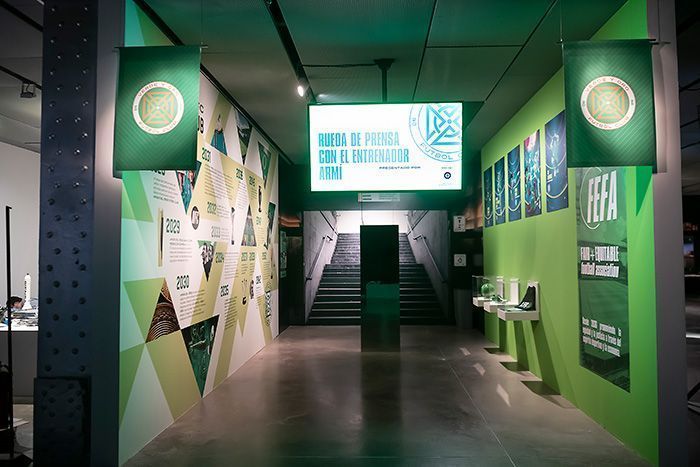
What if, thirty years from now, we had transformed today’s unequal and unsustainable growth paradigm into a new kind of green, innovative and fairer growth? That is the theoretical and political proposal of Carlota Pérez, Honorary Professor at the Institute for Innovation and Public Purpose (University College London, UK), and one of the world’s leading experts on the relationship between technological innovation and social change. Jacques Barcia and Jake Dunagan, researchers at the Institute for the Future and experts in futures design, brought this possibility to life to transport us to the first final of the FIFA Regeneration Cup. Today, Verde y Oro FC is competing for the trophy that celebrates having mitigated climate change without having to sacrifice global economic prosperity, which thanks to technological advances has never been more evenly shared.
A future of collapse. Raphaël Stevens + NORMALS
For Raphaël Stevens, collapse is our generation’s horizon. Stevens is a researcher and specialist in ecological transition, one of the initiators of the intellectual movement that gives its name to the book Collapsologie, which he co-authored with Pablo Servigne and which explores the real possibility of civilisational collapse. The N O R M A L S studio, made up of Cedric Flazinski and Régis Lemberthe, takes this idea as the starting point for a fabulous provocation: faced with imminent collapse, and after a landslide referendum victory, the government of Pyria decides to abolish itself as a state to guarantee the survival of its inhabitants.
A future of discipline. Giacomo d’Alisa + BECOMING
Would it be possible to avoid the collapse that many believe will be the inevitable consequence of unbridled economic growth? An increasingly prominent intellectual and political movement around the world offers a possible way out: living well with less, prioritising equity and sustainability. Giacomo D’Alisa is a political ecologist at the Centre for Social Studies (University of Coimbra, Portugal) and one of the world’s leading experts on degrowth. For this installation he has collaborated with Becoming, a research studio that explores emerging scenarios to rethink the world. Together they invite us to visit the headquarters of the ERRES, an intergenerational group that meets to take part in the regeneration of human and urban ecosystems. Their headquarters is located in a former shopping centre that by 2050 has been converted to house other kinds of services focused on the wellbeing of the community and the planet.
A future of transformation. Holly Jean Buck + OIO STUDIO
A simple life in balance with the Earth may appeal to some people but be fundamentally dull for others. Where would the adventure of discovering new worlds be? What if, to mitigate climate change, we transformed the planet and its ecosystems? Wouldn’t it then be exciting to rediscover it? That is the future represented by Blue Marvel Travels, the result of the collaboration between Holly Jean Buck and OIO Studio. Buck is a professor in the Department of Environment and Sustainability (University at Buffalo, USA) and author of the book After Geoengineering. OIO Studio is a creative practice made up of designers, technologists and bots who develop future products and interactions.
Our Futures
While imagining alternative futures is more important than ever, it will only be useful if among those alternatives we can recognise at least one image whose magnetism inspires us to live differently in the present. The exhibition culminates in an experience created by Domestic Data Streamers in which visitors can assess not only their own individual stance on the future, but also that of other visitors. Ultimately, this journey through more than 250 years of futurist imagination aims not only to spark reflection on the future, but to contribute actively and critically to the process of building it.
You may also like

Fundación Telefónica backs hybrid formats: 8.3 million beneficiaries
Fundación Telefónica Christmas programme: exhibitions and workshops
enlightED 2021: Fundación Telefónica's hybrid education event
Queen Letizia visits Fundación Telefónica
L-Acoustics covers 182 metres at Primavera Sound
Martin Audio TORUS powers Rotterdam's reborn Baroeg
Optimal Audio sets the sound at Unc's Pizza in Detroit
LEDVANCE cuts street lighting energy by up to 75%
Vokkero keeps the Ura Bere Bidean crew connected
Biamp Vocia: a paging system running for over ten years
31 Million Pixels Revolutionise Simulation
Genelec provides sound for a mini-golf venue in Germany
A journey through imagery, interaction and architecture

A new look for the Barcelona Metro with Soltec
Invisible Technology, Great Experiences
Fewer loudspeakers, greater clarity in the classroom
Communication in critical situations with UDE
The Value of Sound in Hospitality and Retail
Acoustics designed for sports and events
Platform for remote projector control

Real-time information for British Airways
Crestron turns the classroom into Wall Street
Church finds its voice with OPTIMUS
Integrated audio for fine dining environments
Networked audio for multifunctional spaces
Coordinates police alerts and emergencies
Sony technology to inspire architects
25 Barco projectors bring an AI museum to life
Anolis Illuminates the Natural Water Cycle
Aetria for Antarctic Exploration

Outdoor Displays for All Weather Conditions
Premium audio serving retail and hospitality
Immersive AV engineering to bring history to life
INFiLED LED at the World's Tallest Hotel
From live sound to home with L-Acoustics
Hikvision improves flood response
Premium audio drives retail performance
A digital canvas for the heart of Seattle
Atmospheres of light in the Qatari desert
Martin Audio brings sonic energy until dawn
Bilbao Brings Fans Together Through Digital Signage

A Sound Atmosphere Tailored for Retail
Universidad Europea Boosts Learning with Nureva
A Camp Nou designed for frictionless operation

HYRISS Technology in Residential Environments

HYRISS technology in residential environments
From isolated systems to smart security
ONGC’s Operational Brain Strengthens with Datapath
DATALAND, the new museum of AI arts
Frankfurt unveils the first native DooH terminal
Invisible audio to reinvent retail environments
Image, sound and space: a new interpretation
AV integration projects in Barcelona
Strategic reinforcement in the LED lighting area
Advanced hybrid education with Shure ecosystem
Multi-zone audio integration in a historic hotel in Lyon
Networked audio optimizes hotel spaces in Barcelona
Hyperclassroom in Granada with professional audio