Fundación Telefónica backs hybrid formats: 8.3 million beneficiaries
Written by ISP Integration editorial teamCategory: NEWS
Published:

Fundación Telefónica strengthened its commitment to culture, art and digital knowledge in 2021.
With a clear commitment to hybrid formats and new narratives, the organisation reached 8,323,657 beneficiaries, an increase of 18% on the previous year.
Focusing on culture, science, technology and the digital society, through a wide variety of forms of expression and thanks to the return of in-person activities and virtual access to talks, forums and digital events, Fundación Telefónica presented 9 exhibitions – 5 of them touring – and 979 educational workshops and guided tours, with 778,213 in-person visitors. The most visited exhibition of 2021 was Joanie Lemercier. Paisajes de luz (Landscapes of Light), which attracted 92,455 visitors. In addition, the various events at the Espacio Fundación Telefónica Auditorium achieved a record 5.6 million in-person and virtual attendees.
A hub for digital culture and knowledge
In a year marked by the aftermath of the pandemic and the digital revolution, Fundación Telefónica has become a hub of culture and knowledge that promotes thinking about and analysis of social transformations and seeks global solutions.
It has done so, and will continue to do so, through debate forums such as TELOS, Sociedad Digital and Cultura en Digital, together with leading national and international philosophers, sociologists, economists, writers, journalists and scientists
With ‘Remembering the Future’, ‘Foro TELOS 2021’ explored the main challenges and opportunities for building a better, more equal and supportive, more technological and sustainable, more humane and fairer world. Thinkers of the calibre of Isabel Wilkerson, Carissa Véliz, Niall Ferguson and Antonio Muñoz Molina were among the participants in this festival of ideas around TELOS magazine, a benchmark title in critical thinking founded in 1985, which had 809,011 readers in 2021.
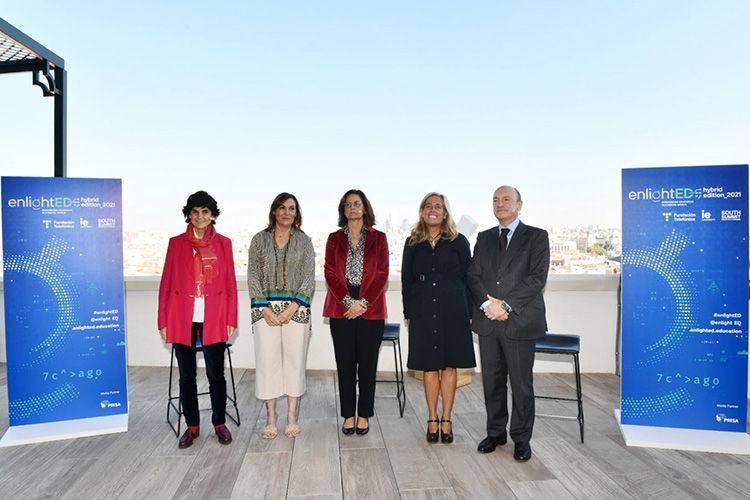
The 4th edition of the global conference on education, technology and innovation, enlightED, brought together more than 25,000 participants from around the world and 147 experts from 11 countries to reflect on the major educational gaps in innovation, skills and digital. Thinkers of the calibre of Howard Gardner, Daniel Goleman, Michelle Weise and Vinton Cerf focused on three of the major gaps that have widened during the COVID-19 pandemic: the challenge of narrowing the innovation gap to transform education systems; the challenge of addressing the lack of skills in relation to new social needs; and, thirdly, how to tackle the lack of digital skills in order to reconnect with young people and promote positive change.

The series of debates on digital transformation in Spain, ‘Foro Sociedad Digital en España 2021’, addressed topics such as data science in the 21st-century city, the responsible use of artificial intelligence, the challenges of Industry 4.0 and the shortage of digital professionals, with experts such as Coral Calero Muñoz, Nacho Rivera and René González Castro. The Forum has its origins in Fundación Telefónica’s publication Sociedad Digital en España, a study that has existed for more than twenty years, analysing each year Spain’s digital transformation and its social and economic impact, with 12,174 readers in 2021.
One of the new features of 2021 was the ‘1st Foro Cultura en Digital’, a meeting to reflect on the digitalisation of culture as a new social ecosystem, with the participation of some of the country’s most important cultural institutions such as ICOM, the Museo Nacional del Prado, the Museo Thyssen-Bornemisza and the Teatro Real. The forum featured panel discussions with specialists such as Javier Pantoja, Borja Ezcurra, Ignasi Miró and Natalia Majluf, offering first-hand insight into digital trends in the cultural world. The Forum also hosted the presentation of the seventh edition of the AC/E Digital Culture Yearbook, a benchmark publication for the cultural sector showing the sector’s digital trends and tools.
New formats and narratives
This commitment to creativity and new trends also extends to new formats and narratives to bring culture and knowledge closer to the general public. Throughout 2021, Fundación Telefónica achieved 936,569 downloads/listens of its podcasts, led by that of historian, journalist and Pulitzer Prize winner Anne Applebaum, with 161,875 listens.
Fundación Telefónica has stepped up this commitment to digitalisation with 7 virtual exhibitions in Spain and Latin America, including the exhibition Destacados. La Colección Telefónica and the Instagram live sessions linked to the exhibition Color. El conocimiento de lo invisible with experts from different disciplines such as Ana Roquero, Javier de Felipe and Eva Villaver, which complemented the exhibition and reached 10,352 users.
2022, the year of transformation
In 2022 Fundación Telefónica will continue to offer a programme of exhibitions and events that helps us understand the major social, cultural, scientific and technological challenges we face as a society. Until April 2022 visitors can continue to enjoy the exhibition La Gran Imaginación. Historias del Futuro, a journey through how the future was imagined in the past and what alternative futures we can imagine today in response to current challenges.
From February, Conexiones en la Colección Telefónica will open its doors, an exhibition connecting the works in the Art Collection with the Technological Heritage and the historical photographic and film archive of Telefónica, the company that created the first “interconnected fabric” of telecommunications across Spain. The exhibition will show compatible connections created through objects and artworks, a narrative also stitched together with the thread of contemporary thought, expressed through the intellectual reflections gathered in TELOSmagazine.

In spring, visitors will be able to discover the exhibition Liam Young. Construir mundos (Building Worlds), a selection of the most recent works by the speculative architect and filmmaker who works in the space where design, fiction and futures studies intersect. Highlights include Planet City (2021), In the Robot Skies (2018), New City (2019) and Where the City Can’t See (2019), all presented as large video installations and accompanied by artefacts, costumes and other materials from his films.
In autumn comes Código y algoritmos. Sentido en un mundo calculado (Code and Algorithms. Meaning in a Calculated World), which seeks to make the phenomenon of decision-making by code and algorithms, and its implications for society, understandable. The exhibition will invite reflection on questions such as: can algorithms guarantee greater neutrality and efficiency? Are they as free of human bias as we tend to think? And why do humans trust decisions made by machines more than those made by other humans?
And at the end of the year it will be possible to explore the human brain with the exhibition Cerebro(s), a co-production by Fundación Telefónica, CCCB and Wellcome Collection that will introduce visitors to the most complex organ we know, as well as the fabric of dreams and conscious experience. The exhibition will try to answer big questions such as: How does our brain create reality? What are the nature and origins of conscious experience? Could a machine imitate human creativity? Are non-human animals conscious? Are humans a society of brains akin to a collective intelligence?
The Espacio will also continue to address relevant topics through its forums, including TELOS, which through the magazine will explore the quantum world, code, and employment and digital skills
In addition, following the success of the first edition, the 2nd Foro Cultura en Digital will be held, addressing the digitalisation of culture as a new social ecosystem, with new partner organisations joining the previous ones. The 2022 programme will also include, in collaboration as always with the Aspen Institute, the Tech&Society series, to foster plural, informed reflection on the major questions raised by advances in digital technology and their influence on a wide range of fields.
Repensando el Mañana (Rethinking Tomorrow) will also continue throughout the coming year helping society understand the post-coronavirus world with leading international experts from fields as diverse as science, technology, politics, economics, culture, communication and the digital humanities, always with special emphasis on digital culture, employability, educational innovation and volunteering.
Fundación Telefónica, the social side of the digital age
For more than 20 years Fundación Telefónica has worked to be a catalyst for social inclusion in the digital age and to help create a more inclusive, fair and supportive world. True to its technological origins, it trusts in the limitless capabilities of new technologies to improve people’s lives and connect them with the opportunities of digital progress.
With that vision, it operates in 41 countries with a transformative vocation connecting society with education to reduce the education gap; with new employability to create the digital profiles demanded by the labour market; with knowledge and culture to generate shared reflection on the ideas that are changing the world; and with solidarity, carrying out social action together with Telefónica employees so that the most vulnerable have the same development opportunities. It does so through digital-minded, global and inclusive initiatives, joining forces with more than 500 organisations and 100 public administrations.
You may also like
Fundación Telefónica Christmas programme: exhibitions and workshops

Fundación Telefónica exhibition ‘The Great Imagination’
enlightED 2021: Fundación Telefónica's hybrid education event
Queen Letizia visits Fundación Telefónica

HK Audio promotes Isabelle Wear to Head of Sales EMEA
ISE 2027: a working TV studio, AI at work and 1,500 drones
Genelec bolsters its Western Europe team
SOLTEC unveils its RET-G retractable monitors
Neutrik brings TRUE1 and DR Series to JTSE 2026

TBS Education warns of AI bias when hiring staff
Panasonic and HIVE: 80% less AV infrastructure

IDC names Shure a Leader in AI meeting rooms
AVPro Edge MXnet 10G-MSE: 4K and H.265 from one encoder

500 Sony BRAVIA displays connect 100 stores

Sony: the traditional office is falling behind
Datapath to operate under the VITEC brand in 2027

40 giant Sony displays for collaborative learning

OPTIMUS installs 19 SIP intercoms at a Mexican power plant
LEA Cloud diagnoses issues without on-site visits
Genelec equips a music school with 143 loudspeakers

AVIXA appoints Marco Pardi as new chief executive
Spark 2027 to open with Casa Batlló mapping artists
Hikvision Village: a city where it all connects
Barco recreates realistic maritime scenarios

LEDVANCE: free training in LED and smart lighting

Daktronics upgrades video and audio at Lane Stadium
Crestron Collab Engine: meetings and AV control in one
Nureva appoints Ted Shuter as VP, Products
Kramer makes SailPoint's Pune rooms divisible
Pulse brought seven minutes of AV to InfoComm

Sony miniaturises medical imaging with the IMX742
Sony equips Crestron’s centres in London and Paris

ISLE 2027 opens visitor registration in Shenzhen

Nureva brings AI to meeting room management
Hikvision applies thermography to fire prevention
Spark 2027 opens registration and grows at Montjuïc
Ghost meetings under the technological spotlight
Genelec creates a sound forest inside Finlandia Hall
Light + Building strengthens British lighting presence
Bluesound brings licensed music to shops and hotels
Hikvision renews its Madrid Excelente certification

Crestron develops its first proprietary AV chipset
Video Control and Distribution on a Single Platform
Immersive audio and smart rooms: how InfoComm went
Video control and distribution on a single platform
SeeSound equips Cuenca Hospital auditorium

Hikvision Village 2026 recreates a connected city

Curved displays, transparent LED and COB technology
InfoComm América Latina puts AI into practice
Mo Gawdat examines the impact of AI on businesses
IntelliMix Bar Pro takes centre stage in Shure’s strategy

OPTIMUS public address built for maximum demand

Sony equips Crestron's new Experience Centres

AV over IP: When the Network Becomes the System
Captech EXPO Tests Technological Convergence

IFMA Spain: Technology, Spaces and People
Crestron connects more than 200 rooms at Camp Nou
Self-Service Kiosks and AI at InfoComm Latin America