L-Acoustics covers 182 metres at Primavera Sound
Written by Editorial TeamCategory: SUCCESS STORIES
Published:
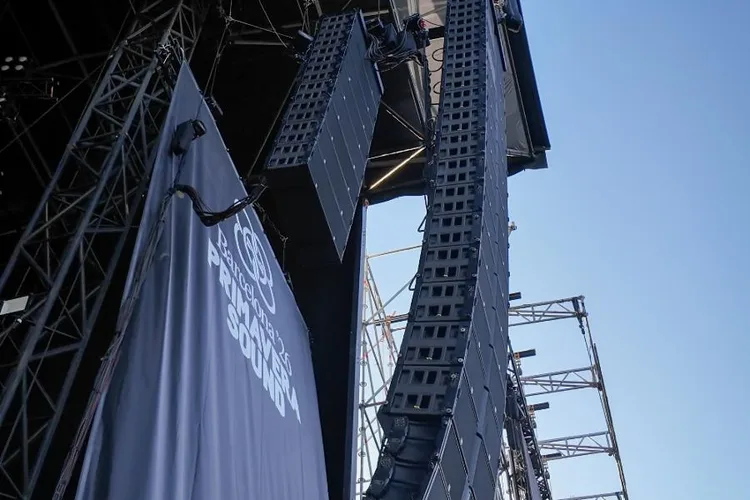
Twincam Pro International designs and deploys 304 L-Acoustics K Series enclosures across Primavera Sound's twin main stages at Parc del Fòrum, holding tonal balance from barricade to far rail while keeping sound off the city and neighbouring stages.
Primavera Sound began in 2001 at the Poble Espanyol and moved in 2005 to the Parc del Fòrum, the seafront site on the edge of Barcelona where it has grown into one of Europe's defining festivals. The 24th edition sold out for the second year running, with The Cure, Gorillaz, Doja Cat, The xx, Skrillex and My Bloody Valentine heading a bill that moves from shoegaze to hyperpop to techno.
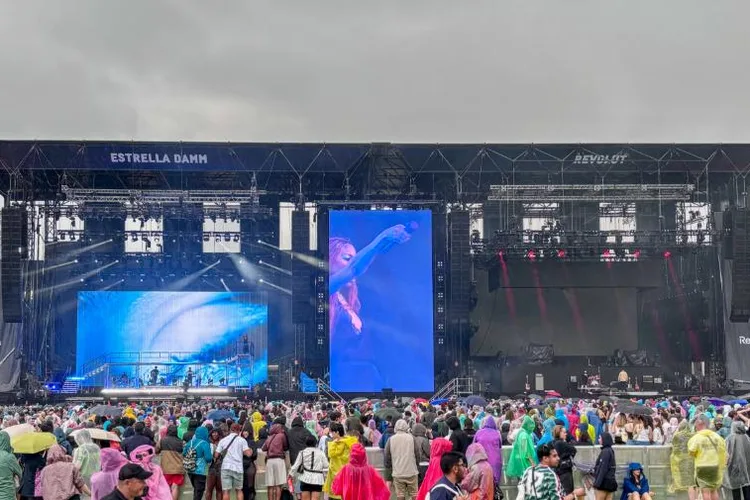
At the centre of the site stand the two main stages, Estrella Damm and Revolut, built side by side and divided by a single large screen. They share one audience field and alternate sets from mid-afternoon until the early hours; for a headliner, 70,000 to 75,000 people stand in front of them. The sea is on one side, a residential city on the other, with six further stages around the perimeter.
We defined success as much more than simply achieving sufficient SPL. The audience experience had to be determined by the mix and the artistic content, and not by where somebody is standing in the venue, says Pedri González, Audio, Video and Broadcast Manager at Primavera Sound.
The Parc del Fòrum makes that hard to deliver: irregular terrain, a single delay position 88 metres from the stage, a 10-metre wall around 220 metres out ready to return reflections, a VIP grandstand to one side, another stage roughly 230 metres to the rear and the city beyond the fence. The site also swings hard in temperature and humidity between afternoon and night, and the sea wind blows all three days.
Two decades of partnership
Twincam Pro International, formerly Twincam Audio, has been an official audio provider to the festival since 2004, supplying L-Acoustics systems to the twin main stages and the Plenitude and Cupra Pulse stages. Fellow L-Acoustics partners Ara So and TST delivered the Cupra stage and the Schwarzkopf and Port stages. Josep María Riera, System Engineer at Twincam, says the choice of L-Acoustics reflects the festival's commitment to technology that matches the standards of its international artists.
182 metres from a single delay position
Design for each edition starts around six months out, with Riera reviewing the site drawings, reopening the previous year's design in Soundvision and agreeing terms with those responsible for noise control. With only one delay position, the main arrays carry far more of the field than usual: the long-throw section of each K1 array covers 116 metres and the main system 125 metres; with the delay towers, coverage reaches 182 metres without exciting the rear wall.
SPL drifts by less than 3 dB between the barricade and a listener at 160 metres, and by less than 6 dB for the furthest listener at 180 metres.
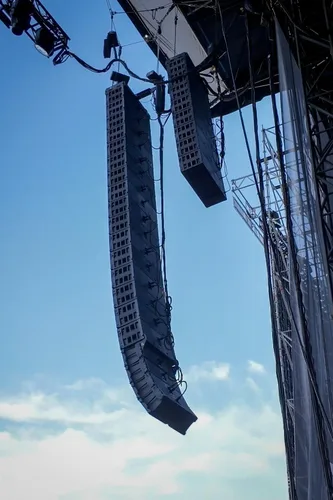
Each stage flies left and right arrays of 16 K1 over four K2, with eight K1-SB flown behind each. On the ground, 99 KS28 subwoofers form 33 stacks of three in a line running close to 70 metres across both stages. The Estrella Damm stage carries an out-fill of eight K1 over eight K2 reaching the VIP grandstand at up to 120 metres, while Revolut uses a deliberately smaller out-fill of eight K2. Front-fill comes from 37 Kara II across 17 points, and the two delay towers fly 16 K2 each.
 |
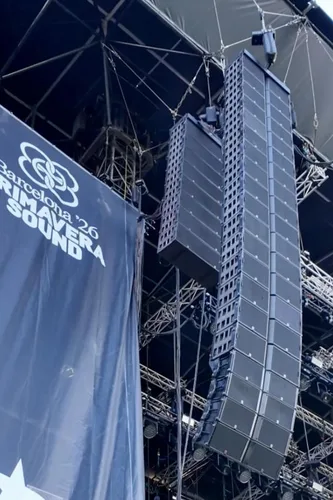 |
In total, 304 enclosures are driven by 113 LA12X amplified controllers in 38 LA-RAK II touring racks, with six P1 processors on a redundant Milan-AVB network backed by an analogue fallback loop. The whole system is monitored and controlled through LA Network Manager.
Holding the low end
Each KS28 stack runs two boxes forward and one back on the KS28_C cardioid preset. No electronic arc delay is applied, as the number of active stacks changes through the day. According to Riera, the flown K1-SB significantly improved the low-frequency contour at long distances and increased rear rejection.
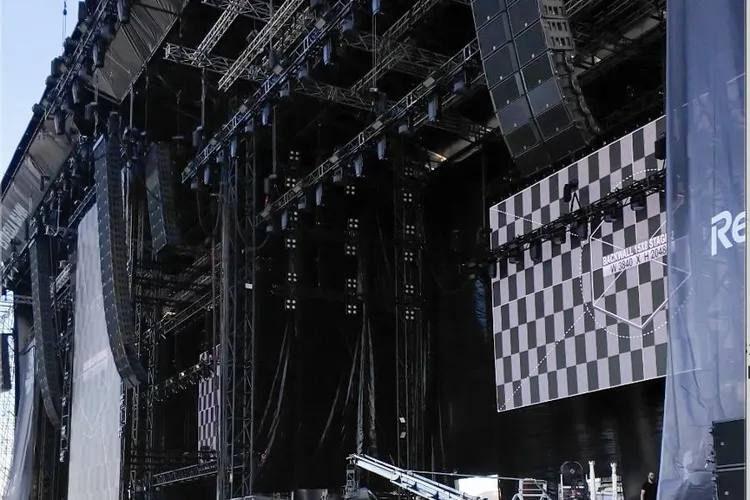
The asymmetric out-fills express the brief: sixteen enclosures face the sea, where the VIP grandstand sits, and eight face the city. The final day on site is given over to environmental noise measurement inside and outside the perimeter. González highlights a clear improvement this year in managing acoustic impact towards the city and between stages.
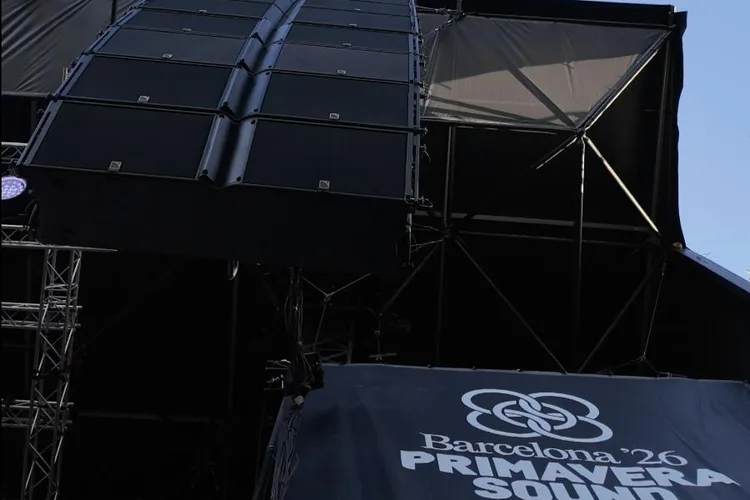
Two stages, one system
Both front-of-house positions feed a single unified master control, letting the team change how much of the system is live from set to set, so changeovers are not an operational issue. Autoclimate in LA Network Manager takes temperature and humidity from the P1 sensors and adjusts air compensation filters in real time, zone by zone. Riera calls it crucial given the day-to-night swings, although the wind remains a relentless enemy.
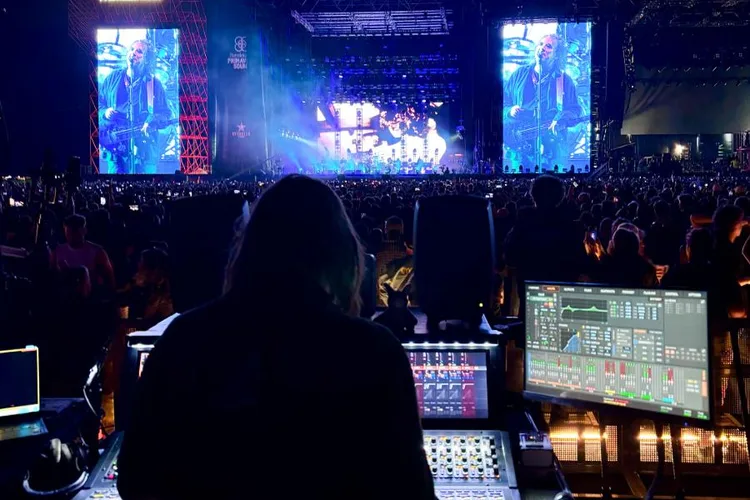
L-Acoustics supported Twincam through pre-production and the festival, with Andy Carrington acting as technical liaison with the headliners' engineers. Riera recalls that the systems and FOH engineers of headliners such as The Cure said it sounded fantastic and that they did not need to touch a thing. González points to the clarity and punch of the midrange, precisely the part the wind takes away.
Products used: Per stage: 2 × (16 K1 + 4 K2) and 16 flown K1-SB; in total 99 KS28, 37 Kara II front-fills, K1/K2 out-fills, two delay towers of 16 K2; 304 enclosures, 113 LA12X in 38 LA-RAK II, 6 P1 on a Milan-AVB network, LA Network Manager.
Photos: © L-Acoustics
You may also like
HYRISS Technology in Residential Environments
HYRISS technology in residential environments
Reference-grade academic sound with L-Acoustics
New Soka and SB6i by L-Acoustics for installation
L-Acoustics: Immersive Audio Beyond the Cinema
L-Acoustics: Immersive audio outside cinema
L-Acoustics Creations and C SEED reach new heights
Wayne State University chooses L-Acoustics
New compact L-Acoustics SB10i subwoofer
Sakura MATE upgrades with L-Acoustics
L-ISA is the perfect complement to ARTECHOUSE NYC
Kulturhuset Spira upgrades system with L-Acoustics K Series
Japan’s Sakura Hall blooms with L-Acoustics
L-Acoustics Kara II at the Phoenix Suns Arena
Frost School of Music chooses L-Acoustics
L-Acoustics at the Floridian Social Club
L-Acoustics K2 for Dodger Stadium
L-Acoustics Creations brings home the Concert Experience
L-Acoustics launches the new M1 suite
Presenting the M1 from L-Acoustics
L-Acoustics in St. Matthew Catholic Church
L-Acoustics Unveiled LA2Xi Amplified Controller
Newest L-Acoustics Creations at ISE 2020
Martin Audio TORUS powers Rotterdam's reborn Baroeg
Optimal Audio sets the sound at Unc's Pizza in Detroit
LEDVANCE cuts street lighting energy by up to 75%
Vokkero keeps the Ura Bere Bidean crew connected
Biamp Vocia: a paging system running for over ten years
31 Million Pixels Revolutionise Simulation
Genelec provides sound for a mini-golf venue in Germany
A journey through imagery, interaction and architecture
A new look for the Barcelona Metro with Soltec
Invisible Technology, Great Experiences
Fewer loudspeakers, greater clarity in the classroom
Communication in critical situations with UDE

The Value of Sound in Hospitality and Retail
Acoustics designed for sports and events

Platform for remote projector control

Real-time information for British Airways

Crestron turns the classroom into Wall Street
Church finds its voice with OPTIMUS
Integrated audio for fine dining environments
Networked audio for multifunctional spaces
Coordinates police alerts and emergencies
Sony technology to inspire architects
25 Barco projectors bring an AI museum to life
Anolis Illuminates the Natural Water Cycle
Aetria for Antarctic Exploration
Outdoor Displays for All Weather Conditions
Premium audio serving retail and hospitality
Immersive AV engineering to bring history to life
INFiLED LED at the World's Tallest Hotel
Hikvision improves flood response
Premium audio drives retail performance
A digital canvas for the heart of Seattle
Atmospheres of light in the Qatari desert
Martin Audio brings sonic energy until dawn
Bilbao Brings Fans Together Through Digital Signage