ITI collaborates with the Port of Valencia
Written by ISP Integration editorial teamCategory: NEWS
Published:

ITI is working on SOROLL-IA, a project funded by IVACE and ERDF funds.
Noise is one of the most significant environmental factors in terms of public health. Today, one in four people in Spain is exposed to high levels of noise pollution. The sources of noise are very diverse, ranging from road traffic, construction work and industrial plants to air traffic. And while it is true that the European Commission has established various Directives to mitigate its effects, there is still a lack of specific data on the sources of this noise that could be turned into action plans.
In order to address this situation, ITI, a technology centre specialising in ICT, is working on the SOROLL-IA project, which aims to create a database of generic audio recordings in a port environment.
Along these lines, ITI will collaborate with the Port of Valencia to advance the research, for which a series of acoustic nodes have been deployed at strategic locations around the port. The work, in which the Valenciaport Foundation is also taking part, focuses on collecting these sounds and then extracting information from them using “Machine Listening” techniques, also known as computer audition.
This is a technology from the field of Artificial Intelligence that works on and designs algorithms and models capable of extracting knowledge and relevant information from audio signals, specifically from environmental or generic sounds. This learning enables computers to carry out specific tasks autonomously, that is, without needing to be programmed.
SOROLL-IA, a project funded by IVACE and ERDF funds, will make it possible to improve various applications based on Artificial Intelligence (AI) systems, such as the identification of noise sources, with the aim of locating and acting on the noisiest and most disruptive elements in the environments where they occur.
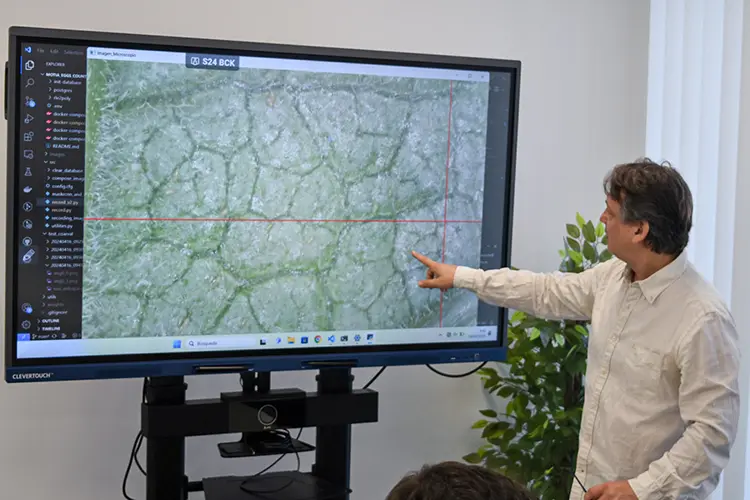
The purpose of the project is to obtain data and structure it so that it is useful for the various tasks within the computer audition field. As Pedro Zuccarello, principal investigator of ITI's Soroll-IA project, explains, “to deploy a real machine listening solution, the first step is to build a database of sounds related to the context in which you are working”.
Industrial application
The creation of the Soroll-IA database will enable ITI to tackle future computer audition problems efficiently and effectively, particularly in the industrial environment.
In the field of safety and the identification of noise sources, this technology would be a key factor in protecting not only the health of workers, but also that of people and other living beings in the surroundings of the facilities.
Among the possible applications of sound recognition at industrial level, the use of acoustic sensors to carry out predictive maintenance also stands out. It will make it possible to detect problems effectively.
One of the main characteristics of industrial machines is that they make noise; analysing these sounds using AI can give us information about the condition of the machine and show whether it is drifting from its normal operation. Predictive maintenance is expected to eventually replace classic preventive maintenance, owing to the cost savings its use would bring. This initiative will enable, in subsequent projects, much more efficient and accurate development of R&D projects aimed at providing industrial solutions based on AI models within the area of computer audition, adds Pedro.
Finally, the SOROLL-IA project, file number IMDEEA/2022/68, is funded by the Valencian Institute for Business Competitiveness (IVACE) and the European Regional Development Fund (ERDF).
You may also like
ITI boosts business competitiveness

IDC names Shure a Leader in AI meeting rooms
AVPro Edge MXnet 10G-MSE: 4K and H.265 from one encoder

500 Sony BRAVIA displays connect 100 stores

Sony: the traditional office is falling behind
Datapath to operate under the VITEC brand in 2027
40 giant Sony displays for collaborative learning

OPTIMUS installs 19 SIP intercoms at a Mexican power plant

LEA Cloud diagnoses issues without on-site visits
Genelec equips a music school with 143 loudspeakers
AVIXA appoints Marco Pardi as new chief executive

Spark 2027 to open with Casa Batlló mapping artists
Hikvision Village: a city where it all connects
Barco recreates realistic maritime scenarios

LEDVANCE: free training in LED and smart lighting

Daktronics upgrades video and audio at Lane Stadium
Crestron Collab Engine: meetings and AV control in one

Nureva appoints Ted Shuter as VP, Products
Kramer makes SailPoint's Pune rooms divisible

Pulse brought seven minutes of AV to InfoComm

Sony miniaturises medical imaging with the IMX742
Sony equips Crestron’s centres in London and Paris

ISLE 2027 opens visitor registration in Shenzhen

Nureva brings AI to meeting room management
Hikvision applies thermography to fire prevention
Spark 2027 opens registration and grows at Montjuïc

Ghost meetings under the technological spotlight
Genelec creates a sound forest inside Finlandia Hall
Light + Building strengthens British lighting presence
Bluesound brings licensed music to shops and hotels
Hikvision renews its Madrid Excelente certification
Crestron develops its first proprietary AV chipset
Video Control and Distribution on a Single Platform
Immersive audio and smart rooms: how InfoComm went

Video control and distribution on a single platform
SeeSound equips Cuenca Hospital auditorium

Hikvision Village 2026 recreates a connected city

Curved displays, transparent LED and COB technology

InfoComm América Latina puts AI into practice

Mo Gawdat examines the impact of AI on businesses
IntelliMix Bar Pro takes centre stage in Shure’s strategy

OPTIMUS public address built for maximum demand
Sony equips Crestron's new Experience Centres

AV over IP: When the Network Becomes the System
Captech EXPO Tests Technological Convergence

IFMA Spain: Technology, Spaces and People

Crestron connects more than 200 rooms at Camp Nou

Self-Service Kiosks and AI at InfoComm Latin America
Collaboration, Wireless Audio and AV Management
Sommer hybrid cable for underwater lighting
AVL SUMMIT by AFIAL: Exhibition and Technical Sessions
A Sharp plugin connects Q-SYS with NEC displays
AISpeech and effective listening in meetings

ISE 2027 expands its technological and creative universe

ISE 2027 adds Montjuïc with Spark and EdTech Congress

An agreement connects training and the AV industry

Classrooms that understand: audio and learning

Meetings: the cost of a meeting room that fails