













An audio or connection failure results in an average loss of 12.2 minutes per person during a meeting.
As agentic AI begins to require rooms capable of "understanding" what is happening within them, the main challenge remains proper planning, standardisation and measurement.
The hidden cost of a meeting room that doesn't work
The Workplace Equation study, conducted by Logitech among 1,700 executives across 11 countries, puts figures on a widespread problem. Technical issues during meetings result in an average loss of 12.2 minutes of productivity per person, while 30% of respondents say they lose 16 minutes or more due to a single interruption.
The source of the problem is not always the technology itself, but how it is planned. Only 24% of organisations involve IT/AV teams before they begin designing their spaces, forcing technology to be adapted to designs that have already been finalised. Responsibility is also divided: 81% of HR leaders consider their department the main authority on workplace experience, while IT/AV and Real Estate teams also see themselves as playing that role.
There is also a gap when it comes to justifying investment. While 87% associate a good workplace experience with increased productivity, only 58% are confident that they have enough data to justify the expenditure.
Standardising to scale
For large organisations, the solution lies in repeatable meeting rooms: the same design, the same user experience and predictable upgrades. One example is the ABMX range from Ashton Bentley (a Kramer company), designed to migrate legacy Cisco MX rooms to the latest Cisco Room Bar and Room Kit systems. These tool-free structures can be assembled in hours without building work and transfer the load to the floor rather than the wall. This allows them to be installed in offices with glass walls or in listed buildings. The latest Cisco systems support Webex, Microsoft Teams, Zoom and Google Meet, reducing dependence on a single platform.
BYOD: let everyone bring their own meeting
In coworking spaces or shared meeting rooms, imposing a specific platform can create friction. At Maslow’s Kensington in London, Tateside equipped the nine meeting rooms with a USB-C cable on the table: when a laptop is connected, the room automatically switches to videoconferencing mode, making the camera, microphone and speakers available to whichever application the user chooses.
As a coworking space, BYOD capability is important, says Jack Cornish, Technical Director at the systems integrator.
Agentic AI and the room that understands
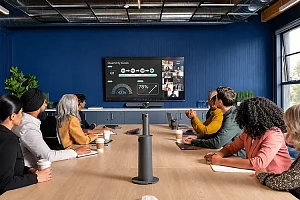
The next step is already being discussed. Barco argues that, for AI agents to genuinely participate in meetings, the room must provide them with an understanding of the environment at three levels: the geometry of the space, the people (who they are, where they are and what they are paying attention to) and the interactions (who is speaking to whom and turn-taking). According to the company, this processing should take place locally, at the edge, because sending high-resolution video to the cloud generates too much traffic. As an example, it cites the integration of ClickShare Hub Pro with the Huddly C1 camera. For the systems integrator, this has a specific consequence: cameras, microphones and sensors are no longer standalone peripherals but become part of a perception system that must be designed as a whole.
Measuring value, not just functionality
The pressure to demonstrate results also extends to artificial intelligence. According to the Value of AI Report 2026 by SAP and Oxford Economics, companies expect the average return on their AI investments to increase 2.5-fold within two years. In the AV environment, this means that the argument "this system incorporates AI" will become increasingly less useful than more specific metrics: how much operational time it saves, how many incidents it prevents, how it improves room utilisation or which tasks it automates.
Centralised management helps provide this data. Certified plugins such as the one launched by Sharp to integrate its Sharp and NEC displays into Q-SYS make it possible to monitor equipment status and diagnose faults from a single platform, rather than discovering them when the meeting starts.
Key considerations for meeting rooms that work
- Bring IT/AV, Human Resources and Real Estate teams together from the beginning of the project.
- Standardise room types to enable scalability and simplify support.
- Make BYOD easy: a single cable or wireless connection that works the first time.
- Think of cameras, microphones and sensors as a single system designed to support AI.
- Monitor and diagnose systems remotely to anticipate failures.
- Define metrics (incidents, room usage and time lost) that can justify the investment.
 Instagram
 Facebook
 LinkedIn
 X
X