








Intelligibility, accessibility and professional environments are shaping the evolution of AV in education.
If students cannot hear clearly, they cannot learn effectively. Auditoriums with beam-steering arrays, Auracast assistive listening systems and classrooms that recreate professional environments show where educational technology is heading.
Intelligibility, the first requirement
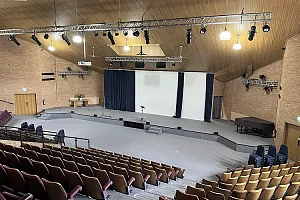
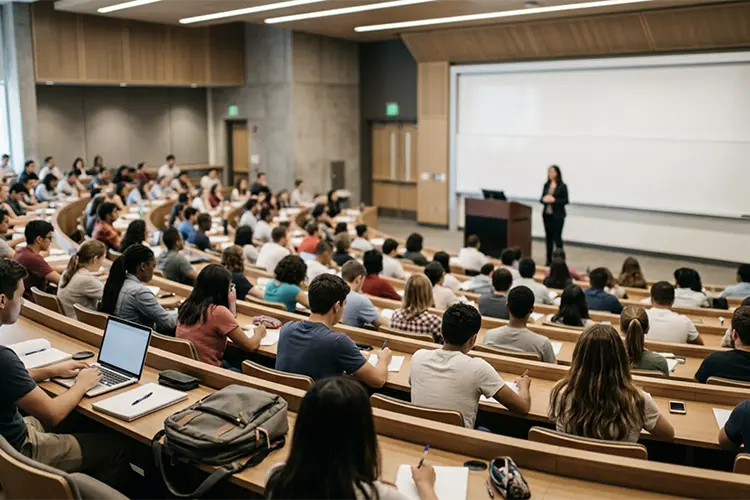
In a university classroom or auditorium, image quality often receives more attention than sound. However, speech intelligibility is what determines whether the message gets through. The Leonard Deacon Lecture Theatre at the University of Birmingham's Medical School illustrates this well. This 450-seat venue previously used a system of wall- and ceiling-mounted loudspeakers without time alignment, causing sound to arrive from multiple directions with audible delays. The result was poor intelligibility and listening fatigue for students.
The room also had two very different acoustic environments: a highly reflective semicircular stage and a seating area with more absorptive finishes. Following acoustic modelling and an on-site demonstration, four Renkus-Heinz Iconyx beam-steering arrays were selected: two IC16 units beside the screen and two more compact IC8 units for the rear, time-aligned using DSP delay. Each IC16 features eight steerable beams that can be adjusted to the room's dimensions, reducing energy in areas where it is not needed. The system achieved more controlled coverage with considerably fewer loudspeakers than the previous installation.
Lessons from this project
- Treat acoustically distinct zones as separate systems.
- Time-align all sources to prevent echoes and listening fatigue.
- Direct sound towards the audience rather than reflective surfaces: beam-steering technology makes this possible without compromising the room's aesthetics.
- Carry out an on-site demonstration before making a decision.
Conventional classrooms matter too
The same approach applies to conventional classrooms. Williams AV has introduced the TeachLogic SP-5000, a vertical line array that brings technology from larger venues into the classroom. According to the manufacturer, just two loudspeakers can provide a more uniform sound field than installations that typically require four or more, thanks to its wide horizontal dispersion.
Accessibility: listening on your own device
Assistive listening is another area undergoing rapid development. Auracast, which broadcasts audio over Bluetooth LE, allows audiences to receive sound directly through compatible hearing aids, cochlear implants or phones. Williams AV's Infinium platform combines FM, Wi-Fi and Auracast in a single solution for assistive listening, interpretation and audio description services. It also includes an outdoor transmitter and a headphone receiver that requires neither a smartphone nor an app, providing an option for users without a compatible device. Campuses, auditoriums and lecture halls are natural candidates.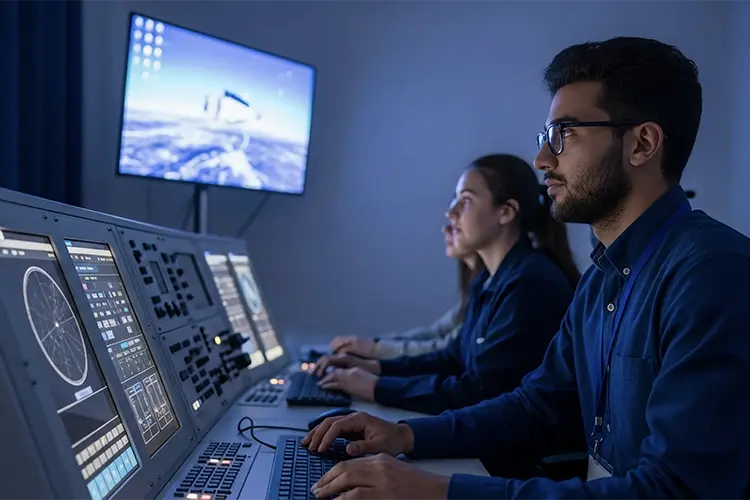
Learning in a real-world environment
Technology also makes it possible to bring professional environments into the classroom. The Bloomberg Trading Suite at Manchester Metropolitan University recreates a financial trading floor with 35 dual-screen workstations, Bloomberg terminals and a custom-built vertical ticker. The Crestron system, featuring DM NVX AV-over-IP video distribution, allows lecturers to send content throughout the room or let each workstation operate independently.
Lecturers can display complex tasks on one screen while students follow them on the other in real time, explains John Valentine, the campus IT manager.
The campus as a training ground for professionals
Universities are not only AV customers: they are also where the industry's future talent is developed. Several students awarded scholarships by the AVIXA Foundation this year began as technicians in their own campus audiovisual services, while the ISE Hackathon brought together 60 finalists from 17 European universities for its second edition, working on sustainability, innovation and cybersecurity.
In Spain, the agreement signed in September between AVIXA and ALIA gives association members access to webinars and preferential terms for training and certification, and includes plans for an annual joint event. AVIXA now also offers SynAudCon's online audio courses, ranging from sound system fundamentals to digital signal processing.
The education market will continue to be analysed: AVIXA and Futuresource Consulting are preparing a report on demand for professional AV in education in North America for the fourth quarter of 2026.
Key considerations for education projects
- Prioritise speech intelligibility over power.
- Measure and model the acoustics before selecting the system.
- Include assistive listening from the design stage rather than treating it as an add-on.
- Design for different modes of use: lectures, individual work and group work.
- Use campus technical services as partners in system operation and maintenance.
 Instagram
 Facebook
 LinkedIn
 X
X