AV solution at Rey Juan Carlos University
Written by ISP Integration editorial teamCategory: SUCCESS STORIES
Published:

NRD integrates state-of-the-art audio technology for its seamless integration and superb sound.
Rey Juan Carlos University was founded by the Government in 1996 in the Community of Madrid (Spain). The university has 400 teaching spaces spread across five campuses in Madrid, Fuenlabrada, Móstoles, Aranjuez and Vicálvaro, with more than 49,000 undergraduate, master's and doctoral students enrolled each year.
In July 2020, the university launched a four-year digital transformation plan to adapt its teaching spaces to the demands of 21st-century teaching.
Although the university was created to serve the citizens of the Community of Madrid, today it is committed to all Spanish and European Union citizens. Rey Juan Carlos University is part of the international university consortium EULIST, together with eight other European universities.
For this project, the university has won the prestigious @aslan Digital Transformation in Public Administration award in the "Digital Transformation in Education" category.
NRD, the integrator chosen for this project, used Xilica/Sennheiser audio equipment.
Challenge
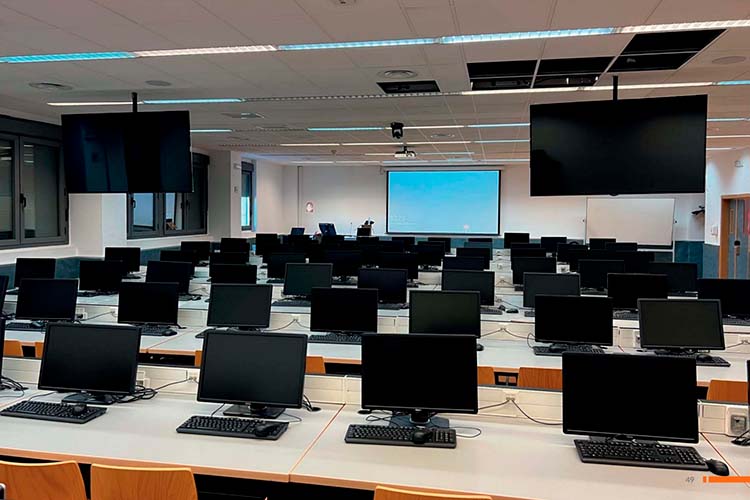
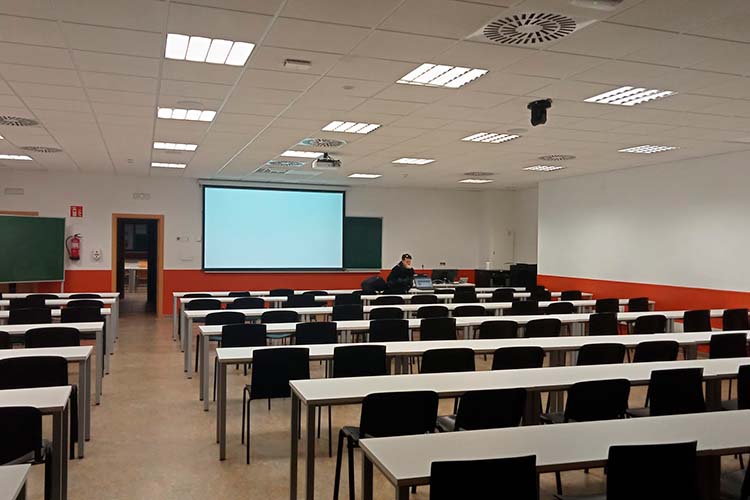
The client aimed to equip its classrooms with a high-quality AV solution for face-to-face, hybrid or remote lessons. For the university, it was essential to have a high-quality audio and video system that was easy to operate for people with no AV knowledge.
The acoustics of each space had to be adjusted to achieve the highest audio quality. The system integrator, NRD, designed a simple user interface that is very easy to understand and use for people unaccustomed to operating this kind of equipment.
 |
 |
Solution
NRD, which was responsible for the AV refurbishment of 100 classrooms across the five campuses, chose top-tier brands to supply the equipment and professional technical and after-sales support.
The digital transformation solution consisted of audio and video capture in each classroom, plus recording and distribution via streaming when required.
The biggest challenge NRD faced was adapting the microphones, as every space is different. All the classrooms are distinct and have varied layouts, so the integrators had to adapt the microphones to each specific room.
Xilica and Sennheiser equipment formed the core of the audio solution thanks to its seamless integration and superb sound.
Sennheiser's TCC2 ceiling microphone captures high-quality sound from anywhere in the classroom, covering the entire room. At the same time, Xilica's Solaro QR1 digital sound processors (DSPs) deliver clear, intelligible sound, free from annoying noise such as feedback, echoes and so on. The open-architecture Solaro QR1 processor was one of the key strengths for NRD, as it allows a custom configuration with the right cards for the needs of each installation. It is also powered via PoE and integrates into a Dante audio network.
NRD configured each DSP with Xilica's Solaro XC-SML (two-channel analogue audio input card), XC-SLO (two-channel analogue audio output card) and Solaro XC-SUB (2x2 USB audio card (send/receive)).
In line with the university's requirements, each classroom also had a Sennheiser MEG14-40 B, a 40 cm gooseneck microphone with a flexible section mounted on an MZS31 shock-absorbing elastic mount for fixed installation.
Impact
This digital transformation at Rey Juan Carlos University has created multifunctional, easy-to-use teaching spaces. In other words, it means that any teacher or student who enters the classrooms can connect to the equipment or carry out specific actions without the intervention of technical staff.
Teachers and students can move freely around the space, as the Sennheiser ceiling microphones automatically track their voices.
The Solaro technology, now available in every classroom, will provide realistic, natural-sounding audio with echo cancellation, enabling self-recording, content creation, digitisation and streaming of lessons with a noise-free experience.
Everyone, whether in the room or remote, or perhaps listening to a recorded lesson later, will hear clearly wherever they are.
Two-way audio functionality will allow remote students to collaborate or ask questions via the Microsoft Teams web platform as if they were on site, unifying communication and turning it into a great experience.
What's more, from now on any teacher with voice or throat problems, or perhaps a soft voice, will be able to give the lesson with the support of the Sennheiser gooseneck microphone placed on the teacher's desk.
Rey Juan Carlos University has also rolled out whiteboard digitisation, automated recording, high connectivity for external equipment, smart lighting, electrification of the classrooms and the removal of architectural barriers, among other improvements.
We are very pleased with the integration of the Xilica and Sennheiser equipment in this project, as it has more than met the client's requirements. It made the installation easier thanks to its quality and simplicity, as well as all the technical support provided by Magnetrón, the supplier of these two brands. The university's managers are delighted with the results, as they allow both on-site and remote students to follow lessons with crisp sound, concludes Lluís Torroella, of the Engineering Department at NRD Spain.
You may also like

Hyperclassroom in Granada with professional audio
Advanced audio for a new university Hiperaula

New era in AI-powered smart audio

Novotic and Xilica reach a distribution agreement

Sennheiser restores the audio of All Souls College

Gilsama and Xilica enter distribution partnership for Mexico

Hybrid Collaboration: Xilica with Lumens

Xilica joins HETMA as gold partner
Audiovisual Solution at Rey Juan Carlos University

Xilica and Sennheiser announce the TCCM

Xilica showcases audio solutions at ISE

Xilica presents: Xilica Follow Me

Xilica and Sennheiser launch hybrid conferencing kits

Xilica Launches Sonia CatX-based Ceiling Speaker System

Xilica launches Xilica One Partner Program

Xilica adds Lua Scripting

Xilica appoints new Canadian distributor

Xilica improves hospitality at Dubaiʼs Hutong

Xilica releases fourth generation of designer software
Vokkero keeps Ura Bere Bidean's technical crew connected
Biamp Vocia: a paging system running for over ten years

31 Million Pixels Revolutionise Simulation

Genelec provides sound for a mini-golf venue in Germany
A journey through imagery, interaction and architecture
A new look for the Barcelona Metro with Soltec
Invisible Technology, Great Experiences
Fewer loudspeakers, greater clarity in the classroom
Communication in critical situations with UDE

The Value of Sound in Hospitality and Retail
Acoustics designed for sports and events

Platform for remote projector control

Real-time information for British Airways

Crestron turns the classroom into Wall Street
Church finds its voice with OPTIMUS
Integrated audio for fine dining environments
Networked audio for multifunctional spaces
Coordinates police alerts and emergencies
Sony technology to inspire architects
25 Barco projectors bring an AI museum to life

Anolis Illuminates the Natural Water Cycle

Aetria for Antarctic Exploration

Outdoor Displays for All Weather Conditions

Premium audio serving retail and hospitality
Immersive AV engineering to bring history to life

INFiLED LED at the World's Tallest Hotel

From live sound to home with L-Acoustics

Hikvision improves flood response

Premium audio drives retail performance

A digital canvas for the heart of Seattle

Atmospheres of light in the Qatari desert

Martin Audio brings sonic energy until dawn

Bilbao Brings Fans Together Through Digital Signage

A Sound Atmosphere Tailored for Retail

Universidad Europea Boosts Learning with Nureva

A Camp Nou designed for frictionless operation

HYRISS Technology in Residential Environments

HYRISS technology in residential environments

From isolated systems to smart security