GoldenseaUV UVAIR216: UV-C air disinfection vs SARS-CoV-2
Written by ISP Integration editorial teamCategory: NEWS
Published:
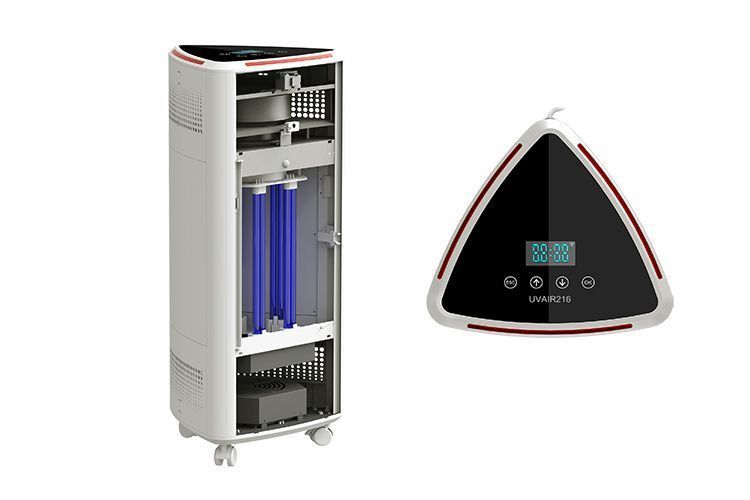
Ultraviolet air disinfection with documented effectiveness against SARS-CoV-2.
Official and independent reports have documented the effectiveness of the UVAIR216, with ultraviolet technology, in inactivating viruses such as SARS-CoV-2. They have also proven its safety, particularly in occupied spaces.
Biotec GmbH was responsible for examining the UVAIR216 in terms of its efficiency in inactivating airborne viruses. The surrogate virus used for the analysis was MS2, which can be used as a model organism in cases such as SARS-CoV-2 to determine the inactivation rates of germicidal systems. During the study, a single pass through the UVAIR216 reduced MS2 by 4.0 log levels. This corresponds to an inactivation rate of 99.991%.
The UVAIR216 was examined by the University of Hamburg as part of research into the inactivation of coronavirus using UV-C technology. During the evaluation, all air inlets and outlets were checked
The German company decided to test its UVAIR216 device in the same way to corroborate its effectiveness, even though that independent documentation should confirm that, in general, GoldenseaUV's various UVAIR models are highly effective.
UVAIR therefore holds a Certificate of Conformity, issued in accordance with Council Directive 2014/30/EU. This certificate confirms that the product meets all the essential requirements of the EMC Directive. Once the necessary technical documentation has been prepared, the CE marking can be affixed to the product. But that is not all: UVAIR also holds ETL, RoHS and REACH approval. GoldenseaUV is one of the few companies with this type of documentation clearly referring to specific products.
Safe and effective disinfection with GoldenseaUV UVAIR
The 200nm-280nm wavelength has proven to be the most effective for disinfection within the UV spectrum. UV-C light attacks the molecular structure of the DNA and RNA of microbial cells, destroying growing and/or regenerative cells. In this way, it achieves the disinfection effect.
GoldenseaUV uses the short-wave UVC spectrum (253.7nm), as it is considered the most efficient choice for disinfecting these agents. Its devices are made with quartz glass tubes, a material that allows full transmission of UV light.
UVAIR devices are useful for disinfecting airborne viruses and bacteria in all kinds of spaces, from small rooms to large auditoriums
Thanks to its technology, it can operate silently in the presence of people, rapidly regenerating air quality. One of its main features is the safety it offers, as it emits no ozone and uses no toxic products.
UVAIR devices offer different fan speeds and can be operated manually, by remote control or via an app. Their smart technology includes a filter-change detector and automatic alert. In addition, the UVAIR216 features a 45º tip-over detector.
Fast, efficient inactivation of SARS-CoV-2 using UV-C technology
Many studies corroborate the effectiveness of UV-C disinfection, which is also chemical-free and applicable to a wide range of environments.
The pandemic caused by SARS-CoV-2 has created the need to find disinfection technologies that are cheap, fast and, above all, reliable. A study by the University of Tübingen has evaluated the effectiveness of ultraviolet-C light in inactivating SARS-CoV-2. The results indicate that relatively low doses of UV-C are enough to inactivate the virus, making it an effective solution for disinfecting surfaces and air.
A key question is the suitability of this technology in a “real-life” environment, where exposure time on surfaces or aerosols must be kept as short as possible to allow realistic application, for example in hotel rooms or meeting rooms that need to be used frequently – not just operating theatres, where it has already been used for many years.
Disinfection versus air purification
Many studies have already shown that viruses can spread through particles. These exhaled aerosol particles play a prominent role in spreading the virus. They are so small that they can pass through the filters commonly used to purify air in enclosed spaces. UV-C light, by contrast, attacks and completely eliminates these microscopic particles, preventing them from circulating again.
Air purifiers make a big difference in indoor spaces and are effective in preventing the spread of other viruses and bacteria
However, they have not been shown to be highly effective against SARS-CoV-2. Using H13 and H14 filters has no technical advantages (compared with E11 filters) and is neither economically nor energy efficient. This means that the same H13 cleaning performance can be achieved with E11 filters if the airflow is just 5% higher. It should be borne in mind that air disinfection requires many air changes with a high airflow, which is limited as soon as a filter is added because of the reduction in air density. That is why it is important to incorporate an ultraviolet system.
Liquid aerosol particles, for their part, can shrink through evaporation, depending on ambient conditions. But particle size matters in terms of how they are transported and separated. The separation efficiency of HEPA filters does not take this important fact into account. It is therefore necessary not to rely solely on the mechanical separation of aerosols and to critically review the evidence provided. There is clearly a considerable need for research, especially at the interdisciplinary boundaries between fields of research such as epidemiology, infectious diseases, virology and so on.
Today, ultraviolet air disinfection systems have gained prominence and are positioned as one of the best solutions for making spaces safe when people are present.
You may also like
ISE 2027: a working TV studio, AI at work and 1,500 drones
Genelec bolsters its Western Europe team
SOLTEC unveils its RET-G retractable monitors
Neutrik brings TRUE1 and DR Series to JTSE 2026
TBS Education warns of AI bias when hiring staff
Panasonic and HIVE: 80% less AV infrastructure
IDC names Shure a Leader in AI meeting rooms
AVPro Edge MXnet 10G-MSE: 4K and H.265 from one encoder

500 Sony BRAVIA displays connect 100 stores

Sony: the traditional office is falling behind
Datapath to operate under the VITEC brand in 2027

40 giant Sony displays for collaborative learning
OPTIMUS installs 19 SIP intercoms at a Mexican power plant

LEA Cloud diagnoses issues without on-site visits
Genelec equips a music school with 143 loudspeakers

AVIXA appoints Marco Pardi as new chief executive
Spark 2027 to open with Casa Batlló mapping artists
Hikvision Village: a city where it all connects
Barco recreates realistic maritime scenarios
LEDVANCE: free training in LED and smart lighting
Daktronics upgrades video and audio at Lane Stadium
Crestron Collab Engine: meetings and AV control in one
Nureva appoints Ted Shuter as VP, Products
Kramer makes SailPoint's Pune rooms divisible
Pulse brought seven minutes of AV to InfoComm
Sony miniaturises medical imaging with the IMX742
Sony equips Crestron’s centres in London and Paris
ISLE 2027 opens visitor registration in Shenzhen

Nureva brings AI to meeting room management
Hikvision applies thermography to fire prevention
Spark 2027 opens registration and grows at Montjuïc
Ghost meetings under the technological spotlight
Genelec creates a sound forest inside Finlandia Hall
Light + Building strengthens British lighting presence
Bluesound brings licensed music to shops and hotels
Hikvision renews its Madrid Excelente certification
Crestron develops its first proprietary AV chipset
Video Control and Distribution on a Single Platform
Immersive audio and smart rooms: how InfoComm went
Video control and distribution on a single platform
SeeSound equips Cuenca Hospital auditorium

Hikvision Village 2026 recreates a connected city
Curved displays, transparent LED and COB technology
InfoComm América Latina puts AI into practice

Mo Gawdat examines the impact of AI on businesses
IntelliMix Bar Pro takes centre stage in Shure’s strategy
OPTIMUS public address built for maximum demand

Sony equips Crestron's new Experience Centres
AV over IP: When the Network Becomes the System
Captech EXPO Tests Technological Convergence
IFMA Spain: Technology, Spaces and People
Crestron connects more than 200 rooms at Camp Nou
Self-Service Kiosks and AI at InfoComm Latin America
Collaboration, Wireless Audio and AV Management
Sommer hybrid cable for underwater lighting
AVL SUMMIT by AFIAL: Exhibition and Technical Sessions
A Sharp plugin connects Q-SYS with NEC displays
AISpeech and effective listening in meetings