
Identidades Comunes makes Zaragoza a citizen science capital
Written by ISP Integration editorial teamCategory: NEWS
Published:
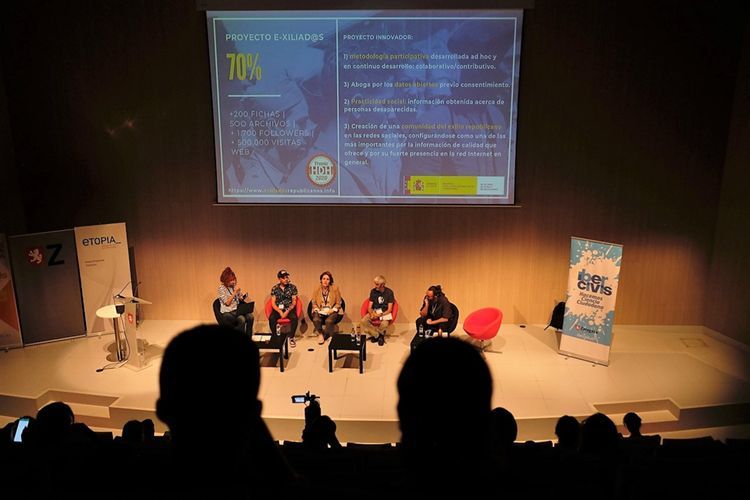
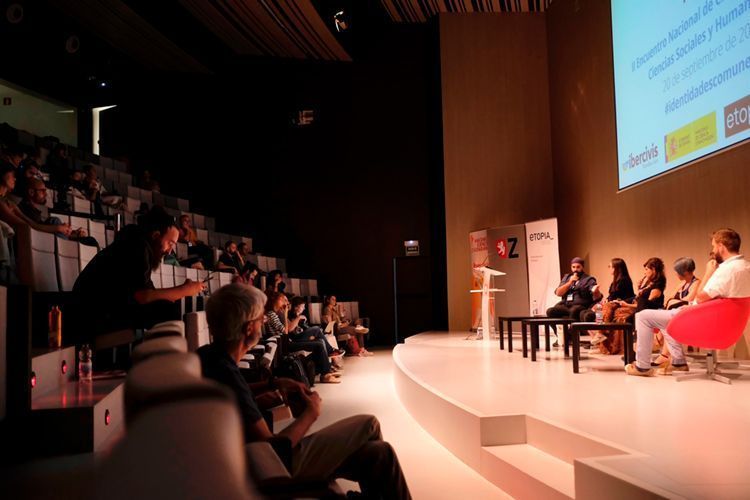
The Identidades Comunes initiative turns the Etopia centre into a space for co-creating projects.
The event brought together researchers, project managers and hundreds of attendees, who took part in round tables and workshops on ethnography, digitisation, collective memory, crowdfunding, communication and working on bottom-up projects.
In its second edition, Identidades Comunes presented a dozen citizen projects, including initiatives to preserve historical heritage, educate against fake news, monitor drought risk or build support networks for mental health.
This initiative was promoted by the Ibercivis Foundation, Zaragoza City Council and the Open Innovation Laboratories (LIA) of the University of Zaragoza, in collaboration with Etopia Centro de Arte y Tecnología.
Zaragoza has once again become the capital of citizen science, thanks to Identidades Comunes: the 2nd National Meeting on Citizen Science, Social Sciences and Humanities. The initiative brought together researchers, project management specialists and hundreds of participants around the creation and dissemination of collaborative, open initiatives born of citizens’ commitment to contribute to their communities.
The second edition of this innovative event, held at Etopia Centro de Arte y Tecnología, confirmed the growing interest in cooperative projects, with high attendance at the various activities on the programme.
The event opened with a keynote by Eva Méndez, Vice-Rector for Science Policy and Open Science at Universidad Carlos III and an expert in open knowledge, followed by the round tables “Developing bottom-up projects” and “Digitising heritage through citizen science”.
The afternoon was devoted entirely to workshops open to the public, providing training in various aspects of managing collaborative projects, such as crowdfunding, prototyping, forms of co-creation and communication.
The event also made room to show the results that these “bottom-up” initiatives can achieve, with the presentation of the 12 citizen science projects selected for this edition, whose promoters had the opportunity to share their ideas with researchers and the audience.
The projects presented included initiatives aimed at preserving historical heritage by training artificial intelligence, promoting public education to recognise fake news, collaborative monitoring to detect drought risk, and creating support networks to promote mental health in digital environments.
Making science more accessible is a basic step towards making it more useful to citizens, so that it has real transformative power in communities. Initiatives such as Identidades Comunes seek to show that scientific knowledge is not the exclusive preserve of academics and researchers, but can be acquired and used by anyone who is curious and has an idea to develop, which sends a very powerful message about the potential of citizen collaboration as a tool to change one’s surroundings. The success of this second edition confirms that citizen science is a field full of possibilities that attracts more and more people of all ages, interests and sensibilities, says Etopia.
You may also like
Neutrik brings TRUE1 and DR Series to JTSE 2026

TBS Education warns of AI bias when hiring staff
Panasonic and HIVE: 80% less AV infrastructure

IDC names Shure a Leader in AI meeting rooms
AVPro Edge MXnet 10G-MSE: 4K and H.265 from one encoder

500 Sony BRAVIA displays connect 100 stores

Sony: the traditional office is falling behind
Datapath to operate under the VITEC brand in 2027

40 giant Sony displays for collaborative learning

OPTIMUS installs 19 SIP intercoms at a Mexican power plant

LEA Cloud diagnoses issues without on-site visits
Genelec equips a music school with 143 loudspeakers

AVIXA appoints Marco Pardi as new chief executive

Spark 2027 to open with Casa Batlló mapping artists
Hikvision Village: a city where it all connects
Barco recreates realistic maritime scenarios

LEDVANCE: free training in LED and smart lighting

Daktronics upgrades video and audio at Lane Stadium
Crestron Collab Engine: meetings and AV control in one

Nureva appoints Ted Shuter as VP, Products
Kramer makes SailPoint's Pune rooms divisible

Pulse brought seven minutes of AV to InfoComm

Sony miniaturises medical imaging with the IMX742
Sony equips Crestron’s centres in London and Paris

ISLE 2027 opens visitor registration in Shenzhen

Nureva brings AI to meeting room management
Hikvision applies thermography to fire prevention
Spark 2027 opens registration and grows at Montjuïc
Ghost meetings under the technological spotlight
Genelec creates a sound forest inside Finlandia Hall
Light + Building strengthens British lighting presence

Bluesound brings licensed music to shops and hotels
Hikvision renews its Madrid Excelente certification

Crestron develops its first proprietary AV chipset
Video Control and Distribution on a Single Platform
Immersive audio and smart rooms: how InfoComm went

Video control and distribution on a single platform
SeeSound equips Cuenca Hospital auditorium

Hikvision Village 2026 recreates a connected city

Curved displays, transparent LED and COB technology

InfoComm América Latina puts AI into practice

Mo Gawdat examines the impact of AI on businesses
IntelliMix Bar Pro takes centre stage in Shure’s strategy

OPTIMUS public address built for maximum demand

Sony equips Crestron's new Experience Centres

AV over IP: When the Network Becomes the System
Captech EXPO Tests Technological Convergence

IFMA Spain: Technology, Spaces and People
Crestron connects more than 200 rooms at Camp Nou

Self-Service Kiosks and AI at InfoComm Latin America
Collaboration, Wireless Audio and AV Management
Sommer hybrid cable for underwater lighting
AVL SUMMIT by AFIAL: Exhibition and Technical Sessions
A Sharp plugin connects Q-SYS with NEC displays
AISpeech and effective listening in meetings
ISE 2027 expands its technological and creative universe

ISE 2027 adds Montjuïc with Spark and EdTech Congress

An agreement connects training and the AV industry