Poly hybrid work trends for 2022: flexibility and equality
Written by ISP Integration editorial teamCategory: NEWS
Published:
POLY has analysed the main trends in workplace collaboration.
The long-awaited return to “normal” does not mean going back to our old habits. Hybrid working is here to stay, and the new year brings irreversible changes in the way we carry out our work. In fact, the global pandemic forced companies to tackle remote working and tested employees’ ability to adopt new forms of engagement and interaction.
Now the possibility of continuing to drive sustainable, collaborative change lies in the ability of managers and employees to adapt to this new normal. In this respect, companies wishing to face the near future more efficiently will need to understand and adapt to this new approach and successfully balance technology and transformation.
Trend 1: The end of the 9-to-6 office day. The future is more flexible work
The pandemic has allowed many workers to experience the advantages of hybrid working: fewer and fewer people are now willing to return to the office full time. According to a recent Poly study, 80% of employees in Europe prefer to spend some days working from home and, in Spain, 42% of respondents say that being able to work two days remotely and three in the office would be the most efficient and desirable option.
This shows that workers are asking for more flexibility and, following the economic recovery and the phenomenon of the "Great Resignation" – which mainly affects on-site jobs – it is possible that in the near future the ability to retain talent will depend on letting employees choose how and where they work.
According to Paul Clark, Senior Vice President for Europe, Middle East and Africa at Poly: "Workers are increasingly looking for a work-life balance and need flexibility that allows them to reconcile both areas more efficiently. The reality is that today employees cannot simply be seen as an asset to be managed; we have to understand that they have an ever-greater level of empowerment within organisations: they know what they want, why, when and how. If they are ignored, they will look for new opportunities".
Trend 2 – Offices as ecosystems of physical spaces for working with quality technology tools – not mere “gadgets”
Offices are being transformed and will no longer necessarily be physical places with defined, individual spaces. The workplaces of the future will be ecosystems with areas and rooms adapting to the working habits and needs of different people. The office will no longer be seen as the place you have to go to work, but rather as a place to make the most of specific interaction between professionals.
This will also bring significant changes in terms of the architecture and design of spaces, as well as investment in collaboration devices and technologies, with the aim of improving the working experience as the main focus of this whole transformation
"Companies that remain very reluctant to create a more flexible workplace will find it hard to foster a culture of collaboration among their workforce in the near future. During the pandemic, reduced contact between colleagues affected innovation and creativity, as it is often informal conversations or unscheduled meetings that contribute most to sharing knowledge and solving problems. Cooperation is essential to foster employee satisfaction, as numerous studies reveal", adds Clark.
Trend 3 – Equality: the new imperative
During the pandemic everything revolved around business continuity, but now a people-centred philosophy is the real catalyst for business success. In this sense, the possibility of choosing where and how to work is a major driver of efficient collaboration, as it allows employees to perform at their best and become more committed to managing their tasks. This approach is an opportunity for HR, IT and workforce management departments to focus more on launching initiatives that improve the employee experience.
In fact, a recent Stanford University study highlights that more than 40% of workers are more likely to change jobs when their company proves to be against hybrid working
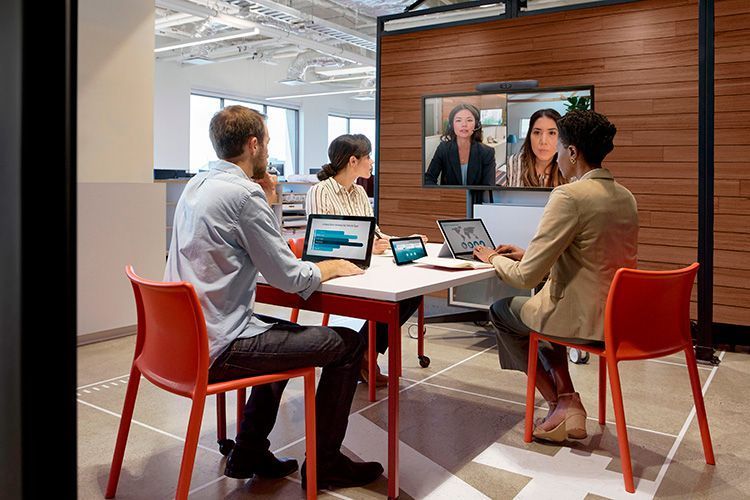
In this respect, the main challenge of hybrid working is to create equity for everyone. And this is where technology plays a key role: clear, high-quality images and sound are now essential to improve collaboration between colleagues regardless of where they work. Flexible workers need to be able to rely on professional devices that ensure a level playing field for those connecting from a meeting room, those in the office, and those joining the meeting remotely.
“Access to reliable communications is essential to ensure people receive the same information at the same time, while avoiding any unconscious bias,” concludes Paul Clark.
You may also like
Poly at ISE 2022: Studio R30, Sync 10 and Poly Lens updates
Poly and WORKTECH Academy: 12 Key Hybrid Working Considerations

Poly Sync 10 USB speakerphone launched at ISE 2022
Poly hybrid working study: Recruit, Retain and Grow
Poly guide: how to tackle noise in the hybrid workplace
Poly new bussines media phones

HK Audio promotes Isabelle Wear to Head of Sales EMEA
ISE 2027: a working TV studio, AI at work and 1,500 drones

Genelec bolsters its Western Europe team
SOLTEC unveils its RET-G retractable monitors
Neutrik brings TRUE1 and DR Series to JTSE 2026

TBS Education warns of AI bias when hiring staff
Panasonic and HIVE: 80% less AV infrastructure
IDC names Shure a Leader in AI meeting rooms
AVPro Edge MXnet 10G-MSE: 4K and H.265 from one encoder

500 Sony BRAVIA displays connect 100 stores

Sony: the traditional office is falling behind
Datapath to operate under the VITEC brand in 2027
40 giant Sony displays for collaborative learning

OPTIMUS installs 19 SIP intercoms at a Mexican power plant
LEA Cloud diagnoses issues without on-site visits
Genelec equips a music school with 143 loudspeakers

AVIXA appoints Marco Pardi as new chief executive

Spark 2027 to open with Casa Batlló mapping artists
Hikvision Village: a city where it all connects
Barco recreates realistic maritime scenarios
LEDVANCE: free training in LED and smart lighting

Daktronics upgrades video and audio at Lane Stadium
Crestron Collab Engine: meetings and AV control in one

Nureva appoints Ted Shuter as VP, Products
Kramer makes SailPoint's Pune rooms divisible
Pulse brought seven minutes of AV to InfoComm

Sony miniaturises medical imaging with the IMX742
Sony equips Crestron’s centres in London and Paris
ISLE 2027 opens visitor registration in Shenzhen

Nureva brings AI to meeting room management
Hikvision applies thermography to fire prevention
Spark 2027 opens registration and grows at Montjuïc
Ghost meetings under the technological spotlight
Genelec creates a sound forest inside Finlandia Hall
Light + Building strengthens British lighting presence
Bluesound brings licensed music to shops and hotels
Hikvision renews its Madrid Excelente certification
Crestron develops its first proprietary AV chipset
Video Control and Distribution on a Single Platform
Immersive audio and smart rooms: how InfoComm went
Video control and distribution on a single platform
SeeSound equips Cuenca Hospital auditorium

Hikvision Village 2026 recreates a connected city
Curved displays, transparent LED and COB technology
InfoComm América Latina puts AI into practice

Mo Gawdat examines the impact of AI on businesses
IntelliMix Bar Pro takes centre stage in Shure’s strategy
OPTIMUS public address built for maximum demand
Sony equips Crestron's new Experience Centres

AV over IP: When the Network Becomes the System
Captech EXPO Tests Technological Convergence

IFMA Spain: Technology, Spaces and People