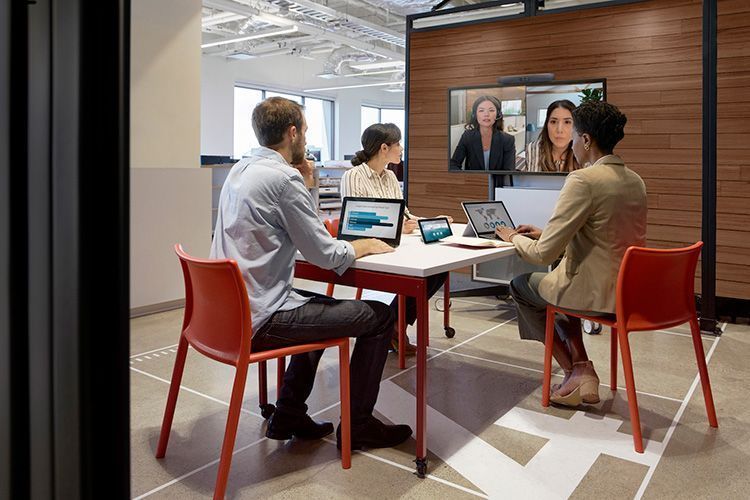
Poly hybrid working study: Recruit, Retain and Grow
Written by ISP Integration editorial teamCategory: NEWS
Published:

Under the title Recruit, Retain and Grow, Poly analyses the views of more than 2,500 business leaders in 16 countries.
The post-pandemic attitudes and expectations addressed by the research show that workers are going into the office an average of three days a week, with Wednesday the most popular day in practically every country in the study.
“At Poly we believe that being able to enable hybrid working is not the end goal, but the starting point for organisations' competitiveness today. Our latest study supports Poly's view,” says John Goodwin, Senior Vice President of Public Affairs at Poly. “We found that employees support companies that take a holistic approach to defining their culture, that offer flexibility in where and how to work and that provide the right tools for them to perform at their best.”
Key findings of the Poly report
Recruitment and talent retention are at risk: more than half (56%) of organisations believe that if they do not implement hybrid working plans and processes, they will start to lose staff and will be unable to attract new talent. This is particularly notable in the Asia-Pacific region, where 60% of business leaders say so, compared with 55% in the EME region (Europe and the Middle East) and 53% in the Americas. In Spain, this view is shared at very similar levels: 55% agree.
Overall, companies have already noticed these effects: 58% globally report higher staff turnover since the start of the pandemic; the figure is 54% in Spain, very much in line with neighbouring countries such as France, Germany and the UK
The survey also reveals that companies' approach to hybrid working plays an increasingly important role in retaining staff. In fact, when asked about the main reasons employees left over the past year, the organisations surveyed highlighted that:
- workers found better career opportunities, cited by 19% of the organisations surveyed globally,
- employees did not have the flexibility they wanted in terms of hybrid working (a reason given by 16% globally)
- workers were unhappy with the way their companies handled the COVID-19 pandemic (9% globally)
Even so, Spain differs considerably from the overall averages, proof that its labour market has different characteristics and behaves differently. In Spain, companies stress that career growth remains the main reason employees leave (26%), compared with flexibility (14%) or dissatisfaction with how COVID was handled (6%)
Hybrid strategy and equal conditions are not well aligned: globally, less than half of organisations (48%) say they are fully prepared for hybrid working, while 37% say they are prepared in the short term but have not tackled long-term planning. In Spain, 39% of companies say they are fully adapted, while 45% say they are adapted in the short term but do not have a long-term plan.
However, 52% globally see hybrid working as a passing phase and are seeking a return to the office, and 19% say they are already requiring employees to return to fully in-person working.
Countries in the EME region are not far from this global trend, as the view of hybrid working as something temporary is reflected in 51% of the companies surveyed in the region. Despite this, Spain, together with the UK, is the country where this view is least shared, at 45%.
Other considerations highlighted by the companies surveyed are:
- that employees should have the right to request flexible working from their first day. 80% of business leaders globally agree, while in Spain the figure is 86%, making it the country where this view is most widely shared, well above the EME regional average (79%)
- that there should be clear rules on the number of days employees must spend in the office (84% globally and 94% in Spain)
- that, as employees will be in the office more sporadically, the next step will be smaller office spaces (22% globally and 18% in Spain).
A lack of culture and staff wellbeing affects productivity: 72% of the companies surveyed globally (74% in Spain) report an increase in productivity as a result of the shift to hybrid working, with an average global increase of 27% (28.5% in Spain)
However, 60% globally agree that if employees are not in the office, they will not be able to build the relationships they need to progress in their careers. In Spain the figure is below these averages, at 55%.
Other aspects revealed by the Poly report in this area are:
- Companies are concerned about a harmful culture of work overload (49% globally and 42% in Spain)
- Only half of companies say they are taking steps to prevent people feeling they must always be connected (51% globally, 52% in Spain)
- The vast majority of organisations believe remote working has made it harder than ever to foster and retain workplace culture. This is the view of 74% of respondents globally, a similar proportion to Spain and practically identical across regions.
According to Poly's analysis, most companies consider that technology and experiences, not just their offices, are the face of the company. This is the view of 64% of companies globally, with very similar figures across regions. In Spain, the percentage drops to 59%.
Broadening the range of available spaces, rather than defining whether a space is virtual, external, remote or hybrid, will help companies develop a robust hybrid working strategy
Forward-looking companies are investing, or plan to invest, equally in software and devices, with the most common technology investments being cloud applications and collaboration software (92% globally), followed by headsets (89%), cameras (86%) and speakers (83%). The figures for Spain are practically the same, indicating unanimous commitment to these technology upgrades.
77% of companies (79% in Spain) say they are redesigning their offices with more open areas, collaboration spaces, quiet zones and areas for socialising. Ultimately, companies must look after their employees, who will be the main users of these spaces.
About the study
The results are based on a survey of 2,528 senior and middle managers conducted between December 2021 and February 2022 in Germany, the UK, Ireland, France, Spain, Sweden, Poland, the United Arab Emirates, the United States, Canada, Mexico, Japan, Australia, India, Singapore and China.
You may also like
Poly at ISE 2022: Studio R30, Sync 10 and Poly Lens updates
Poly and WORKTECH Academy: 12 Key Hybrid Working Considerations

Poly Sync 10 USB speakerphone launched at ISE 2022
Poly guide: how to tackle noise in the hybrid workplace
Poly hybrid work trends for 2022: flexibility and equality
Poly new bussines media phones

HK Audio promotes Isabelle Wear to Head of Sales EMEA
ISE 2027: a working TV studio, AI at work and 1,500 drones

Genelec bolsters its Western Europe team

SOLTEC unveils its RET-G retractable monitors
Neutrik brings TRUE1 and DR Series to JTSE 2026

TBS Education warns of AI bias when hiring staff

Panasonic and HIVE: 80% less AV infrastructure

IDC names Shure a Leader in AI meeting rooms
AVPro Edge MXnet 10G-MSE: 4K and H.265 from one encoder

500 Sony BRAVIA displays connect 100 stores

Sony: the traditional office is falling behind
Datapath to operate under the VITEC brand in 2027

40 giant Sony displays for collaborative learning

OPTIMUS installs 19 SIP intercoms at a Mexican power plant

LEA Cloud diagnoses issues without on-site visits

Genelec equips a music school with 143 loudspeakers

AVIXA appoints Marco Pardi as new chief executive

Spark 2027 to open with Casa Batlló mapping artists
Hikvision Village: a city where it all connects
Barco recreates realistic maritime scenarios
LEDVANCE: free training in LED and smart lighting

Daktronics upgrades video and audio at Lane Stadium
Crestron Collab Engine: meetings and AV control in one

Nureva appoints Ted Shuter as VP, Products
Kramer makes SailPoint's Pune rooms divisible

Pulse brought seven minutes of AV to InfoComm

Sony miniaturises medical imaging with the IMX742
Sony equips Crestron’s centres in London and Paris
ISLE 2027 opens visitor registration in Shenzhen

Nureva brings AI to meeting room management
Hikvision applies thermography to fire prevention
Spark 2027 opens registration and grows at Montjuïc
Ghost meetings under the technological spotlight

Genelec creates a sound forest inside Finlandia Hall
Light + Building strengthens British lighting presence

Bluesound brings licensed music to shops and hotels
Hikvision renews its Madrid Excelente certification

Crestron develops its first proprietary AV chipset
Video Control and Distribution on a Single Platform
Immersive audio and smart rooms: how InfoComm went

Video control and distribution on a single platform
SeeSound equips Cuenca Hospital auditorium

Hikvision Village 2026 recreates a connected city

Curved displays, transparent LED and COB technology

InfoComm América Latina puts AI into practice

Mo Gawdat examines the impact of AI on businesses
IntelliMix Bar Pro takes centre stage in Shure’s strategy

OPTIMUS public address built for maximum demand

Sony equips Crestron's new Experience Centres

AV over IP: When the Network Becomes the System
Captech EXPO Tests Technological Convergence

IFMA Spain: Technology, Spaces and People