Sony Edge Analytics: hybrid learning at the University of Bamberg
Written by ISP Integration editorial teamCategory: SUCCESS STORIES
Published:
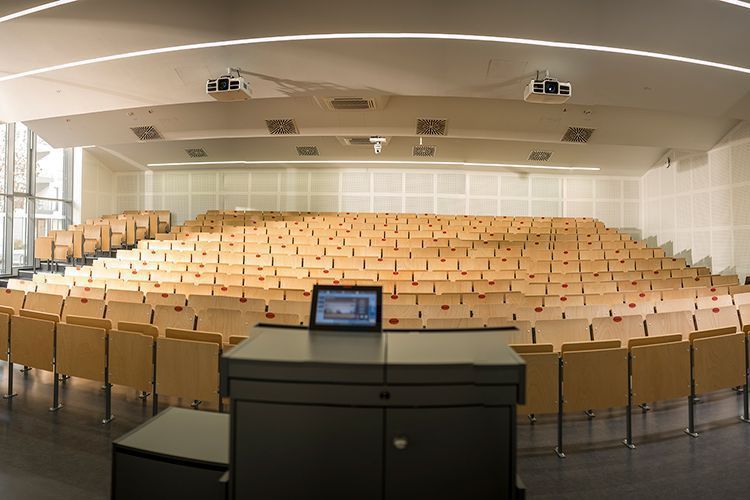
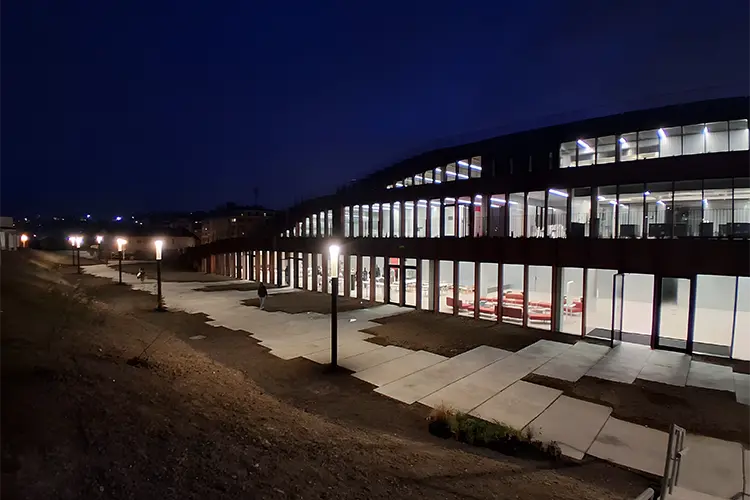
The University of Bamberg was founded in 1647 as the Academia Bambergensis.
The University of Bamberg (Otto-Friedrich-Universität Bamberg) is one of Germany's oldest universities and currently attracts almost 13,000 students from all over the world.
Like many other institutions, it faces major digital transformation challenges, on top of the uncertainties of the pandemic era. A highly motivated team of multimedia technicians and IT specialists has implemented a digital system to optimise much of its hybrid learning operations, ensuring that students can benefit from either in-person or remote teaching. Innovative artificial intelligence technology from Sony, Edge Analytics, is part of the solution.
Christoph Seeger looks almost inquisitively towards the back of lecture theatre WE5/00.022, currently empty, in the University of Bamberg's "An der Weberei" building and points at the ceiling. A camera the size of a handball has been mounted there, quite discreetly. "It's hanging up there at the back," says Seeger, who works at the University of Bamberg's IT centre. "We currently have five large lecture theatres permanently equipped with these modern cameras. This technology is a fundamental element in being able to continue university teaching even during a pandemic." Over the summer, Seeger and his colleagues optimised the university's main lecture theatres for hybrid learning with Sony supplier MR Datentechnik Vertriebs und Service GmbH, based in Nuremberg.
Pan and tilt
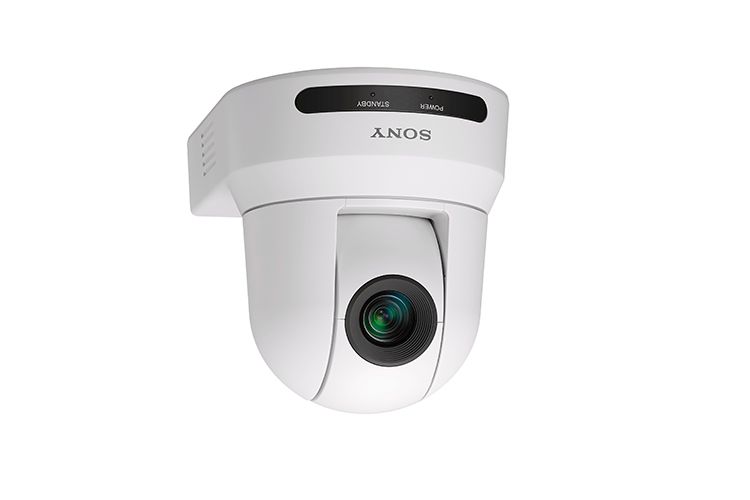
The cameras used are PTZ cameras, which stands for "pan-tilt-zoom" and describes the directions in which these remotely controlled cameras move. They are best known for their use in surveillance technology, but more and more TV channels and production companies are using them to control live broadcasts such as sporting events remotely. That is exactly the type of camera hanging in lecture theatre WE5/00.022, specifically a Sony SRG-X120 IP 4K PTZ camera. The camera captures every corner of the 300 m2 lecture theatre in the university's modern building in high resolution. It is a fundamental element of hybrid learning which, in these pandemic times, is becoming an increasingly important teaching and learning format.
However, it is not the ceiling-mounted PTZ cameras that create the hybrid learning system. That role falls to the small and even less conspicuous black boxes to which the cameras are connected. The small cube, just over 10 cm long, is called Edge Analytics and contains video technology based on artificial intelligence. "That's where the intelligence behind our system lies," explains Michael Fries, Account Manager for the Professional Displays & Solutions Business Group at Sony, who specialises in hybrid learning systems for the education sector.
"Edge Analytics detects the lecturer and enables the PTZ camera to follow the class. It also detects participants' gestures and captures and stores the notes on the whiteboard, even if the lecturer is covering part of it"
The Edge Analytics system is easily configured via a web-based user interface and operated with a standard media control unit, compatible with all the usual professional media control systems. The five lecture theatres at the University of Bamberg equipped with Sony's Edge Analytics system use Extron controls and touch panels. According to Fries: "Edge Analytics generates engaging content automatically and in real time. It can stream video from the camera directly to a display or a storage medium, over IP, to any location in the world or, as at the University of Bamberg, to the video streaming server it uses. This convenient system runs on its own, without lecturers having to constantly check or adjust the settings of the media technology."
The University of Bamberg has not yet modernised all the lecture theatres and seminar rooms in its various buildings spread across the city, so in order to offer hybrid learning in more rooms, the university has bought two mobile unitsin addition to the five permanently installed systems. These mobile units also consist of a Sony PTZ camera and the Edge Analytics box. The system is compact, housed in a transport case and can easily be moved from one room to another. "Lecturers can connect the system themselves in a few simple steps, start it up and configure it for the class or course, for example specifying whether the class is to be streamed live or recorded for later download", says Fries. Installation is also easy, because the individual components are simply connected to each other with network and HDMI cables, and then to the media control unit.
A virtual camera operator at your fingertips
The Edge Analytics system offers a total of five functions that can be activated through a licensing model as required. First, there is the PTZ auto-tracking function, which drives the connected camera technology and ensures that the PTZ cameras follow a moving subject completely automatically, especially in large lecture theatres such as those in Bamberg. An algorithm ensures speakers are tracked automatically so that they always remain sharp and in focus. The handwriting extraction function uses augmented reality techniques so that words and diagrams written on the board are visible to students at all times. Edge Analytics automatically detects handwritten text, drawings and diagrams, extracts a real-time overlay from them and displays it in front of the speaker. Even if the speaker is standing directly in front of the board, students can always see the ideas and reasoning. The extracted text can be downloaded to a laptop as a JPEG file.
Sony's Edge Analytics uses the gesture function to detect certain movements in the room. For example, if someone in the audience stands up, the camera automatically zooms in on that person and keeps them in focus while they are speaking. According to Fries: "This is especially useful in lectures or corporate presentations to capture questions or comments." The cropping function improves classroom dynamics, as it can be used to show adjustable image sections on additional screens. This means several screen views can be achieved with a single camera.
Last but not least, the overlay function can be used to display additional content on screen that is visible to students, such as the presentation window, a fixed university logo or a completely different background
Easy to install and highly compatible
Seeger: "In Bamberg, six of the seven Edge Analytics systems are equipped with the PTZ auto-tracking licence. One of our systems has all the licences. For the time being, we are using it as a test system and trying out the individual functions." So far, the experience has been very promising: "Installation and configuration were very straightforward and there were no compatibility issues with our existing Extron system. We now have a modern hybrid learning system in our large lecture theatres and in the auditorium, where we are also using this solution," says Seeger.
"I am totally convinced that intelligent media technology not only helps lecturers in their work, but also improves academic performance," says Fries
The existence of a large and clear demand for hybrid learning was also evident in autumn 2021 in a survey commissioned by Sony and carried out by 3Gem and SAPIO Research. The survey involved 3,000 students and more than 150 IT managers at higher education institutions across Europe. The study shows that most universities are still not doing enough to develop modern learning formats and that students are dissatisfied with the investment in media technology to date.
The survey reveals that more than three quarters of the students surveyed (79%) believe university learning would improve if there were investment in online and hybrid learning technologies. More than a third (34%) of students feel disconnected from their peers, highlighting the need to facilitate and support collaboration between students through technology, for both in-person and remote learning.
By opting for a hybrid learning system, the University of Bamberg has undoubtedly paved the way for a promising, contemporary hybrid teaching offer, even in difficult times such as a pandemic. In doing so, it has ensured that one of Germany's oldest universities can continue its teaching programme with modern media.
You may also like

Sony: the traditional office is falling behind

40 giant Sony displays for collaborative learning

Sony equips Crestron's new Experience Centres
Sony technology to inspire architects
European retail technology gap: a trust challenge
Sony reinvents comfort in hospitals
The NHS Hospital installs Sony BRAVIA displays
Technological and sustainable universities
Installation agile, elegant and scalable
Sony and Allianz Portugal: Innovation in Lisbon
Crestron transforms its workspace

Sony strengthens its BRAVIA display lineup
Stella McCartney with Sony BRAVIA and TRISON
Technological advertising signage
The SAGA space habitat takes off with Sony
Modern and high-quality learning with Sony
Assosia modernizes its offices with Sony

Sony expands its range of BRAVIA monitors
Sony and Telelogos technology

Sony present at Paris Fashion Week 2024
Sony expands BRAVIA integration capabilities
Sony provides collaborative visual experiences

Future of connected experiences at ISE
Sony opens an immersive exhibition in Madrid
The restaurant Drevny Kocur installs 69 Sony displays
Motoya Itako, new manager at Sony Mexico

Sony appoints Henrik Breda as Head of Sales
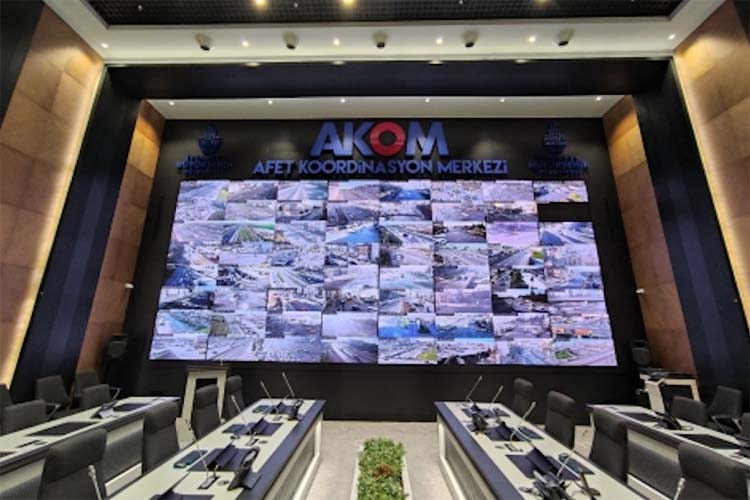
Control room with a Crystal LED display in Istanbul
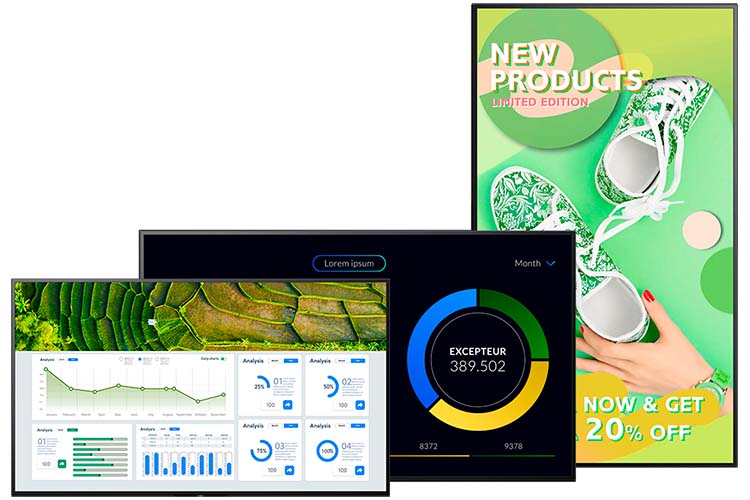
New line of Sony BRAVIA 4K displays

Sony BRAVIA 4K HDR professional displays
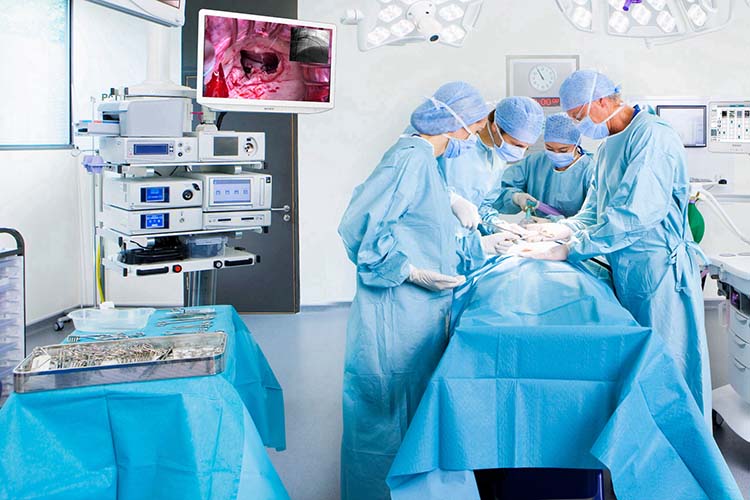
Latest developments in operating theatre digitalisation

Rik Willemse is Sony's new European head

Sony connected experiences at ISE 2023
Sony presents its new developments for 2023

Key technology trends for 2023

The future of Sony will be on show at ISE 2023

Sony Corporation partners with signageOS
Sony partners with Kramer to optimise a classroom
Sony launches 3LCD laser projectors
Sony LMD-XH550MT and LMD-XH320MT 4K HDR surgical monitors
Sony TEOS and BRAVIA digitise North West Ambulance Service
Sony BRAVIA 4K digital signage partners with Navori Labs
Sony TEOS Meet and TEOS Lite: next-generation workplace management
Sony unveils new generation of BRAVIA professional displays

Sony NUCLeUS LIVE cloud streaming for surgical collaboration
Sony SRG-X40UH: new 4K PTZ camera with up to 40x zoom
Sony's BRAVIA 4K professional displays at UCF

Optimal Audio sets the sound at Unc's Pizza in Detroit

LEDVANCE cuts street lighting energy by up to 75%
Vokkero keeps the Ura Bere Bidean crew connected
Biamp Vocia: a paging system running for over ten years
31 Million Pixels Revolutionise Simulation

Genelec provides sound for a mini-golf venue in Germany
A journey through imagery, interaction and architecture

A new look for the Barcelona Metro with Soltec
Invisible Technology, Great Experiences
Fewer loudspeakers, greater clarity in the classroom
Communication in critical situations with UDE