Christie CounterAct far-UVC disinfection enters mass production
Written by ISP Integration editorial teamCategory: NEWS
Published:
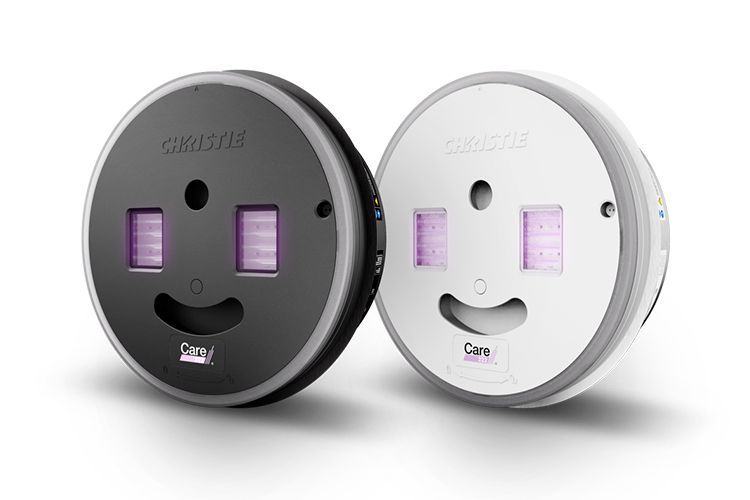
For use in occupied spaces and with CE and UL marking.
As the world prepares for the post-pandemic era, a phase in which reducing pathogens and virus circulation will be crucial, global audiovisual technology company Christie has announced the mass production of the Christie CounterAct product line for commercial disinfection using ultraviolet radiation.
The new products incorporate Care222, a patented far-ultraviolet (far-UVC) technology that allows them to be used in occupied indoor spaces, from cinemas, theme parks, museums and sports complexes to shops and restaurants, as well as high-traffic areas such as airports and railway or underground stations.
Developed by Christie, the CounterAct product line uses Care222nm, an ultraviolet lamp technology patented by Ushio Inc., Christie's parent company, which licensed it from Columbia University. Designed for mounting on high ceilings, CounterAct luminaires are as simple to install as any other light fitting and easy to manage.
Christie CounterAct is the first ultraviolet disinfection technology for use in places where people are present. It uses filtered, patented far-ultraviolet (far-UVC) light to eliminate up to 99% of pathogens on surfaces in indoor spaces, such as severe acute respiratory syndrome coronavirus (SARS-CoV-2) —the virus that causes COVID-19— as well as the influenza virus and antibiotic-resistant bacteria and superbugs, by damaging the pathogen's DNA or RNA and preventing it from reproducing and infecting humans.
“With CounterAct luminaires acting as an additional shield of defence, bringing customers back to their favourite venues to share and create memorable experiences is now safer than ever,” says Brian Claypool, Executive Vice President of Cinema at Christie. “Right now, countless businesses and industries around the world are trying to bring their customers back together in person under the same roof. And to make sure they do so safely, they need to use every tool available.”
Following testing carried out at third-party facilities, the Christie CounterAct models have been shown to meet CE, UL and UKCA standards for electrical safety, electromagnetic compatibility (EMC), compliance with the Radio Equipment Directive and, most importantly, photobiological safety
Photobiological safety is a method designed to assess whether the level of ultraviolet exposure of a space's occupants complies with the guidelines established by the industry, a crucial element in third-party verification testing.
Technological advances that add safety and effectiveness to UV disinfection
The effectiveness of ultraviolet light in neutralising pathogens has been proven for years. However, the 254-nanometre wavelength used in other disinfection products on the market can be harmful to people, as it can penetrate human skin and eyes.
The award-winning CounterAct luminaires contain Ushio's patented Care222 lamps, which emit 222-nanometre far-UVC light. A 2020 study by Kobe University found that it can be used safely in the presence of people. The 222 wavelength is precisely what guarantees effectiveness against pathogens in occupied spaces, without any harm to human health. In addition, Care222 is the world's first far-UVC technology equipped with a patented optical filter capable of blocking the emission of potentially harmful UVC wavelengths (>230nm).
“The ability to use far-UVC light automatically and continuously —in particular our Christie CounterAct luminaire— in the presence of people is a real advantage,” concludes Claypool. “The technology reduces pathogens in environments where people gather. With the benefits this easy-to-use, easy-to-install product offers, we hope to give our partners around the world the boost they need.”
You may also like
Experience the creativity and solutions of Christie
Christie powers Mexico's largest refinery
New 1DLP laser projectors from Christie

Christie appoints Ernest Bakenie as Senior Director of Entertainment
Christie Griffyn 4K50-RGB: 50,000-lumen pure laser projector
Christie at ISE 2022: Griffyn, MicroTiles LED and CounterAct

Christie appoints Hideaki Onishi as President and CEO
Christie partners with University of Central Florida

Former Christie EMEA head joins Datapath as VP Global Sales

HK Audio promotes Isabelle Wear to Head of Sales EMEA
ISE 2027: a working TV studio, AI at work and 1,500 drones
Genelec bolsters its Western Europe team
SOLTEC unveils its RET-G retractable monitors
Neutrik brings TRUE1 and DR Series to JTSE 2026

TBS Education warns of AI bias when hiring staff
Panasonic and HIVE: 80% less AV infrastructure

IDC names Shure a Leader in AI meeting rooms
AVPro Edge MXnet 10G-MSE: 4K and H.265 from one encoder

500 Sony BRAVIA displays connect 100 stores
Sony: the traditional office is falling behind
Datapath to operate under the VITEC brand in 2027
40 giant Sony displays for collaborative learning

OPTIMUS installs 19 SIP intercoms at a Mexican power plant

LEA Cloud diagnoses issues without on-site visits
Genelec equips a music school with 143 loudspeakers

AVIXA appoints Marco Pardi as new chief executive
Spark 2027 to open with Casa Batlló mapping artists
Hikvision Village: a city where it all connects
Barco recreates realistic maritime scenarios

LEDVANCE: free training in LED and smart lighting

Daktronics upgrades video and audio at Lane Stadium
Crestron Collab Engine: meetings and AV control in one

Nureva appoints Ted Shuter as VP, Products
Kramer makes SailPoint's Pune rooms divisible
Pulse brought seven minutes of AV to InfoComm
Sony miniaturises medical imaging with the IMX742
Sony equips Crestron’s centres in London and Paris
ISLE 2027 opens visitor registration in Shenzhen

Nureva brings AI to meeting room management
Hikvision applies thermography to fire prevention
Spark 2027 opens registration and grows at Montjuïc
Ghost meetings under the technological spotlight
Genelec creates a sound forest inside Finlandia Hall
Light + Building strengthens British lighting presence
Bluesound brings licensed music to shops and hotels
Hikvision renews its Madrid Excelente certification
Crestron develops its first proprietary AV chipset
Video Control and Distribution on a Single Platform
Immersive audio and smart rooms: how InfoComm went

Video control and distribution on a single platform
SeeSound equips Cuenca Hospital auditorium

Hikvision Village 2026 recreates a connected city
Curved displays, transparent LED and COB technology
InfoComm América Latina puts AI into practice
Mo Gawdat examines the impact of AI on businesses
IntelliMix Bar Pro takes centre stage in Shure’s strategy

OPTIMUS public address built for maximum demand
Sony equips Crestron's new Experience Centres