
Panasonic brings the Normandy landings back to life
Written by ISP Integration editorial teamCategory: SUCCESS STORIES
Published:

Panasonic projectors provide an immersive and informative experience of the Normandy invasion.
Audiovisual technology from Panasonic Connect has been chosen by the D-Day Museum in Arromanches-les-Bains, on the north coast of France, to illustrate the activity before, during and after the historic Normandy landings, bringing the events of 1944 to life as never before through multiple immersive and interactive experiences.
The newly rebuilt museum, working with AV integrator Auvisys, needed innovative, discreet and effective projectors to bring the events of 1944 to life in four key exhibition spaces.
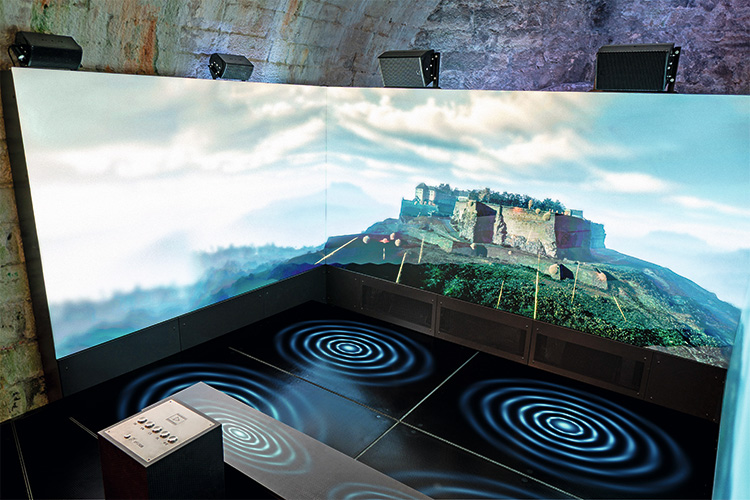
These were an auditorium, an immersive video, a mapping installation and virtual reality projections. The Museum chose a combination of Panasonic's latest-generation PT-MZ16K, PT-RZ790 and PT-RZ990 laser projectors, and ET-EMW300, ET-DLE060, ET-DLE085 and ET-DLE020 lenses.
The Museum, the best of its kind, is located at the geographical epicentre of the D-Day landings on Gold Beach, one of the five main beaches of the events of 6 June 1944. It depicts the invasion and the subsequent construction of one of the two artificial harbours, known as the Mulberry Harbours. “Mulberry B” was built at Arromanches to bring men, equipment and supplies ashore during the summer of 1944, avoiding the need to immediately capture the heavily fortified deep-water ports of Cherbourg and Le Havre. The logistics operation was key to the liberation of Europe and, at its peak, a lorry loaded with supplies left the artificial harbour every 80 seconds on average.
Thanks to Panasonic projection technology, visitors can truly visualise and understand the unprecedented logistics operation that was required, through an immersive and interactive experience that complements the objects on display.
As many of the venues were in small spaces, the museum required short-throw and ultra-wide-angle lenses, a key differentiating factor in choosing Panasonic's AV products. For projection onto the large 28 m² scale model depicting the operations after D-Day, the Museum used the PT-RZ990 with an ET-DLE020 ultra-wide-angle lens, available only from Panasonic.
The immersive capability of Panasonic technology is best illustrated by a projection of the Mulberry B harbour, using transparent projection, positioned in front of windows overlooking the English Channel. This allows visitors to witness the construction of the artificial harbour, just as it was built in less than 10 days in 1944.
The latest-generation dust-resistant optical engine and 20,000 hours of maintenance-free operation offered by Panasonic's PT-MZ16K and PT-RZ series projectors ensure that the exhibits can run continuously without risk of damage. The discreet, quiet operation of Panasonic projectors ensures that visitors are not disturbed, in a setting that calls for respect and tranquillity.
Thanks to the technology brought into the new building, above all through the use of Panasonic projectors, history meets the future. The use of immersive video helps to visualise the story of the D-Day Landings, harnessing the power of the image over words, added Frédéric Sommier, Director of the D-Day Museum.
You may also like

Innovation in projection and LED at ISE 2026

Modern and ergonomic space with Sony screens

Generative AI drives a 38% increase in sales

Seamless collaboration and communication with Panasonic

360-degree environment with Datapath

Panasonic projectors: 4K resolution and high brightness

Integrated Systems Europe supports the Joan Miró Prize 2024
The digital version of the Sistine Chapel comes to life

The digital version of the Sistine Chapel
Digital version of the Sistine Chapel comes to life

Monet’s Garden with Panasonic projectors
Lifesize Plans projects the future with Panasonic
Lifesize Plans projects the future with Panasonic

Immersive audiovisual experience

Panasonic's immersive karting experience

New sound system at Barrosa Palace Hotel

Panasonic immerses audiences in 'The Life of Hokusai'

Panasonic crea una experiencia inmersiva de 'Game of Thrones'

Panasonic 1-Chip DLP™ laser projectors
Panasonic immersive visual exhibition
Panasonic at the Musée du Debarquement

Top 4 things for an immersive experience
New Panasonic Connect website
Make you audience part of the action with Panasonic

Panasonic Visual Webinars

Panasonic launches AW-UE100 camera
TOP 5 Panasonic at ISE
Panasonic Business Mapping at the Palacio de Cibeles in Madrid
Vokkero keeps Ura Bere Bidean's technical crew connected
Biamp Vocia: a paging system running for over ten years

31 Million Pixels Revolutionise Simulation

Genelec provides sound for a mini-golf venue in Germany
A journey through imagery, interaction and architecture

A new look for the Barcelona Metro with Soltec

Invisible Technology, Great Experiences
Fewer loudspeakers, greater clarity in the classroom
Communication in critical situations with UDE

The Value of Sound in Hospitality and Retail
Acoustics designed for sports and events

Platform for remote projector control

Real-time information for British Airways

Crestron turns the classroom into Wall Street
Church finds its voice with OPTIMUS
Integrated audio for fine dining environments
Networked audio for multifunctional spaces

Coordinates police alerts and emergencies
Sony technology to inspire architects
25 Barco projectors bring an AI museum to life

Anolis Illuminates the Natural Water Cycle

Aetria for Antarctic Exploration

Outdoor Displays for All Weather Conditions

Premium audio serving retail and hospitality
Immersive AV engineering to bring history to life

INFiLED LED at the World's Tallest Hotel

From live sound to home with L-Acoustics

Hikvision improves flood response

Premium audio drives retail performance

A digital canvas for the heart of Seattle