Sennheiser TeamConnect Ceiling 2 brings hybrid learning to USF
Written by ISP Integration editorial teamCategory: SUCCESS STORIES
Published:
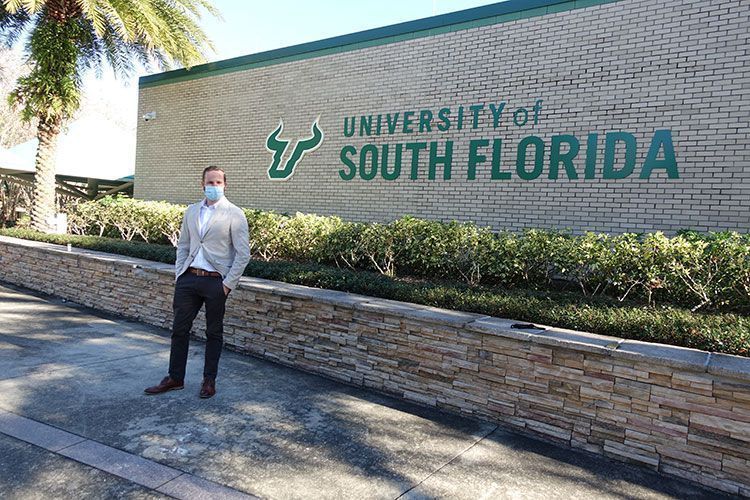
The University of South Florida takes hybrid learning to the next level with Sennheiser TeamConnect Ceiling 2.
The University of South Florida (USF) is a leading public research university in the heart of Tampa Bay. With a student population of almost 50,000 across 14 different colleges, USF prides itself on being at the forefront of medicine, science, engineering, the arts and more. Early last year, the USF IT team tested and subsequently purchased a Sennheiser TeamConnect Ceiling 2 (TCC2) system for one of its main conference rooms, taking another step towards its goal of having a microphone in every classroom.
Once the pandemic hit in March 2020, the USF IT team, and by extension the whole university, faced an urgent need to make its vision of rolling out a hybrid learning scenario across the entire campus a reality. Fortunately, the Sennheiser TCC2 already installed in one of the campus’s high-profile meeting rooms had performed flawlessly, paving the way for the cost-conscious USF to give the green light to a TCC2 installation in 96 classrooms across campus.
When COVID-19 reached the US in mid-March, the USF IT team sprang into action to ensure the continuity of its classroom offering: “The first thing we did was bring our whole team together so we could carry out a complete inventory assessment of the campus,” explains Michael Kraus, Audio Visual Engineering and Systems, USF IT. “We deployed emergency staff across campus with PPE to document everything we had and everything we didn’t have complete information on. Did a particular room have a computer and an instructor source? Or just a wall plate? Did it have HDMI, was it analogue?”
By April, the USF IT team had a full assessment of classroom readiness, as well as a complete dashboard of what a hybrid solution would look like. This gave the university the information it needed to make a decision
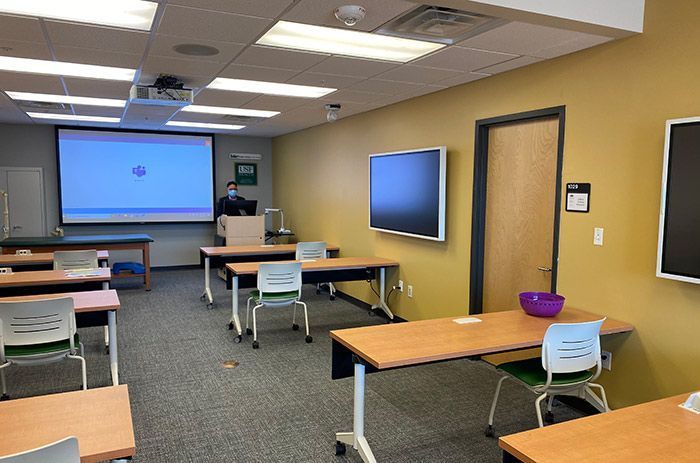
USF’s flexible hybrid technology initiative
“We wanted a technology solution that would allow full student participation both online and in person,”says Kraus. “Noah [Kessler, Technology and Systems Manager, USF] came up with a design for around 700 rooms showing what could be done, how much it would cost and what it would take to achieve this new definition of ‘flexible hybrid technology’.”
“We always wanted to be able to mic an entire classroom, but until then we hadn’t found a solid, cost-effective solution,”explains Kessler. “When I saw the Sennheiser TCC2, we were keen to try it out in a couple of rooms and experiment. Andrew [Kornstein, Applications Engineering and Customer Development, Sennheiser] brought it in and we installed it in one of our conference rooms. During testing, we walked around the room to assess the microphone quality before diving headfirst into this project. We knew we had a cost-effective solution”.
Teaming up with the Sennheiser TCC2
Once the scope of work and design phases were complete, the physical installation took just three weeks. Working with Sennheiser’s full support, USF’s team of IT and AV experts brought in AV integrator AVI-SPL to help with the installation. Jake Gilray of AVI-SPL recalls: “Mike [Kraus] called and said: ‘We have a pretty big project and we’ll need a super-quick turnaround.’ The project involved equipping 96 classrooms in 17 buildings, and we had to have everything finished before classes started in the autumn semester.”
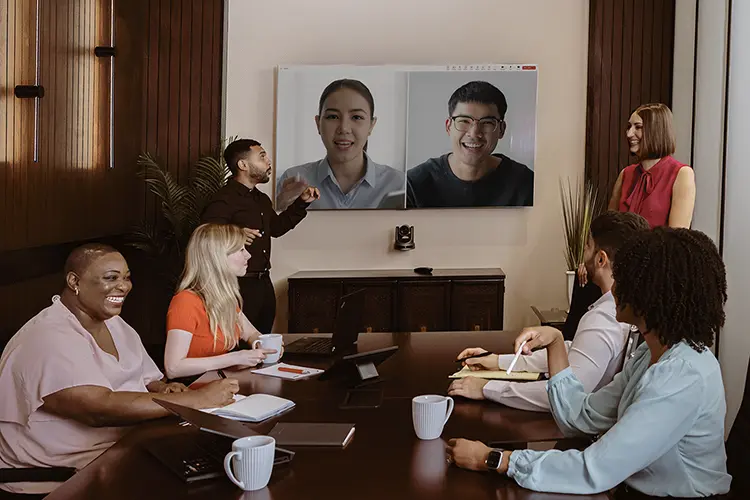
The design commissioned by USF required both in-person and online students to take part in the classroom, using a camera and the TCC2. Gilray brought his team at AVI-SPL together to adapt to the compressed timeframe
“The USF staff are a team,”says Gilray. “They take a collaborative approach to every project and communicate regularly with their partners. After receiving the USF brief, we understood what they wanted and knew we could meet their requirements within the set timeframe.”
“Our team has extensive experience in deploying solutions that require a high degree of technical expertise,” says Gilray. “What makes the TCC2 different is that it is efficient to install. This allowed us to deploy the TCC2 quickly and safely in every classroom and help meet the rapid turnaround of this project.”
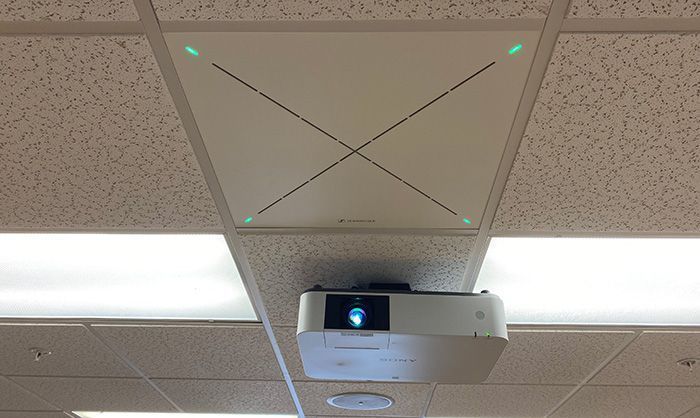
The USF IT team appreciated the TCC2’s ability to handle different audio sources, making it an agile solution that can work well with almost any audio infrastructure. “For the most part, almost all the signal routing was fairly straightforward,” says Kessler. “We usually take the analogue out, connect it to our Crestron processor and then take it out again. If we ever needed more microphones, we could integrate other Crestron USB mixers or, alternatively, send signals straight to the computer using a Dante USB adapter. That’s the beauty of this system, because some competing units only offer Dante connectivity or, in some cases, only an analogue output. Those limitations would have made the project much more difficult.” As well as the TCC2 handling all the audio signals, each room was equipped with an audience camera and a lecturer camera.
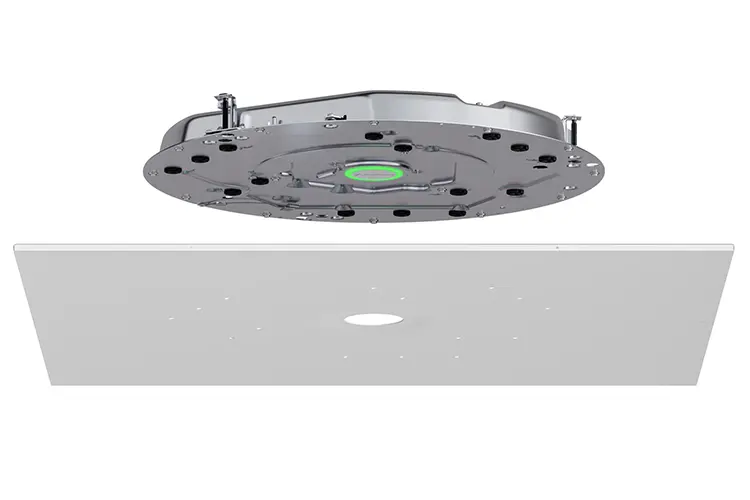
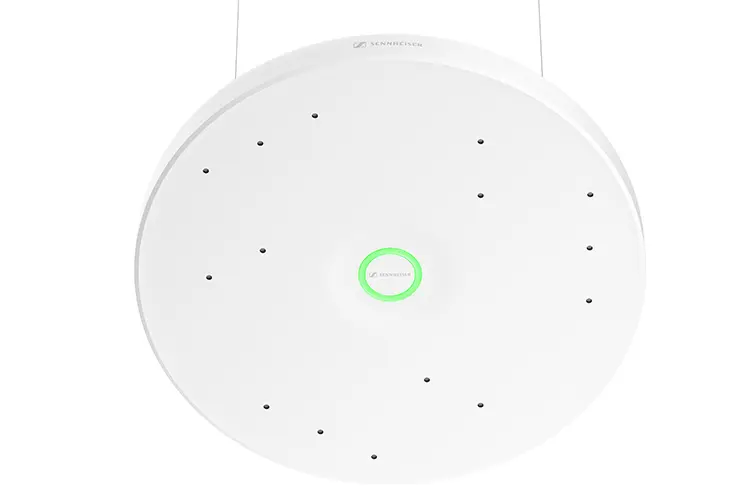
Each of the 96 classrooms in USF’s recent integration was equipped with a Sennheiser TeamConnect Ceiling 2, an audience camera and a lecturer camera
Predictable high-quality performance from Sennheiser
Once all the TCC2 units had been installed and tested, they performed as expected, delivering great audio quality. “In my opinion, Sennheiser means quality when it comes to microphones,”says Kessler. “What really impressed me, though, is how well the product worked straight out of the box. Hang it up and bang, tweak a couple of settings and you’re on to the next room. In terms of performance, the audio is very clear and I really like the fact that you can create exclusion zones in two dimensions in case you have noise from an HVAC system or something similar – that’s very exciting.”
Not surprisingly, the USF IT team collects and shares product feedback with other leading universities across the country: “I’ve heard numerous universities say that after installing the Sennheiser TCC2, it’s nice not to have to worry about microphones,”says Kraus. “A lecturer’s ability to walk into a room without having to put on a microphone and simply focus on what they need to communicate to students is extremely valuable.” Kraus adds that since the hybrid system with TCC2 was installed, classes have been going strong and the team meets routinely to discuss any necessary adjustments and changes.
“This is a living system and we feel we are taking all the right steps, particularly with TCC2”
USF is confident that its TCC2 installation will continue to deliver value to staff and students, not only during the pandemic but long after it: “That was part of the original discussion,” says Kraus, “whether we could use all this equipment after COVID. We know we will be able to use all these systems and it is a good investment for the future.” As an added-value point, many lecturers are using TCC2 to capture high-quality recordings of their lectures, says Dominic Cesario, Senior Audiovisual Project Manager, USF. “Since the pandemic began, we have been encouraging instructors to use the recording capability within our video conferencing software, and the microphones in the TCC2 allow high-quality audio capture.”
Kraus remains enthusiastic about the performance of the Sennheiser microphones and TCC2 systems across campus. “We have already included Sennheiser microphones in all future standard classrooms, regardless of whether or not they have flexible hybrid requirements,”he concludes. “As for TCC2 itself, I gave demonstrations to other universities as recently as last week, and explained to them that this has now become our classroom standard.”
You may also like
Xilica signs distribution agreement with Magnetron in Spain
Sennheiser TeamConnect Ceiling 2 now certified for Zoom

Sennheiser wireless conference system at Sheraton Grand Doha
Sennheiser TeamConnect Ceiling 2: voice lift for hybrid rooms
Collaboration, Wireless Audio and AV Management
More Devices Compatible with DeviceHub
Sennheiser and collaboration at InfoComm 2026
Sennheiser Brings Simplicity to Enterprise Audio
Advanced audio for a new university hyperclassroom
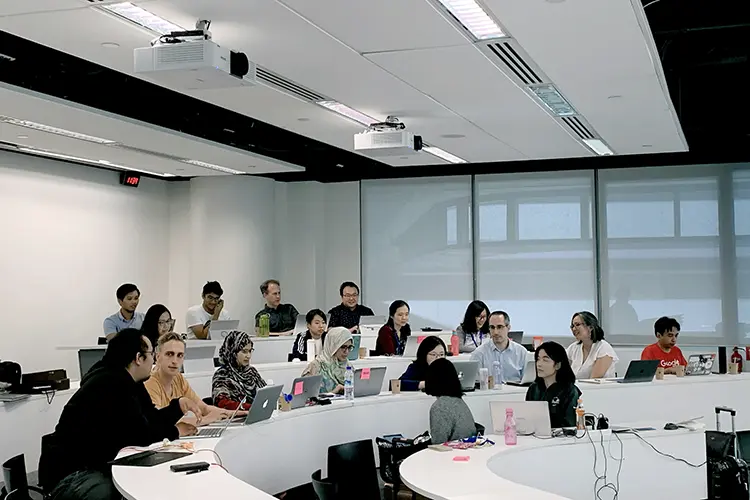
Hyperclassroom in Granada with professional audio
Advanced audio for a new university Hiperaula

Smarter camera tracking for meetings
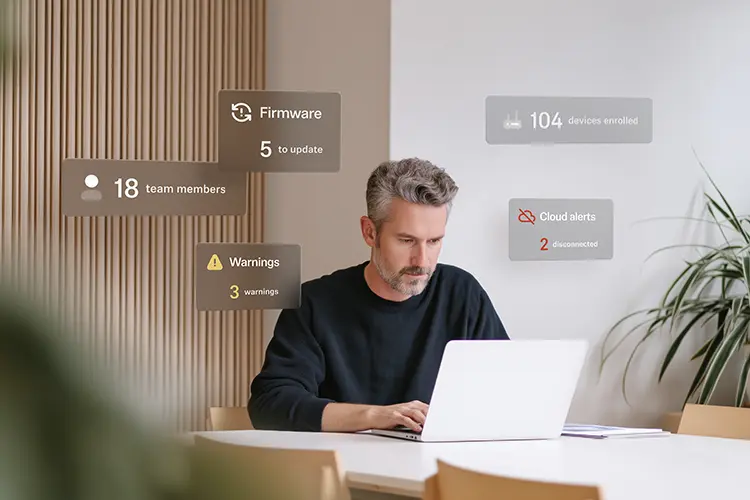
DeviceHub optimizes enterprise AV management
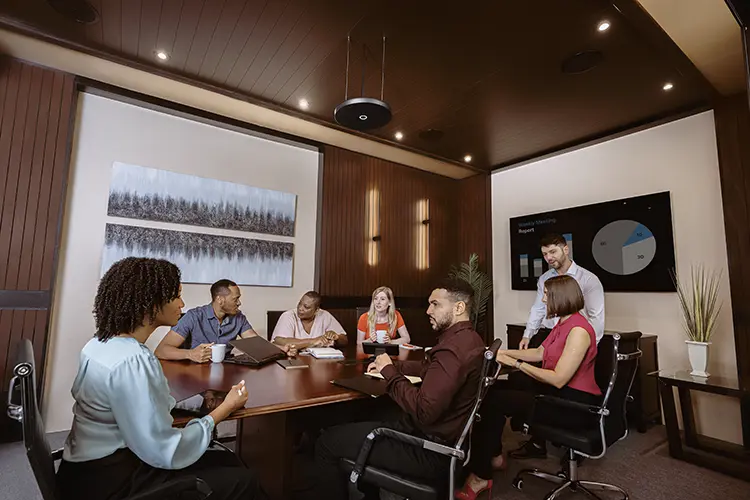
Hybrid environments with smarter audio
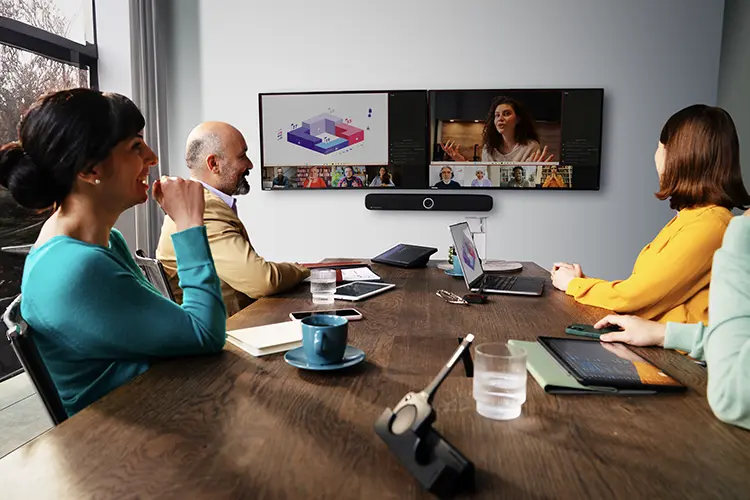
Simpler hybrid collaboration with Microsoft Teams
Technology that drives inclusive audio experiences
Sennheiser takes classroom sound into the future
A more diverse and inclusive AV industry
Hybrid meetings without tech barriers
Quick and easy setups with Sennheiser
Effortless audio for demanding teams
Impeccable audio in busy hospital settings
Reliable hybrid learning with Sennheiser

Conferences with Ecler and Sennheiser
Educational spaces with Sennheiser microphones
Professional communication in meetings
Reliability and performance of Sennheiser

Sennheiser high-fidelity audio system
Secure and elegant proposals for learning
Secure enterprise tools for AI
More intuitive learning experience with Sennheiser
Versatile ceiling solution for any space
Aston University enhances its teaching with Sennheiser and proAV
Aston University enhances teaching with Sennheiser and proAV
Seamless engagement with Sennheiser
Broadband Technology Revolution
Enhanced collaboration with Sennheiser
Better wireless collaboration for meetings
Sennheiser business solutions
Digital wireless technology for collaboration and learning
Sennheiser Scalable 'All-in-One' conference devices
Sennheiser enhances the meeting experience
Superior design and functionality with Sennheiser
Audiovisual Solution at Rey Juan Carlos University
Sennheiser TeamConnect Bar solutions
Xilica and Sennheiser announce the TCCM
Xilica presents: Xilica Follow Me
Magnetron becomes official Xilica distributor in Spain
Xilica and Sennheiser launch hybrid conferencing kits
Blaze Audio PowerZone Amplifiers at ISE 2022 with Magnetron
Sennheiser TeamConnect Ceiling 2 powers UNLV hybrid classrooms
Sennheiser TeamConnect Ceiling 2 at German Center Beijing
Video: Sennheiser TeamConnect Ceiling 2 at German Centre Beijing
Sennheiser TeamConnect Ceiling 2 – German Center, Beijing
Sennheiser MobileConnect at Kiel University (Christian-Albrechts)
Sennheiser Evolution Wireless Digital: interview with David Missall

Sennheiser TeamConnect Ceiling 2 at Universidad Francisco Marroquín
Sennheiser presents TruVoicelift