













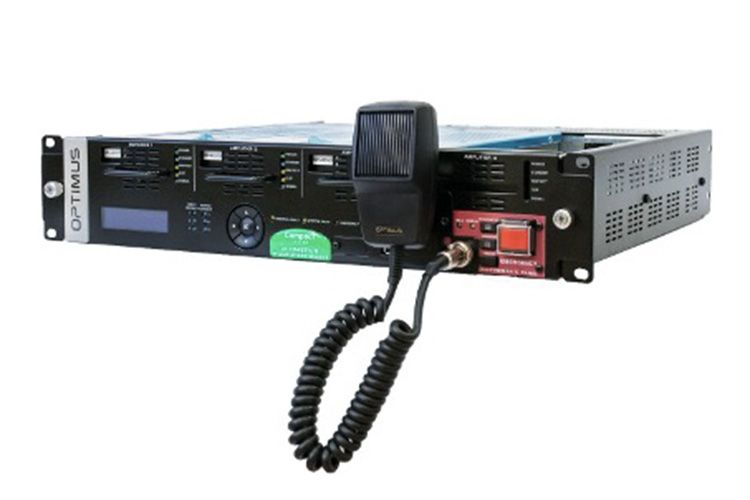
OPTIMUS offers modular, scalable architecture for centralised communications in large-scale complexes.
Some projects cannot be solved with a single device. University campuses with multiple buildings, hospital complexes spread across several facilities, tourist resorts with dozens of areas... These are environments where voice communication must be omnipresent, reliable, and centrally managed, yet adapted to the specific needs of each zone.
For these scenarios, OPTIMUS has developed the IFP solution: a modular system of IP audio interfaces with integrated power, designed to grow without limits and adapt to the specific needs of each installation.
An architecture designed to meet the scalability challenges posed by these projects, offering a robust alternative where conventional solutions—and in many cases even the most advanced ones—may encounter limitations.
Modularity that adapts to the project
The heart of the system is the IF-7P4ETH/0, an IP audio interface featuring four slots for insertable power modules from the WD1/WDC series. These modules are available in a wide range of power ratings (from 60 to 460 W RMS), allowing each interface to be configured according to the exact requirements of each zone—from areas requiring low power to open spaces with high acoustic demand.
Each IF-7P4ETH/0 receives up to four simultaneous IP audio channels through its Ethernet link (dual connection for redundant networks) and can incorporate up to four configurable audio inputs, and integrates DSP and advanced monitoring functions. Each output zone includes connections for A/B loudspeaker lines and an input for a backup amplifier, ensuring continuity even in the event of failure.
But the true strength of the system lies in its expansion capability: each IF-7P4ETH/0 can be expanded with up to 10 slave units IF-7P4/0E, each providing four additional slots for power modules. This means that a single main interface can manage up to 44 power modules, offering unprecedented scalability in the market.
And the architecture doesn’t stop there. As a networked element, each IF-7P4ETH/0 can be linked via Ethernet with up to 19 additional devices (whether digital audio matrices, microphone control consoles, or audio interfaces with or without power), forming distributed systems capable of covering the most extensive and complex installations. An architecture that stands out for its growth flexibility, while maintaining centralised management and system integrity—an uncommon combination in the sector.
Real solutions for demanding environments
Imagine a university complex with multiple faculties, residences, libraries, and sports areas spread across a campus of several hectares. Each building has different needs: classrooms require moderate coverage, common areas need higher power, and residences require specific zoning to avoid interference. With the IFP solution, each building can have its own IF-7P4ETH/0 equipped according to its needs, while centralised management from the control room allows general messages to be broadcast across the campus or segmented by zones.
Or consider a high-level hospital complex with multiple specialised wings: emergency, operating theatres, inpatient areas, administrative buildings, and research facilities. Voice communication must be clear and specific: general announcements in public areas, localised messages in clinical zones, and emergency alerts differentiated according to the type of incident. The modular IFP architecture allows each building to be configured with the necessary power and number of zones, maintaining full interoperability and unified management from a single point.
In a tourist resort with a main hotel, independent villas, restaurants, spa, sports facilities, and beach areas, communication needs are constant yet diverse: background music in leisure spaces, operational announcements in service areas, safety messages in high-risk zones. The IFP solution allows interfaces to be deployed in each area, configured with the appropriate power modules, and managed from a centralised platform that facilitates both daily operation and emergency response.
Technology built to last
Beyond scalability, the IFP system is designed with the highest technical standards. Dual redundant Ethernet connection ensures continuity in case of network failures. The SIP protocol (RFC3261) with G.711, G.722 and L16 encoding ensures compatibility with existing VoIP infrastructures. Configurable contact inputs and outputs allow integration with centralised management systems, BMS, fire prevention systems, or SCADA platforms.
And continuous monitoring of loudspeaker lines, power modules, and audio signals ensures any anomaly is detected immediately, enabling preventive action before service is affected.
A real competitive advantage
When integrators take on large-scale projects, they quickly discover the limitations of conventional solutions. Systems that require multiplying devices without real coordination, closed architectures that do not scale beyond a certain point, or platforms that lose management capacity as they grow.
The OPTIMUS IFP solution breaks these limitations. It is not just modularity: it is intelligent scalability, where each component maintains its individual functionality while integrating seamlessly into the whole. It is unified management in installations that other manufacturers can only address with fragmented systems.
Natural evolution, open architecture
At OPTIMUS, they design systems that do not restrict project growth. The IFP solution is part of their family of large PA and voice alarm systems, COMPACT and OPTIMAX, the result of years of experience in large installations, where flexibility, reliability, and ease of management are as important as technical performance.
Because large projects do not need large complications. They need intelligent architectures that grow with them, adapt to their particularities, and offer total control without sacrificing operational simplicity.
And that is exactly what the IFP solution does: scale without limits, adapt without compromises, and operate without failures.