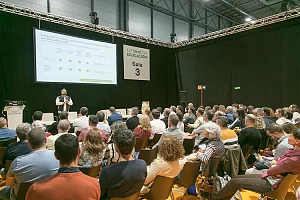












Clevertouch and AVIXA organized a panel on educational technology at Clevertouch’s London showroom.
The debate, Technology Meets Pedagogy in Higher Education, brought together audiovisual technology and learning managers from leading universities to explore how technology and pedagogy can work in harmony.
Simplicity first
A recurring theme during the conversation was simplicity. University staff do not want to deal with complex systems in front of a classroom. As one panelist said: "The simpler, the better. Nobody wants to look bad in front of 150 students".
Standardization in lecture halls and classrooms was considered essential: students and staff need to know what to expect when entering a space. However, there must also be flexibility to adapt to different teaching styles and specialized disciplines.
Technology as an enabler
Instead of being applied for its own sake, technology should support pedagogy. When new tools are introduced, they often redefine teaching approaches, from abandoning ceiling projectors to interactive touchscreens, digital whiteboards, and QR codes. Leading educators play a key role in helping colleagues adopt new solutions, showing how they enhance teaching rather than complicate it.
Hybrid learning: a lasting legacy of the pandemic
The pandemic forced universities to adapt quickly, introducing hybrid systems almost overnight. While many of these systems were initially improvised, they have now become valuable resources. Hybrid tools are used not only for remote students but also for guest lecturers and industry professionals who can access classrooms without costly travel.
Still, hybrid technology presents challenges: managing in-person and remote participants simultaneously often requires technical support. Institutions are revisiting early hybrid classrooms to simplify them and improve reliability.
Accessibility and inclusion
Accessibility is no longer an afterthought. From height-adjustable lecterns to hearing assistance systems and spaces adapted for neurodiversity, universities are rethinking how classrooms serve all students. Some institutions emphasized collaboration with disability support departments to create tailored solutions, while others admitted that accessibility had been siloed and underestimated until recently.
Student expectations have changed
Today’s students arrive at university having used touchscreens and collaborative platforms throughout their education. They have high expectations. As one panelist noted: "There has been a shift in students’ questions: from 'Can I do this?' to 'Why can’t I?'"
Students also demand spaces that foster small-group collaboration and hybrid meetings, reflecting how learning and professional life are increasingly overlapping.
The AI question
Looking ahead, artificial intelligence dominated the final conversation. The consensus was that AI will not replace educators but will become an everyday tool that shapes assessment, course design, and even AV room planning. As one participant summarized: "It’s not AI that will take your job, but the person who learns to use it better".
A future of partnership
The debate made it clear that the future of higher education does not lie in choosing between pedagogy and technology, but in uniting them. Technology should empower teachers and students, not overwhelm them. Success depends on dialogue: between technologists and academics, between institutions and students, and between universities and the tech industry itself.
As universities navigate this accelerated era of change, one principle remains constant: keep it simple, keep it inclusive, and keep pedagogy at the center.