













Pantheon Lab is driving a new generation of digital signage powered by conversational AI and digital humans.
The rise of artificial intelligence is accelerating the transformation of digital signage towards increasingly interactive and service-oriented models. In this interview, Ivan Lau, CEO of Pantheon Lab, explains how technologies such as conversational AI, digital humans and intelligent automation are redefining the relationship between brands and users, while also analysing the key challenges and opportunities facing the industry.
The industry is talking about AI, retail media and personalization. Which technologies do you believe will generate sustainable business opportunities in digital signage over the next three years, and which do you still consider overrated?
The technologies we believe will see sustained growth over the next three years are conversational AI, which transforms one-way screens into two-way interactions; generative AI content pipelines, which finally reduce recurring creative production costs; audience-based personalization through privacy-respecting on-device sensing systems; and the less visible but essential work related to edge computing and content delivery infrastructure. These are the technological layers that change the economics of operations, not just demonstrations.
Building on this foundation, the next major shift will be agentic AI: systems that do not simply converse, but complete tasks directly from the screen, manage orders, process purchases, answer frequently asked questions and escalate to a human agent only when necessary. Multilingual, available 24/7 and consistent at scale. This is the moment when digital signage stops being a communication channel and becomes a service channel.
On the other hand, we consider the current wave of generative image-refresh tools overrated, as they provide novelty without measurable improvements, as well as large-scale AR/VR signage deployments at venue level, where content production economics are still not viable. The real test for any technology is simple: it must reduce costs, improve outcomes or enable new behaviours within twelve months of deployment.
The digital signage market is entering a phase of consolidation and growing competitive pressure. How is your company's strategy evolving to differentiate beyond hardware or CMS platforms?
We do not compete with display manufacturers or CMS platforms; we position ourselves above them as the interaction and intelligence layer. Our differentiation lies in controlling the entire technology stack: the face (synthesis, animation, expressions, lip-sync and body gestures), the brain (an agentic AI core with RAG, content filtering, domain-specific LLMs and enterprise security safeguards), and the analytics layer that closes the loop. Nothing is assembled from third-party components, which is important when the digital human is the first point of contact a passenger, customer or visitor has with a brand.
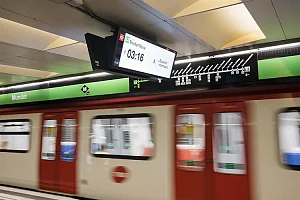
Strategically, this enables three moves that hardware- or CMS-centric competitors struggle to replicate. First, deep integration with the screens and media players customers already own, delivered through APIaaS, SaaS or SDK models depending on their technology architecture. Second, vertical methodologies based on real-world deployments in public transport, public services, retail, cultural institutions and hospitality, rather than generic templates. Third, outcome-driven commercial discussions: in our transport deployments, for example, we have achieved double-digit reductions in passenger complaints and significant decreases in customer service costs. In a consolidating market, the platforms that survive will be those capable of demonstrating this type of impact, not simply offering a long list of features.
The industry increasingly demands integration between AV, IT, data and analytics. Is the integration channel prepared for this new environment, or does a significant technology gap still exist?
Honestly, only partially. The traditional AV integration channel is excellent at what it has always done: physical infrastructure, signal distribution, large-scale deployments and operational discipline. However, the gap appears in the new capabilities demanded by today's market: data engineering, identity and consent management, AI and machine learning operations, API integration with retail and CRM platforms, and measurement frameworks capable of meeting the standards expected by a CMO.
We see two positive responses emerging within the channel. The first is integrators investing in their own software and data capabilities, either through acquisitions or by creating dedicated specialist teams. The second is the establishment of structured partnerships between integrators and software-native vendors—including ourselves—where each party focuses on its area of expertise and a joint delivery model is defined from the outset.
What does not work is adding AI capabilities to a hardware proposal purely as a marketing message. End customers quickly recognise the lack of depth, and projects become stuck in pilot phases. The reality is that the channel is in transition, and those integrators who close this gap over the next 24 months will capture a disproportionate share of the next growth cycle.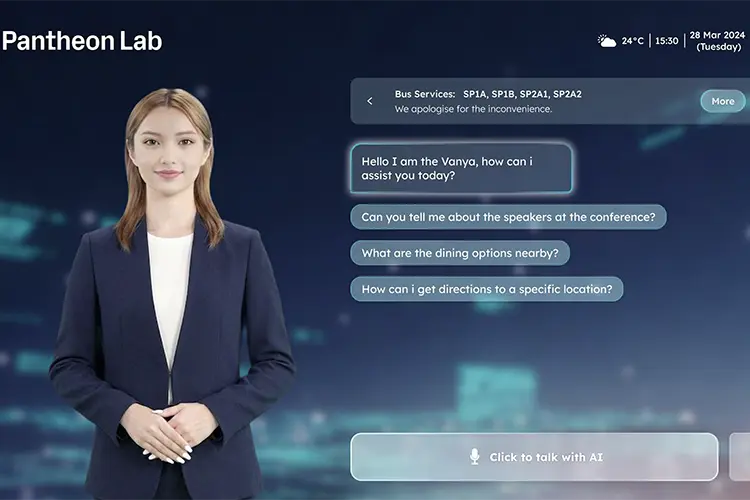
Sustainability is no longer limited to energy consumption. How does it influence your decisions regarding product design, manufacturing, maintenance and installation lifecycle management?
We believe the conversation has rightly evolved beyond kilowatt-hours towards total lifecycle impact, and as a software-first company, this is precisely where we have the greatest ability to make a difference.
The first principle is that our software is designed to run on hardware customers already own. Extending the useful life of installed displays, kiosks and media players, rather than encouraging replacement cycles, is probably the most significant sustainability contribution this industry can make, and it is a deliberate part of our APIaaS and SDK delivery model.
Secondly, a digital human can manage millions of interactions without losing quality, which means fewer screens, fewer staff journeys and fewer on-site maintenance interventions. In high-traffic deployments, we have replaced manual service points with a single always-on assistant per location, significantly reducing the physical infrastructure required.
Finally, we make deliberate decisions about when to use edge computing and when to rely on the cloud. Real-time avatar inference consumes significant energy resources, so we optimise model sizes, share computing capacity across multiple screens within the same venue, and use remote diagnostics and updates to extend installation lifecycles. We are also transparent with procurement teams regarding the energy footprint of the AI features they purchase.
Users increasingly demand immersive and dynamic experiences while also expecting operational simplicity. How do you balance creativity, automation and ease of management in today's digital signage projects?
We believe the mistake is to treat these three elements as a single control. They are not. The right solution is a layered architecture.
For operators, the experience must be simple: scheduled workflows, templates, a limited number of meaningful controls and intelligent default settings. Running a signage network on a daily basis should not require constant creative decisions.
For creative teams, the upper layer should provide generative tools, real-time content adaptation and the freedom to design context-aware experiences—based on time of day, audience, weather, inventory or store traffic—without writing code.
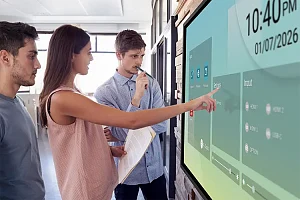
For end users, the experience should feel alive: a screen that recognises their presence, responds in their language, resolves their questions and, when necessary, seamlessly hands them over to a human. This is precisely where digital humans deliver value, removing the distance between one-way communication and conversation without placing additional demands on operators or creative teams. Automation handles repetitive tasks, creativity focuses on the moments that matter, and management remains simple and accessible.
Retail media and DOOH are rapidly converging with traditional digital signage. What real opportunities arise from this convergence, and what role will manufacturers and technology platforms play?
The main opportunity is that digital signage is beginning to be measured using the same criteria digital advertising has employed for more than a decade: impressions, attention, conversion and attribution. Once these metrics exist at screen level, three things happen: programmatic and audience-based buying enters the physical environment, retailers monetise their store networks as media assets, and brands stop treating in-store and out-of-home campaigns as separate budget lines from their digital spend.
For us, the interesting part happens after the impression. With a digital human involved, the screen does not simply count views: it engages in conversations, recommends products, processes orders and drives upselling opportunities. In quick-service retail, this translates into higher average transaction values and lower operational costs; in transport and public services, it results in faster resolutions and less staff time dedicated to repetitive enquiries. Every interaction generates data that feeds back into the analytics layer and improves the next interaction.
The division of roles across the industry is clear: display and media player manufacturers become the trusted and measurable supply side; CMS and ad-tech platforms become the marketplace; and companies like ours transform each impression into a measurable outcome. The winners will be those that treat data interoperability as a core product capability rather than an integration project.
If you had to define what a truly competitive digital signage platform will look like in 2030, which capabilities do you believe are already essential today?
By 2030, the winning platforms will look less like content management systems and more like real-time experience orchestrators: capable of sensing audiences, generating content, holding conversations, completing tasks, attributing outcomes and operating across heterogeneous hardware ecosystems accumulated over many years.
At Pantheon Lab, we are explicitly building towards that vision: face, intelligence and analytics integrated into a single stack, deployable as APIaaS, SaaS or SDK according to customer integration requirements.
The capabilities that are already essential today—and which we would encourage any buyer attending DSS Europe to ask about—include:
- AI-native content workflows, not AI features bolted onto legacy CMS platforms.
- Conversational interaction as a core capability, not a pilot project.
- Built-in multilingual support.
- An agentic core capable of completing real-world tasks.
- Privacy-respecting audience sensing systems designed around consent.
- Enterprise-grade security; certifications such as ISO 27001 are baseline requirements, not differentiators.
- Measurement and attribution systems accepted by marketing leaders.
- Hybrid edge-cloud architectures that optimise latency and costs.
- Sustainability metrics embedded directly within the product.