











Huddly outlines a new vision for meeting rooms in the era of agentic AI.
The company believes the next generation of collaboration spaces will need to understand the context, interactions and dynamics of meetings in order to support AI agents more effectively.
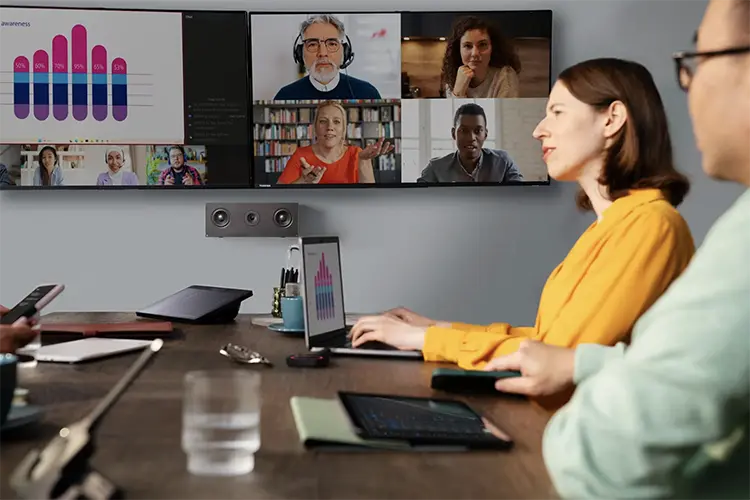
The evolution of agentic AI is changing the way meetings and collaboration spaces are conceived. According to Huddly, meeting rooms will no longer serve solely as spaces for human communication, but will evolve into environments capable of providing structured context and information to AI agents.
According to the company, organizational knowledge remains scattered across emails, messaging applications, documents, management platforms and even informal conversations. This fragmentation has led to the proliferation of meetings whose primary purpose is to share information and update the status of projects or processes.
Huddly's approach is to replace this manual exchange of information with shared knowledge models that are continuously updated by software agents capable of interpreting an organization's context and actively participating in business workflows.
Beyond video and audio
For these agents to participate effectively in meetings, Huddly argues that high-quality video, audio and meeting transcripts alone are not enough.
The company identifies three essential elements that enable an AI system to understand what is happening inside a meeting room:
- The geometry of the space, including the room layout, participant positions and orientation.
- The people present, identifying who is participating and where their attention is directed.
- The interactions, determining who is speaking to whom, who is leading the discussion and how conversational turns develop.
According to Huddly, this information provides the foundation that allows an AI agent to understand the context of a meeting and act accordingly.
Edge processing
Huddly explains that achieving this level of understanding requires processing to take place directly on the devices installed in the meeting room, avoiding the continuous transmission of large volumes of video to cloud-based artificial intelligence platforms.
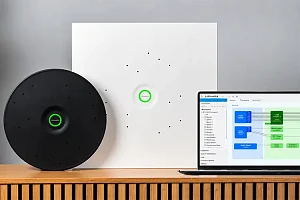
To achieve this, solutions such as the C1 AI-driven Video Bar, C1 Crew and the Crew multi-camera system run AI models directly on the device (edge AI), combining information from multiple cameras and sensors before generating a structured representation of the meeting.
Beyond improving meetings, the same technology can also be used to analyse workspace occupancy and usage, providing valuable data for building and facilities management.
Integration with Microsoft Teams
One of the key developments highlighted by Huddly is the introduction of a dedicated AI data channel within Microsoft Teams.
Through this integration, devices such as Huddly C1 can share structured room intelligence with the platform, going beyond the traditional transmission of audio and video.
One of the first applications is the enhancement of the IntelliFrame feature, enabling automatic participant identification and the accurate attribution of comments, decisions and meeting notes.
According to the company, this type of structured information will allow future AI agents to better understand the social context of conversations and collaborate more naturally with human teams.
Collaboration with Barco
Huddly's proposed infrastructure is complemented by the integration of its devices with Barco's ClickShare Hub and ClickShare Hub Pro solutions, which manage the user experience within the meeting room.
The objective is for a single structured representation of the room to support not only meetings but also other applications related to workspace management, occupancy analytics and future AI-based services.
Towards a new generation of meetings
In this scenario, Huddly believes that many meetings held solely to exchange information could disappear thanks to shared knowledge models that are automatically updated.
The meetings that remain will focus primarily on decision-making, problem-solving and collaboration, while activities such as building trust, negotiation and conflict resolution will become even more important.
According to the company, this transformation also requires a new way of thinking about meeting room technology, which will evolve from simply capturing audio and video into an infrastructure capable of generating context and understanding—two elements it considers essential for the next generation of AI agents.