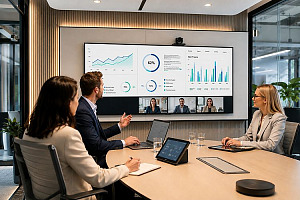













AV technology is redefining the classroom and shaping the key drivers of educational transformation in 2026.
The classroom of 2026 looks nothing like it did five years ago. As educational institutions move beyond pandemic-era stopgap solutions, they are investing in audiovisual systems that not only enable remote learning but fundamentally improve the teaching and learning experience.
Here are seven trends driving that change:
AV over IP is now the standard
In new builds and major refurbishments, AV over IP (AVoIP) has replaced traditional matrix switching as the primary topology in education. Its appeal is practical: institutions can scale incrementally by adding network endpoints rather than replacing entire hardware chassis. It also simplifies management, allowing IT teams to focus on other priorities while centralising control across multiple rooms or campuses.
AI-powered camera tracking reduces the burden on lecturers
AI-based camera tracking is rapidly becoming a standard in hybrid learning environments. Using computer vision, these systems automatically follow the instructor’s movements and switch between wide shots and close-ups of whiteboards or demonstrations, without any manual intervention. The goal is clear: to provide remote students with an experience as close as possible to in-person learning, without turning educators into AV technicians.
Interactive displays are getting smarter
Interactive whiteboards and touchscreens have been around for years, but the latest generation represents a significant leap forward. AI-powered displays can now transform hand-drawn sketches into polished diagrams in real time, with near-zero latency writing that synchronises instantly across devices. In collaborative environments — whether in-person or hybrid — these tools make participation more dynamic and accessible.
Immersive technology enters the curriculum
Augmented reality (AR) and virtual reality (VR) are moving beyond novelty status in education. Students can explore historical sites through immersive virtual field trips or interact with 3D models in science classes. As these technologies become more affordable and easier to integrate into existing AV ecosystems, adoption is expected to accelerate, particularly in STEM and vocational training.
Intelligent audio improves clarity in the classroom
Open learning spaces and large lecture halls have long posed acoustic challenges. Beamforming microphone arrays combined with AI-driven noise cancellation can isolate speakers while suppressing background noise. More advanced systems go further, using neural networks to reconstruct speech in real time, preserving vocal clarity rather than simply eliminating distractions.
Cloud-based AV management scales across campuses
Cloud-based AV platforms allow institutions to manage, store, and stream content remotely from a centralised dashboard. For multi-campus organisations, this eliminates the need for duplicated on-premise infrastructure, reduces hardware costs, and makes it easier to maintain consistency across different learning environments.
Cybersecurity becomes non-negotiable
As AV systems connect to institutional networks, they become potential entry points for cyber threats. Across the AV industry, enhanced security is a top priority, from encrypted audio and video streams to multi-factor authentication for equipment access. One emerging trend is the use of Neural Processing Units (NPUs) to process sensitive data locally on devices rather than routing it through the cloud. For educational institutions handling student data and intellectual property, these measures are becoming essential rather than optional.
These trends — and the technologies behind them — will be showcased at Integrate 2026, taking place from 2–4 September at ICC Sydney.