












General Motors is a global automotive manufacturer known for brands such as Chevrolet, Buick, GMC and Cadillac.
In a context of rapid industry transformation, the company is addressing these changes by adapting its processes and technologies to new mobility demands. The company also has a long track record in the use of driving simulators to study human factors in driving.
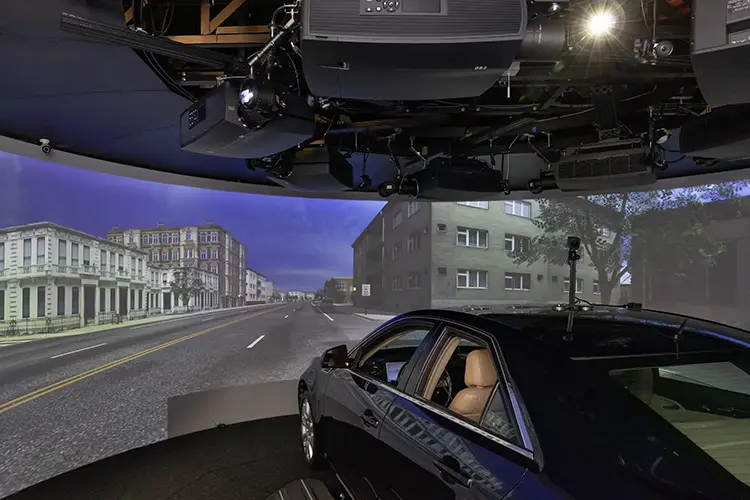
Recently, GM upgraded one of its key simulators, improving the motion system and steering feedback through new electronics, and renewing the visual system with Barco F80 projectors.
General Motors is an American multinational automotive corporation headquartered in Detroit, Michigan. Building on more than a century of automotive experience, GM leverages software, hardware, artificial intelligence and sensors to develop safer, smarter and more sustainable vehicles. The company is developing advanced driver assistance and autonomous vehicle technologies with the goal of eliminating human driving error, saving lives and improving mobility for everyone. GM offers both a broad portfolio of electric vehicles built on its proprietary battery platform and a diverse range of gasoline and diesel cars, trucks and SUVs.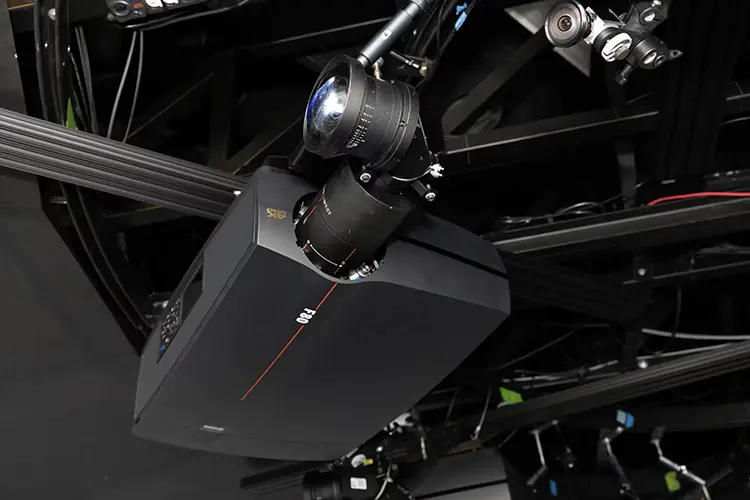 The company also has a long tradition of driving simulators dating back to the 1960s. These simulators have been primarily used to study human factors in driving, with a particular focus on the human–machine interface. The GM Research Driving Simulator (RDS), the fifth-generation human factors driving simulator, has been instrumental in testing Super Cruise and other projects. Built in 2009 and upgraded in 2012 to include a motion system, the simulator has undergone continuous enhancements over time.
For the most recent refurbishment, the GM team worked together with Electric Picture Display Systems, a Florida-based company specialising in advanced display and projection systems, serving sectors such as aerospace, military, education and commercial markets.
Solution
Electric Picture Display Systems selected Barco F80 laser projectors for Barco’s proven track record in delivering reliable, high-performance solutions. Known for their durability and consistent image quality, the Barco projectors provided the confidence required for a mission-critical installation, ensuring long-term stability, minimal maintenance and exceptional visual performance in GM’s advanced driving simulator.
The Barco F80-4K12 projectors deliver brighter images, a wider colour gamut and higher resolution, enhancing the realism and immersion of the driving simulation. This visual clarity is crucial for accurately studying driver behaviour and vehicle systems.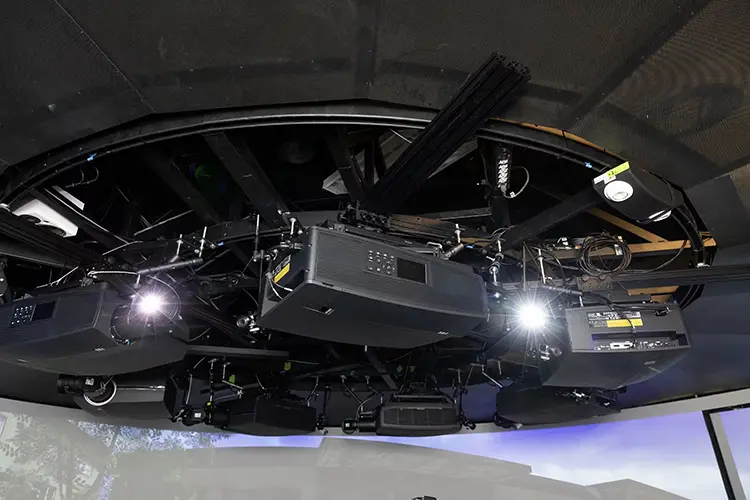
The new Barco projectors are much brighter, have a superior colour space and provide a wider field of view. The projectors have transformed our driving simulator, delivering an excellent immersive experience that enhances our research and development capabilities, says Richard Romano, Senior Researcher in GM R&D.
The Barco projectors create a 360-degree horizontal display, and the motion base rotates up to 360° inside the simulator, delivering an exceptional simulated driving experience. In addition, thanks to their short-throw lenses and compact design, the F80 projectors allow the integration of larger vehicle cabins into the simulator. This expands the range of testing scenarios and ensures the system can evolve to meet future needs.
The projectors, combined with advanced calibration software from Scalable Displays, simplify setup and maintenance. This ease of control and calibration reduces downtime and streamlines simulator operations, allowing teams to focus on research and development.
Results
The upgraded GM RDS simulator now delivers a truly immersive and realistic driving experience, setting a new benchmark in simulation technology.
The integration of Barco’s F80 laser projectors has enhanced visual fidelity, with brighter images, richer colours and sharper resolution that bring every detail of the virtual environment to life. This increased realism enables engineers and researchers to conduct more accurate and detailed studies of driver behaviour and vehicle systems. Thanks to this refurbishment, GM’s simulator is now more versatile for future research and development initiatives.