












In the heart of Milan’s Quadrilatero della Moda, the OPTIMUS COMPACT system manages four floors.
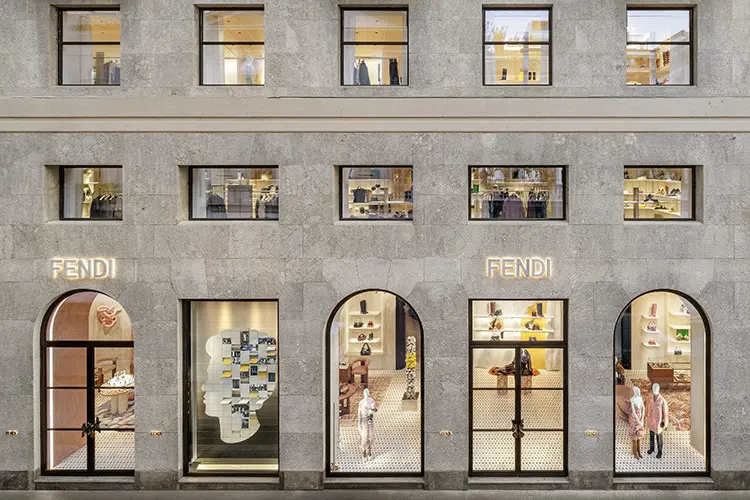
There are spaces that allow no compromises. The new Palazzo Fendi in Milan is one of them: a rationalist building by Emilio Lancia constructed between 1933 and 1936, restored to become more than just a boutique. A project where architecture, fashion, art and craftsmanship coexist across four carefully articulated levels.
In spaces like these, the audio system must integrate with the same logic that defines the project: discreet presence, precise function. The rule is to respect the acoustics of each room, adapt to diverse uses and offer control that is as effective as it is invisible.
Four levels, four identities
The Palazzo is laid out over four floors: the ground level featuring travertine and calce, a first floor with walnut wood finishes, a second level dedicated to women’s fashion and high jewellery with private rooms, and a third floor housing the Atelier and the Appartamento inspired by the Pantheon, featuring works by Arnaldo Pomodoro and Agostino Bonalumi.
Each environment serves a specific function: retail spaces, exhibition areas, private rooms, a craft workshop and a private space. Each function requires differentiated acoustic treatment, precise zone management and operational flexibility that does not compromise the visitor experience.
For this project, OPTIMUS has collaborated with its exclusive representative in Italy, TEA Elettroniche, developing a system based on the modular COMPACT matrix, designed to adapt to the building’s architectural complexity while maintaining simple operation.
Purpose-driven technical architecture
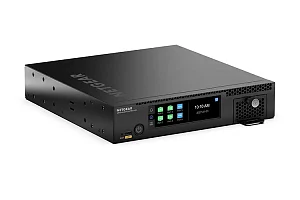
The system, certified to EN54 standards, is built around a COMPACT matrix with a COMPACT-E expansion unit, configured with UMX-EA3 cards for priority audio inputs and UMX-2SA cards for supervised outputs. This modular architecture allows independent management of each area of the palazzo: background music during business hours, audio for private events and operational communications for staff.
Power is distributed via DA-500D4 and DA-500D2 Class D digital amplifiers, delivering the required output without occupying excessive space. The system is controlled from a DC-700ETH desktop unit with Ethernet connectivity, enabling message management, zone selection and real-time system monitoring.
An MXD-88 matrix with integrated DSP complements the system with advanced processing: zone-specific equalisation according to acoustic characteristics, feedback control and automatic level adjustments. Tools that allow the audio to adapt to spaces as diverse as a high-ceiling exhibition hall or an atelier where textiles alter the acoustics.
Distribution is handled using A-225DEN 6W RMS in-ceiling loudspeakers certified to EN54-24, selected for their ability to integrate visually while maintaining uniform coverage.
Precise and discreet technology
At Palazzo Fendi Milano, the audio system is present without being seen. Background music accompanies without intruding, operational messages reach staff without disturbing visitors, and each space maintains its own acoustic identity.
The project reflects a vision of luxury as a holistic experience, where design and technology coexist seamlessly. And for that coexistence to work, the technical system must share the same philosophy: precision in function, discretion in form.