











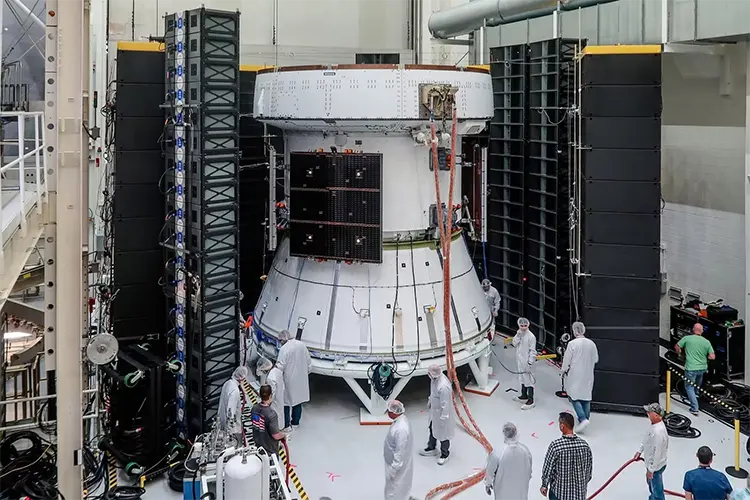
NETGEAR® AV switches enable mission-critical aerospace testing operations.
At MSI-DFAT Services (Maryland Sound International Direct Field Acoustic Services), NETGEAR AV switches provide a robust network foundation for acoustic qualification testing of satellites and aerospace components.
This mission-critical application demands flawless performance to ensure that satellites valued at several million dollars can withstand the extreme acoustic environment of rocket launches.
MSI specializes in acoustic qualification testing, also known as Direct Field Acoustic Testing (DFAT), for the aerospace industry, offering an alternative to traditional fixed acoustic chambers. Instead of requiring satellite manufacturers to transport their costly payloads (often valued at $500 million or more) to remote testing facilities, MSI brings its mobile sound systems directly to manufacturing sites.
The company’s innovative approach uses professional audio equipment, purpose-built for this application, configured in a circular array ranging from 3 to 15 meters in height, surrounding the satellite with MSI-designed loudspeakers to recreate the intense acoustic environment of a space launch. These tests are critical, as satellites must prove they can withstand sound pressure levels of 130 to 150 decibels—levels that can cause eardrum perforation and irreversible hearing loss in humans—before being approved for space missions.
We typically operate between 80 and 300 amplifiers in a single system. Each one requires both audio signal and control data, and everything has to work flawlessly because there is no room for error when testing a half-billion-dollar satellite, emphasized Arthur Isaacs, MSI’s lead audio engineer.
Challenge
MSI’s transition from analog to digital systems created complex networking requirements that traditional solutions could not adequately address. The company needed to manage a large number of networked devices while maintaining the reliability demanded by aerospace applications.
The technical challenges were substantial: supporting 80–300 networked amplifiers per installation, distributing high-quality digital audio across large speaker arrays, managing control data for precise acoustic calibration, integrating multiple device types—including serial-controlled equipment—ensuring zero-tolerance reliability for mission-critical testing, and enabling remote monitoring from safe distances during extreme-volume tests.
The networking infrastructure had to seamlessly handle these data types while also allowing rapid reconfiguration, a necessity in modern aerospace testing. Traditional networking approaches required extensive manual cable management and offered limited flexibility for system modifications.
Solution
MSI selected NETGEAR M4250 series switches as the backbone of its mobile acoustic testing systems, choosing the platform for its AV-optimized features and robust technical support. The solution is built on NETGEAR AV Line switches with pre-configured audio networking profiles that simplify deployment and configuration.
The network architecture features a distributed design with multiple M4250 switches (48-port and 12-port models) connected via fiber optic links to a central control room. In MSI’s largest installation, 16 NETGEAR switches manage the entire system infrastructure. Each switch handles approximately 24 amplifiers, along with additional monitoring and control devices, creating a scalable architecture capable of adapting to different testing requirements.
The system leverages NETGEAR’s AV-specific features, including pre-built profiles for audio applications, simplified VLAN configuration to separate audio, control, and communications traffic, auto-trunking capabilities for seamless multi-switch coordination, and integrated support for both networked devices and legacy serial-controlled equipment through strategic computer placement.
A critical component of the solution is NETGEAR’s comprehensive technical support, which provides ongoing guidance for complex configurations. This support proved essential as MSI developed and refined its networking approach across multiple installations.
The deployment also utilizes NETGEAR Engage management software, providing centralized control and monitoring of all switches from a single interface. This eliminates the need to manage individual device browsers and delivers full visibility of the network topology, which is crucial for troubleshooting in critical environments.
Results
The NETGEAR-based solution has transformed MSI’s operational capability, supporting three active mobile systems with proven reliability in demanding aerospace testing environments. The network infrastructure has enabled MSI to maintain its position in the industry while expanding its service capabilities.
The implementation delivered multiple operational benefits, including a dramatic reduction in setup complexity through digital reconfiguration replacing manual cable management, centralized monitoring and control via NETGEAR Engage, a scalable architecture supporting systems from 80 to more than 300 amplifiers, and robust performance during extreme acoustic testing.
The technical support relationship proved equally valuable, with continuous consultation allowing MSI to optimize configurations across multiple installations. This long-term collaboration has been key to MSI’s decision to standardize on NETGEAR equipment, replacing its previous networking infrastructure with a more AV-optimized solution.