








CMS platforms, media players, operating systems, and cybersecurity are redefining digital signage.
For years, much of the conversation around digital signage revolved around the display itself: higher brightness, higher resolution, extreme form factors, or new LED technologies. But as signage networks become increasingly complex, distributed, and connected, value is shifting toward a far less visible layer: the technology stack that enables these networks to operate reliably, securely, and at scale.
The battle is no longer fought solely on the display. It is fought in the CMS, the operating system, the media player, monitoring, APIs, cybersecurity, and the ability to manage increasingly complex networks with a logic that is ever closer to the IT and cloud world. Digital signage is evolving from a collection of isolated screens into a connected, mission-critical communications infrastructure.
From standalone media player to continuous operations
As deployments expand across retail, corporate environments, hospitality, transportation, and DOOH, operational complexity grows exponentially. It is no longer simply about playing content, but about keeping thousands of endpoints running with guaranteed availability, security, and remote maintenance.The CMS is no longer just a playlist manager—it is becoming a continuous operations platform. The market increasingly demands real-time monitoring, remote recovery, permission management, auditing, proof-of-play, automation, and operational traceability.
The underlying logic has changed completely: a failed display is no longer just a visual issue. It can impact retail media campaigns, advertising reporting, corporate communications, or mission-critical messaging in public spaces.
As a result, digital signage is moving closer to the operating model of enterprise software and managed services.
BrightSign and the media player as an edge node
The media player remains a critical component within the digital signage technology stack, but its role is no longer limited to simple media playback.
BrightSign is reinforcing this evolution with its Series 6, a new generation designed for advanced signage, HTML5 rendering, WebGL, IP streaming, and processing capabilities that are closer to edge computing than to the traditional media player.
The integration of features such as PoE+, M.2 storage, 4K, HDR, and NPUs reflects how the market is beginning to demand devices capable of executing local automation, analytics, and dynamic content processing without relying continuously on the cloud.
This shift also responds to the growth of immersive experiences, retail media, and contextual analytics, where part of the processing must take place locally to reduce latency and minimize data transfer.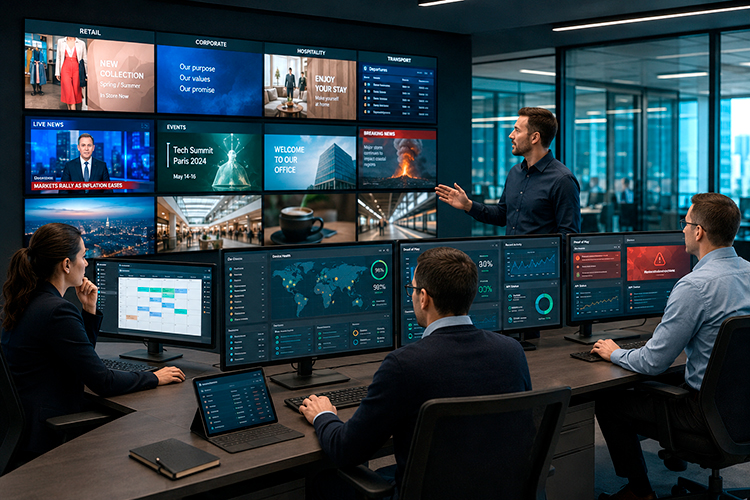 At the same time, companies such as Concept International are promoting compact systems designed for enterprise and industrial signage applications, where reliability, 24/7 operation, and remote maintenance outweigh raw hardware performance.
The underlying message is clear: the more mission-critical digital signage becomes to business operations, the more important the stability of the technology infrastructure becomes.
The hardware abstraction layer
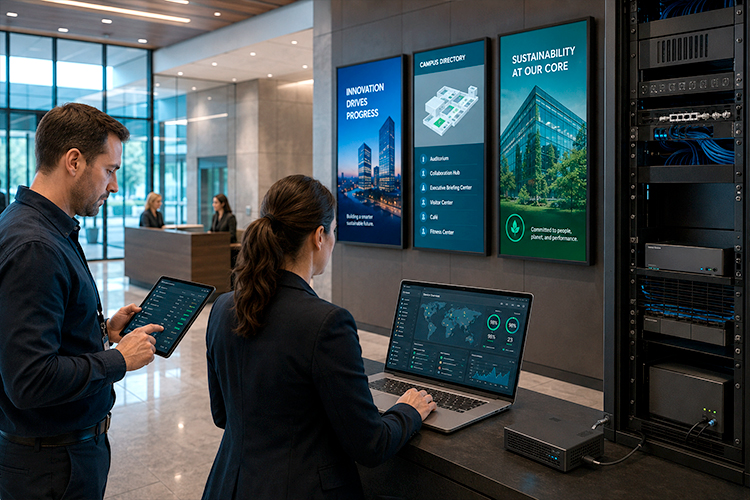
Part of the industry's transformation is also taking place at the software layer. signageOS has positioned itself around the concept of abstracting manufacturers, operating systems, and devices, allowing integrators and operators to manage heterogeneous networks from a single platform. Solutions such as CloudControl, DevSpace, Supra, and Content Guard demonstrate how the market is increasingly prioritizing interoperability, scalability, and centralized control over closed ecosystems tied to a single manufacturer.
The ability to manage Samsung, LG, Philips, Android, Windows, or ChromeOS displays from a unified software layer is becoming an operational necessity rather than a competitive advantage. The question is no longer simply which display to install, but how to maintain complex networks over many years while minimizing incidents, on-site technical visits, and dependence on specific hardware.
The CMS is no longer just a playlist
The CMS itself is also undergoing a radical transformation. NoviSign, Dimedis, OptiSigns, and ImpressBox represent a clear evolution from content-focused platforms toward connected business operations environments.
Digital signage is increasingly integrating with:
- APIs,
- automation,
- proof-of-play,
- analytics,
- contextual AI,
- dynamic templates,
- advertising,
- and multi-site remote management
Digital signage is therefore no longer functioning as an isolated visual tool but is becoming directly integrated into retail media strategies, corporate communications, and distributed operations. In enterprise environments, the CMS increasingly resembles business operations software rather than a conventional AV platform.
Cybersecurity becomes a core part of digital signage
The more connected signage networks become, the more critical cybersecurity also becomes. For years, many signage deployments operated with outdated media players, poorly controlled remote access, or networks shared with other corporate systems. However, the expansion of retail media, contextual data, and cloud-based management is significantly raising the level of risk. The issue is no longer purely technical—it is also operational and reputational. A connected display that is poorly managed can become a vulnerable entry point within a company's digital infrastructure. Companies such as Radix are strengthening capabilities in advanced monitoring, device management, and remote control specifically designed for distributed digital signage infrastructures.
Integrators are therefore taking on new responsibilities related to network segmentation, firmware updates, compliance, access protection, auditing, and remote security. The conversation is shifting away from hardware and toward the operational resilience of the entire network.
AV integrators move into IT territory
All of this is fundamentally redefining the role of the AV integrator. The market increasingly demands professionals capable of combining audiovisual expertise with networking, software, APIs, cloud computing, edge computing, and cybersecurity. Physical installation is no longer the end of the project—it has become the beginning of continuous operations.
Business models are also evolving toward recurring contracts linked to support, monitoring, maintenance, and SLAs. Digital signage is beginning to look less like a one-off AV project and more like a managed digital infrastructure service. This requires integrators and solution providers to develop capabilities that, until only a few years ago, clearly belonged to the IT domain:
- remote management,
- monitoring,
- compliance,
- cybersecurity,
- multi-site support,
- automation,
- and cloud operations
And this is perhaps one of the most significant conclusions emerging from DSS Europe Munich 2026: market leadership will no longer depend solely on who builds the best displays, but on who can master the entire software, operations, and connectivity stack that underpins the next generation of digital signage.