











MicroLED and COB technologies are driving the evolution of video walls toward immersive spaces.
For years, premium digital signage was built around a fairly straightforward idea: increasing size, brightness, and resolution. Traditional video walls represented the industry's ultimate visual expression, and much of the innovation focused on reducing bezels, improving uniformity, and expanding display formats.
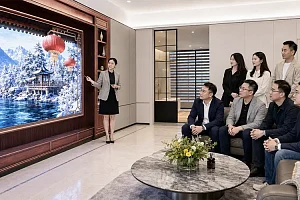
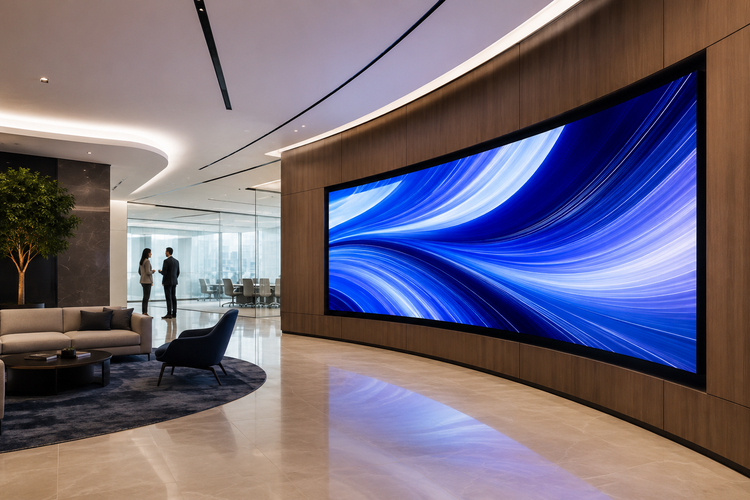
However, the shift that began to take shape at DSS Europe Munich 2026 points in a much deeper direction. Displays are gradually ceasing to function as devices added to a space and are instead becoming part of the architecture itself. They are no longer simply "installed" on a wall. They can become storefronts, transparent surfaces, sculptural elements, digital totems, immersive stages, or integrated visual layers within retail, corporate, and hospitality environments.
This shift is significant because it also transforms the role of digital signage within physical spaces. Displays are no longer used solely as communication tools; they are becoming active elements of the architectural and brand experience.
MicroLED and COB: less display, greater spatial integration
The expansion of MicroLED and COB is accelerating precisely this transition. For years, premium LED technology was associated with large visual surfaces for broadcast, events, and control rooms. However, advances in fine-pitch LED are shifting these solutions toward environments where visual integration, close viewing distances, and architectural continuity matter more than sheer display size.
Interest in MicroLED and COB is not driven solely by aesthetics. It is also linked to operational stability, maintenance, and seamless integration into demanding permanent installations. Samsung continues to strengthen this strategy with The Wall, a platform clearly aimed at corporate environments, broadcast facilities, and prestigious venues where uniformity, deep blacks, and continuous operation are critical.
LG is following a similar path with MAGNIT Micro LED, particularly targeting premium retail and corporate headquarters where the display is becoming an integral part of the interior design rather than an element added afterward. Sony, meanwhile, is consolidating Crystal LED VERONA within virtual production and immersive visualization, a segment where color reproduction, on-camera performance, and visual accuracy carry far greater weight than the traditional "wow" effect of conventional LED.
The underlying trend is becoming increasingly clear: the high-end signage market is no longer competing solely on visual spectacle. It is competing on spatial integration, architectural continuity, and the ability to transform the physical perception of a space.
Transparent LED enters commercial architecture
One of the most interesting developments in the premium market is taking place around transparent LED and integrated digital surfaces. The ability to incorporate visual content without completely blocking visibility, natural light, or spatial openness is expanding applications across luxury retail, automotive, hospitality, museums, and experiential storefronts.

AUO Display Plus is strengthening this category through Transparent MicroLED and solutions designed for integrated digital architecture. The appeal of these technologies lies not only in their visual impact but also in their ability to add digital layers without physically overwhelming the space.
At the same time, TCL is expanding its presence in the commercial LED and all-in-one display segment, an area gaining traction in corporate, education, and hybrid environments where integrated aesthetics, operational simplicity, and clean deployment are becoming increasingly important.
The result is significant: displays are no longer perceived as visible hardware but are beginning to behave as dynamic architectural materials.
From signage to immersive spaces
The evolution of premium LED is closely tied to the growth of immersive experiences, flagship stores, and hybrid environments that combine AV, architecture, and experiential branding.
The most ambitious projects are no longer focused solely on installing large-format displays. They aim to transform spatial perception, build visual narratives, and create physical experiences that are difficult to replicate in conventional digital environments. This is why the growth of MicroLED and COB is having a particularly strong impact on flagship stores, automotive showrooms, museums, airports, auditoriums, broadcast facilities, and premium DOOH.
DynaScan is reinforcing fine-pitch LED solutions specifically designed for close-viewing applications and professional environments where visual precision and operational reliability are top priorities.
Sansi, meanwhile, continues expanding its COB and MicroLED portfolio for creative experiences, large-format LED deployments, and high-impact visual environments where modularity and structural flexibility are becoming just as important as image quality.
As a result, displays are no longer merely communication channels—they are becoming central elements of a brand's physical language.
Rental, events, and temporary architecture
A significant part of this evolution is also linked to the rental and live events market, where premium LED technologies are finding one of their strongest growth drivers.
Companies such as LANG and ICT are actively participating in projects involving virtual production, immersive stages, brand activations, and temporary experiences where the boundaries between signage, digital scenography, and visual architecture are beginning to disappear. Apatronics is also strengthening its presence in large-format LED projects designed for experiential installations and technically demanding visual deployments.
This is also reshaping the role of AV integrators, who are increasingly collaborating with architects, stage designers, structural engineers, and creative studios. The conversation is shifting away from displays alone and toward spatial design, visual storytelling, and integrated physical experiences.
The challenge is not only technological
Even so, the growth of MicroLED, COB, and transparent LED continues to face significant barriers.
The primary challenge remains operational and economic. These installations require advanced calibration, structural integration, content specifically designed for immersive formats, thermal management, visual processing, and technical operation that is considerably more complex than conventional digital signage. Moreover, the market itself is increasingly recognizing that these technologies are not universal solutions for every installation. Their true value emerges in projects where visual experience, branding, permanence, and architectural integration genuinely justify both the investment and the associated maintenance.
This is precisely why one of the clearest takeaways from DSS Europe Munich 2026 is the growing divide between two digital signage models. On one side are solutions focused on operational efficiency, sustainability, and functional communication—where ePaper continues to gain momentum. On the other are technologies designed for maximum visual impact, spatial integration, and immersive experiences, where MicroLED, COB, and transparent LED are shaping the new premium segment of digital signage.
Displays are no longer limited to presenting content. They are beginning to physically redefine the space itself.