












The UAE’s US$1.29 billion cybersecurity market drives strategic AI dialogue at Intersec.
As the United Arab Emirates’ cybersecurity market rapidly expands—from US$620 million in 2024 to a projected US$1.29 billion by 2030—driven by AI-powered security analytics, Zero Trust architecture, and strong government initiatives, the InCyber Briefing at Intersec 2026 will present key insights into the evolving digital threat landscape and the governance of emerging technologies such as artificial intelligence (AI).
According to ResearchAndMarkets, the UAE cybersecurity market is experiencing rapid growth, driven by digital transformation initiatives, rising cyber threats, and strong government support for digital infrastructure, including the formation of the UAE National Cybersecurity Strategy and the establishment of entities such as the Cybersecurity Council. These initiatives are seen as a major catalyst, with research indicating the sector will grow at a compound annual growth rate (CAGR) of 12.8% through 2030.
As part of the 27th edition of Intersec, taking place from 12–14 January 2026 at the Dubai World Trade Centre, the InCyber Briefing is designed for CISOs, cybersecurity strategists, and digital risk leaders navigating unprecedented technological acceleration, with a focus on practical tools and real-world frameworks addressing AI governance, post-quantum readiness, supply chain resilience, and cyber risk reporting.
A highlight of the InCyber Briefing will be the keynote by Luqman Kondeth, Director of Cybersecurity at New York University Abu Dhabi, titled The Oracle in the System: A Village Parable for Governing AI. In this session, Kondeth will translate the complexity of AI governance into practical lessons on trust, oversight, and responsible innovation.
In the story, the village chief must keep his people alive amid uncertainty, balancing resources, risk, and innovation. When he introduces an Oracle—an ingenious but unpredictable tool—he faces the same dilemma we face with AI: how to benefit from its intelligence without surrendering human judgment. By observing how the chief sets rules, validates predictions, and keeps humans in the loop, audiences see governance not as compliance paperwork but as collective wisdom made systematic, explained Kondeth.
 Addressing the critical concern in AI deployment—prediction accuracy versus hallucination—Kondeth emphasised that although governance frameworks cannot eliminate risk, they play a vital role in defining accountability and awareness. He added: “We must build systems, or ‘three lines of defence’: operations teams who test AI in controlled conditions, risk and compliance teams who measure accuracy and bias, and internal auditors who verify that the rules were followed”.
Describing what the future of AI governance will look like in practice, Kondeth considers it will feel less like regulation and more like infrastructure, integrated into design and decision-making processes in the same way cybersecurity and privacy are today.
“AI governance must be continuous, integrated, and human-centred. We are moving toward AI control rooms that constantly monitor model behaviour, supported by ongoing risk assessments rather than periodic reviews. Since AI will operate as both a tool and a service across the organisation, close alignment with Enterprise Architecture is essential. Ultimately, governance must remain adaptive—measuring not only performance but trust, accountability, and societal impact”, concluded Kondeth.
 |
 |
In addition to the one-day InCyber Briefing, consulting firm Kearney —Intersec’s Strategic Intelligence Partner— will host a closed-door roundtable titled Defending the Digital Backbone: Securing National Infrastructure in the Era of AI and Hybrid Threats. Based on the discussion, Kearney will produce a white paper exploring how governments can move beyond reactive defence toward proactive, intelligence-driven resilience, integrating policy, technology, and ecosystem collaboration to safeguard critical assets.
AI, automation, and digitalisation are reshaping the cybersecurity landscape. The InCyber Briefing equips decision-makers with the foresight, frameworks, and leadership strategies they need to govern AI ethically and effectively while protecting their organisations against emerging threats, said Dishan Isaac, Director of Intersec at Messe Frankfurt Middle East.
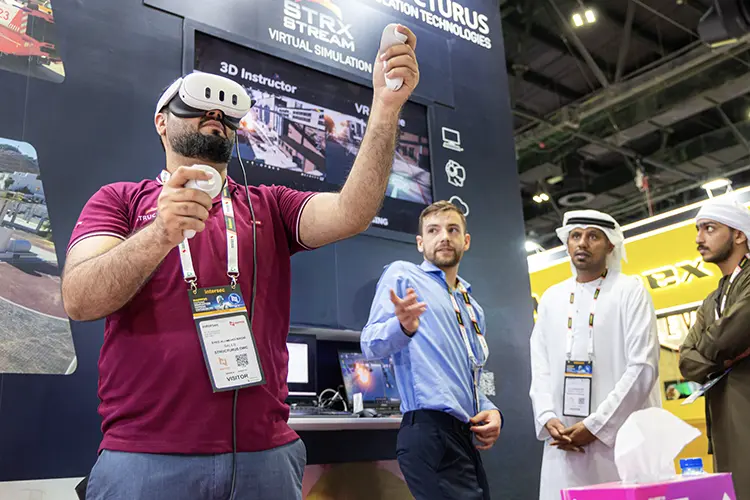
With more than 1,400 exhibitors from over 60 countries and an expected 50,000 visitors, Intersec 2026 will be the largest edition in its 27-year history, spanning 67,000 sqm of exhibition space under the patronage of His Highness Sheikh Mansoor Bin Mohammed bin Rashid Al Maktoum and supported by the General Command of Dubai Civil Defense (DCD) and the Security Industry Regulatory Agency (SIRA).