












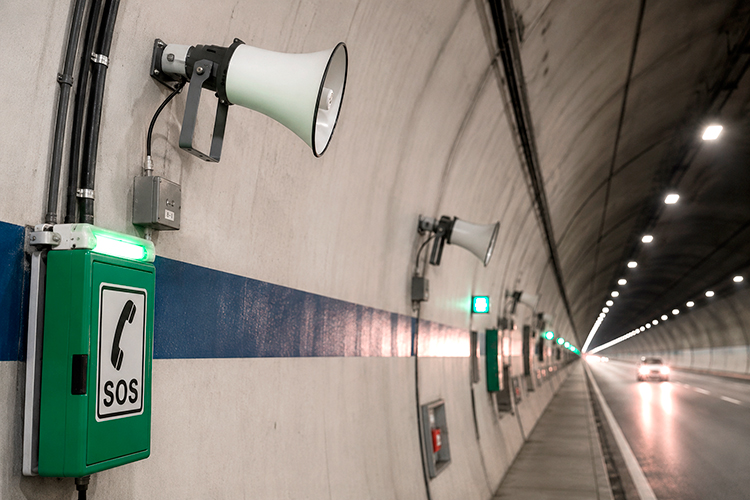
Tunnels are complex environments for public address systems due to noise, reverberation, and long distances.
Installing a public address system in a tunnel requires solving three problems that only appear together in this context: high or extreme reverberation, high ambient noise, and large coverage distances.
The need for immediate response during an emergency turns every project into an exercise in precision, where the real requirement is not only that the message is heard, but that it is clearly understood at any point along the route and under any circumstances.
The real technical challenge
In a tunnel, sound bounces. Hard surfaces (concrete, rock, metal) generate constant reverberation that degrades the intelligibility of any message. Added to this is the noise from road traffic and ventilation systems, which in emergency situations can exceed 90 dB(A). Above that threshold, delivering an audible message requires sound pressure levels above 100 dB, but power alone does not guarantee that the message will be understood.
Intelligibility is measured using the STI (Speech Transmission Index). General regulations require values equal to or greater than 0.50; in tunnels, where acoustic conditions are inherently adverse, 0.45 is accepted provided that equalization is optimized according to background noise. Reaching that threshold in a tunnel several kilometers long is not trivial.
Length adds another layer of complexity. When loudspeakers are separated by dozens of meters, sound reaches the listener at different times, destroying message coherence. Increasing power in that scenario only amplifies the problem. The solution is to apply specific delays through DSP processing to each emission point, creating a synchronized wavefront along the entire route.
The result is that a conventional PA system is not sufficient in a tunnel. A solution with distributed architecture, DSP processing, centralized zone control, and continuous monitoring of all components is required.
Regulatory framework
Royal Decree 635/2006 establishes the mandatory use of public address systems in urban tunnels longer than 200 meters and interurban tunnels longer than 500 meters. The applicable regulations depend on whether the system is linked to fire detection or not: if it is not, UNE-EN 50849 applies; if it is, the EN 54 family comes into play, regulating control equipment (EN 54-16), loudspeakers (EN 54-24), and emergency power supplies (EN 54-4).
EN 54 certification is not merely a documentary requirement. It means that every system component (controller, amplifiers, loudspeakers, power supplies) has passed operational tests under failure conditions, interference, and progressive degradation. A certified system must be capable of maintaining emergency message broadcasting even with partial failures in the installation, with continuous monitoring of lines and equipment, and event logging for subsequent auditing.
In practice, most newly built or modernized tunnels opt for EN 54 certified systems, both due to technical specification requirements and the additional guarantee they provide in installations classified as critical infrastructure. This also includes the renovation processes currently underway in numerous Spanish infrastructures under the Recovery Plan, where tender specifications systematically include certification as a bidding requirement.
How OPTIMUS approaches it
Every tunnel has its own conditions: length, cross-section, materials, traffic level, number of zones, integration with other safety systems. That is why there is no standard solution for this sector. Before selecting any equipment, the acoustic behavior of the infrastructure is analyzed using EASE (Enhanced Acoustic Simulator for Engineers) simulation software. Based on a three-dimensional model of the infrastructure (geometry, materials, and absorption coefficients of each surface), the program calculates how sound behaves in that specific space: reverberation time, sound pressure level at each point, acoustic energy distribution, and estimated STI value according to the expected background noise.
This model allows design decisions to be made based on data before a single piece of equipment is installed. One of the most critical is time synchronization: in a long tunnel, sound emitted by loudspeakers separated by dozens of meters reaches the listener at different times, generating interference that destroys message coherence. The prior acoustic study determines exactly which DSP delay must be applied to each emission point so that the wavefront arrives synchronized along the entire route. Without that calculation, increasing power only amplifies the problem instead of solving it.
The model also defines where to place the loudspeakers, how far apart they should be, how much power each zone requires, and what equalization compensates for the spectral profile of ambient noise. The result is not an estimate: it is a design with intelligibility parameters verified before installation.
From there, work is carried out with Compact and OPTIMAX3 systems: modular and scalable systems that allow management of multiple zones, integration of distributed amplifiers along the route, and continuous monitoring of the entire system. The IP architecture facilitates synchronization of announcements and integration with the infrastructure’s control, ventilation, fire detection, and signaling systems.
The platform used in each project depends on the scale and complexity of the installation. OPTIMAX3 is the solution for long infrastructures or multiple tunnels managed as a single system, where distributed architecture and IP redundancy are decisive. Compact systems cover medium-complexity installations with zone management. And for smaller-scale tunnels, Compact LITE offers an autonomous all-in-one solution, with integrated PA/VA matrix, amplification, and battery charger in a single unit. All three options are EN 54 certified, and the reference projects in this article represent all three solutions, reflecting the real range of installations in which OPTIMUS operates.
Equipment designed for this environment
The loudspeaker is the final link in the system, but in a tunnel it is also part of the solution to the acoustic problem. The directivity of the model determines how much sound energy reaches the listener directly and how much reflects off the walls, contributing to the reverberation that degrades intelligibility. Power and coverage determine how many emission points the design requires, and therefore the complexity and cost of the installation. And the physical construction of the equipment determines whether it will continue operating correctly after five or ten years in an environment with constant humidity, pollutants, vibrations, and extreme temperatures, where maintenance access is limited and a failure is not merely an operational inconvenience but a safety failure.
That is why not just any loudspeaker is suitable for a tunnel. And that is why selecting the model is a technical decision derived directly from the acoustic design, not from the catalog. This is a brief selection of some of the loudspeakers we supply for these environments:
- AET-100: The AET-100 is the exponential loudspeaker specifically designed for this environment. With 100 W RMS and EN 54-24 certification, it provides 133 dB SPL with balanced response and low distortion. Its high directivity is the most relevant factor in this context: it concentrates sound energy toward the listener and reduces reflections on the tunnel’s hard surfaces, improving the ratio between direct and reverberant sound and facilitating achievement of the minimum required STI. The construction is designed for real environmental conditions: flame-retardant plastic housing with IP65 protection, AISI 316 stainless steel fittings, and an operating range from -25 ºC to +70 ºC. In the comprehensive renovation of the Artxanda tunnels, 15 units were installed in an urban infrastructure carrying 30,000 vehicles daily, where equipment reliability under continuous operation is decisive.
- AC-930EN: When the route length requires distributing a large number of emission points, the AC-930EN operates on another scale. With 30 W RMS on a 100 V line, selectable power in four levels, and 112.7 dB SPL maximum output, it offers a frequency response from 250 to 15,000 Hz suitable for voice messages with good intelligibility. The IP66 protection and steel bracket are intended for sections with forced ventilation or direct exposure to humidity. In the Piedrafita tunnels, 82 units were installed covering four independent installations within the same corridor, clearly illustrating the type of project for which it is designed.
- AC-850T: The AC-850T solves a different problem: maximum sound pressure and long-range coverage with the minimum number of emission points. With 50 W RMS, a 508 mm horn, and up to 127 dB SPL, it covers large distances from a single point, simplifying system architecture in tunnels where reducing loudspeaker density has direct implications for installation cost and complexity. Four-level power selection (50, 30, 15, and 7.5 W) allows zone coverage adjustment without modifying wiring. Its aluminum construction with IP66 protection makes it suitable for environments with humidity or atmospheric exposure. In Tunnel 5 Supervía Poetas in Mexico City, 60 units were installed to cover the entire infrastructure route.
Reference projects
OPTIMAX3 Platform
- Guadarrama Tunnels, AP-6
The Northwest Highway crosses the Guadarrama mountain range through three tunnels excavated between 1963 and 2007, with the longest reaching 3.34 km. The integrated management of the three tunnels as a single system, combined with the infrastructure length and dense traffic during peak periods, created a highly demanding scenario both in terms of power and system architecture.
At that scale, time synchronization between emission zones is the central problem: maintaining a coherent wavefront over more than three kilometers requires a strongly distributed architecture, with amplifiers located along the route and DSP delays calculated for each point. The installed configuration, with 17 IF-8P4/0E modules distributed throughout the system, responds exactly to that logic: the goal is not to centralize power, but to bring it to the point where it is needed, synchronized with the rest of the system.
Installed system:
- OPTIMAX3, 3 × IF-8P4 + 17 × IF-8P4/0E, 28,520 W, DC-800ETH
- Artxanda Tunnels, Bizkaia
The Artxanda tunnels connect Bilbao with the Txorierri region, Loiu Airport, and the Bizkaia Technology Park. With an average of 30,000 vehicles daily, they are one of the most critical mobility arteries in the Bilbao metropolitan area.
The Provincial Council of Bizkaia is currently carrying out a comprehensive renovation of the three tunnels in consecutive phases. The goal is to modernize the safety, ventilation, and lighting systems of an infrastructure that has been in continuous service for more than two decades.
OPTIMUS is part of this renovation. The new public address and voice evacuation system is being installed in phases, in parallel with the works, with equipment still being delivered to the site at the time of publication of this article.
Installed system:
- OPTIMAX3, 5 × IF-8P4, powers of 4,520 W and 2,700 W
- 15 × AET-100, 2 × PRO-150B, 1 × P08-EN54
The project combines the demands inherent to a high-traffic infrastructure with the operational restrictions of working in an active tunnel: installation must be coordinated with phased partial closures without interrupting overall operations.
- La Rovira Tunnel, Barcelona
An urban tunnel 1,300 meters long connecting the Baix Guinardó and Carmel neighborhoods with the Ronda de Dalt, with heavy traffic and continuous use. The acoustic particularity of this tunnel lies in its urban layout: an infrastructure with a relatively small cross-section and medium length where reverberation accumulates quickly and traffic noise remains constant even outside emergency situations.
The installation design reflects that complexity: the distribution of loudspeakers into three groups with different densities (46, 30, and 15 AC-630T units) indicates a non-uniform acoustic design adapted to the different conditions of each section of the route. The OPTIMAX3 architecture with distributed amplification allows these zones to be managed independently, synchronizing announcements and adjusting emission levels according to the conditions of each sector.
Installed system:
- OPTIMAX3, 2 × (IF-8P4 + IF-8P4/0E), 4,520 W
- 8 × SP-920EN, 46 + 30 + 15 × AC-630T, 9 × SP-910DEN
Compact System
- Piedrafita, Trabadelo, and Villafranca Tunnels, Lugo/León
The Piedrafita mountain pass includes several tunnels along the A-6 corridor between kilometers 407 and 464, in the section where the highway crosses the border between Lugo and León. The La Escrita, Trabadelo, and Villafranca tunnels are located within less than 10 kilometers, with traffic intensity exceeding 2,000 vehicles daily. It is a particularly demanding section due to the density of infrastructures within the same corridor and the climatic conditions of the Galician mountains.
The particularity of this project lies in the coordination of four independent installations within the same technical logic. OPTIMUS is also participating in the modernization currently underway in these tunnels, which includes the comprehensive renewal of safety systems within the framework of the Recovery Plan.
Installed system:
- 4 × Compact System: 3,000 W + 2,000 W + 3,000 W + 3,000 W
- 4 × SP-920EN, 82 × AC-930EN EN 54 certified
- Pilar de la Horadada Tunnel, Alicante
The Pilar de la Horadada tunnel is 794 meters long and located at km 772 of the AP-7, on the Crevillente-Cartagena section, next to the urban center of Pilar de la Horadada. It has been in service since 2001 and carries around 28,000 vehicles daily. It is a cut-and-cover tunnel with one tube for each carriageway, which implies managing two enclosures with similar acoustic conditions but completely independent installations.
Unlike a tunnel excavated in rock, a cut-and-cover tunnel has a more regular cross-section and more homogeneous construction materials, which makes acoustic behavior easier to predict, but does not eliminate the challenge of reverberation or traffic noise. The adopted solution, with 64 AC-730T column loudspeakers distributed along the route, responds to the need to maintain uniform coverage in each tube with an independent and monitored system for each carriageway.
Installed system:
- Compact System, 3,000 W, DC-700ETH
- 64 × AC-730T, 2 × AC-615T
- Manises Tunnel, Valencia Airport
A cut-and-cover tunnel approximately 460 meters long built on the road access to Valencia Airport via the N-220 as it passes through the urban center of Manises. It operates in a constant traffic environment with a relevant particularity: the dual nature of the flow, with both urban mobility vehicles and airport traffic, implies a continuous and sustained level of use not usually found in conventional road tunnels.
The 4,000 W installed over 460 meters respond to an acoustically demanding environment with permanently high background noise. The combination of AC-730T loudspeakers with SP-30BR units results in a design with differentiated zones, adapting coverage to the different acoustic conditions along the route. The DC-700ETH/T controller, integrable with SIP, facilitates coordination with the airport’s management systems.
Installed system:
- Compact System, 4,000 W, DC-700ETH/T
- 47 × AC-730T, 13 × SP-30BR
Compact LITE
- Tunnel 5 Supervía Poetas, Mexico City
An international project within a road infrastructure in Mexico City. The solution had to meet the communication and emergency announcement needs of a road traffic tunnel while adapting to the local regulatory and operational context, which does not exactly replicate European EN 54 standards but has its own technical and certification requirements.
The choice of Compact LITE as the central platform is consistent with that reality: an autonomous system with integrated PA/VA matrix, built-in battery charger, and IP connectivity that meets the needs of a medium-scale tunnel without requiring an architecture as distributed as that of longer infrastructures. The ability to integrate with external systems through standard protocols also facilitated adaptation to the project’s local control environment.
Installed system:
- Compact LITE + DC-700ETH
- 60 × AC-850T
Beyond power: intelligibility, architecture, and EN 54 regulations
In critical infrastructure, the public address system is part of the safety system, and it is required to provide the same level of reliability as the rest of the subsystems. This has concrete implications for how it is designed, validated, and maintained.
The work that determines whether a system will function correctly takes place before installation: in the acoustic study, zone design, delay calculations, selection of certified equipment, and verification of the expected STI. Once installed, the system must be capable of monitoring itself (detecting line faults, logging events, maintaining broadcasting under degraded conditions) and be supported with guarantees and technical assistance that do not depend on third parties.