













Technology integration is becoming the backbone of the new generation of Smart Buildings.
This evolution, driven by advances in IoT, automation, electronic security and professional audiovisual systems, marks a turning point for cities and organisations seeking more sustainable, secure and activity-adapted spaces.
At a time when Smart Cities are multiplying on a global scale, the role of the intelligent building takes on a new purpose: to become an active node within the urban network, capable of communicating information, optimising flows, anticipating needs and collaborating with external infrastructures. For technology integrators, this convergence opens up an unprecedented growth landscape.

Smart Building: efficiency, connectivity and unified control
The modern Smart Building is supported by BMS (Building Management Systems), IoT networks, advanced sensorisation and control systems capable of automating critical functions. Such infrastructures allow:
- Optimising lighting and HVAC according to actual occupancy.
- Reducing energy consumption through predictive algorithms.
- Monitoring environmental quality and adjusting parameters in real time.
- Centralising building management in a single operational interface.
The result is a building that learns, analyses and acts, improving both internal operations and the end-user experience.
Professional automation and building control: the new backbone of the intelligent building
Home and building automation has evolved into a transversal system present in all types of facilities—offices, industrial sites, healthcare centres, corporate environments or large-scale residential buildings.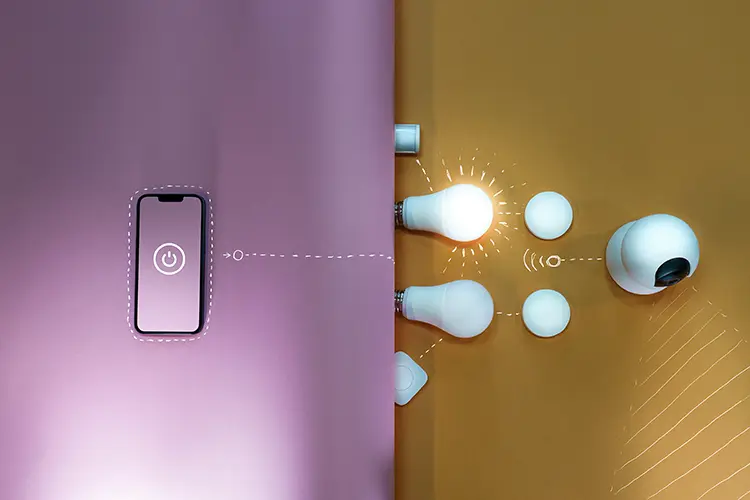 Thanks to professional integration, it is now possible to:
- Automate lighting, HVAC and blinds according to schedules, usage or environmental conditions.
- Unify multiple protocols (KNX, BACnet, Modbus, DALI, IP…) into one homogeneous ecosystem.
- Manage energy from centralised platforms with advanced reporting.
- Integrate digital assistants and touch panels to enhance usability.
This evolution turns automation into a strategic tool for efficiency and sustainability, especially in a context of increasing regulatory demands.
Smart security: connected protection and advanced analytics
Electronic security is one of the key pillars in the digital transformation of buildings. The integration of IP solutions and AI-based analytics enables:
- Real-time detection of anomalous patterns.
- Biometric access control with full traceability.
- Early incident detection through advanced sensors.
- Continuous communication with urban or private control centres.
These systems allow security to move from being reactive to becoming predictive and contextual—a crucial qualitative leap in corporate and urban environments.
Audiovisual systems: the operational heart of connected spaces
Collaborative environments and control rooms are central to the new Smart Building paradigm. Professional AV solutions enable:
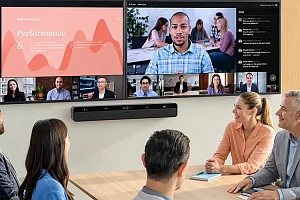
- Fully automated smart meeting rooms.
- Hybrid spaces with advanced videoconferencing and wireless sharing.
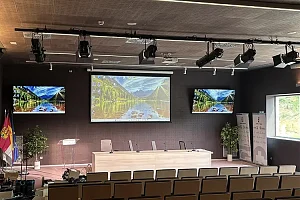
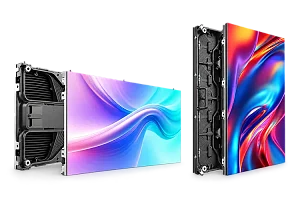
- LED videowalls in urban or corporate control centres.
- Dynamic digital signage for guiding, informing and managing flows.
 AV therefore becomes a central instrument for communication and operational efficiency, connecting people, systems and processes.
Technology integration: the real driver of change
The evolution of the Smart Building is only possible thanks to the role of the technology integrator, responsible for uniting traditionally separate disciplines—AV, security, automation, IoT, communications—into a coherent, operational and scalable system.
This professional profile becomes essential for the cities of the future, where interoperability is the key to transforming data into decisions.
A new urban horizon
The convergence between Smart Building and Smart City is creating more adaptive, sustainable and resilient infrastructures. Technology integration will undoubtedly be the fundamental pillar enabling cities to evolve toward a more connected and efficient future, where buildings not only operate: they actively collaborate in urban life.