












Ricoh has created a platform that enables companies to consume artificial intelligence as a service.
The company has unveiled its proposal to help Spanish businesses generate real value with artificial intelligence, a technology they cannot ignore due to its high impact on productivity, efficiency, business objectives, and overall corporate results.
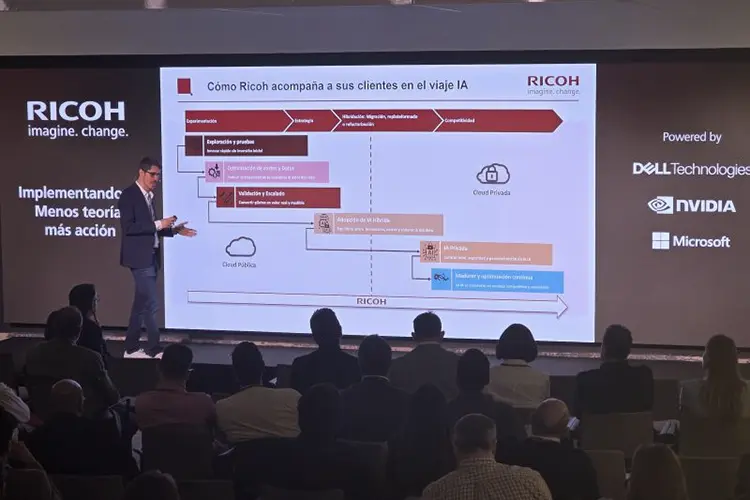
According to Gartner, global AI spending will reach 1.5 trillion dollars by the end of 2025 and exceed 2 trillion in 2025, driven by its integration into devices such as smartphones, personal computers, and the entire IT infrastructure of companies. However, moving artificial intelligence (AI) projects from the initial idea to real production deployment remains a major challenge, as highlighted during the event Implementing AI: less theory, more action, organized by Ricoh together with key partners in this field: Dell Technologies, NVIDIA, and Microsoft.
As explained by Mario Hernando, Director of AI Business Development at Ricoh Spain: 95% of AI projects never move from proof of concept to production, because when transitioning from a controlled environment to integrating a project into real systems with unprepared data, that is where most initiatives fall short. It is not a vision problem but an integration problem: integrating technology, integrating data, and integrating people. That is where the integrator’s role is key.
Artificial intelligence as a service, at the core of Ricoh’s offering
During the event, Ricoh presented to more than one hundred companies its proposal for generating value with this technology, ensuring that investments translate into competitive advantage while guaranteeing efficiency, scalability, and return on investment. “We have built a clear journey to AI, which starts in the cloud—whether in a hybrid or private environment—to integrate this technology in a modular, scalable, and secure way”, Hernando emphasized.
To achieve this, it leverages the experience of the Ricoh Cloud & Cyber team, which has more than 500 specialists in infrastructure, platforms, application development, and cybersecurity, along with the company’s two other major business lines: Workplace and Process Automation. Both have evolved and strengthened their offerings with AI, enhancing their capabilities for personal productivity in the first case and for process automation to enable intelligent information management in the second. “Artificial intelligence is not a new business line, but an accelerator that enhances the businesses we already have, improving services to make them more efficient and intelligent”, the expert summarized.
Across its three business lines, the company can deliver turnkey projects, but the major innovation presented at the event is Ricoh Intelligent Automation (RIA), a platform that provides an operational and consumption model for AI as a service, in which Ricoh manages the infrastructure, the solution, AI development stacks, as well as application or service integration through the platform.
This approach frees organizations from managing infrastructure and the platform itself, allowing them to focus on creating real business value.
RIA allows us to drastically reduce time to value: we accelerate adoption, simplify integration, and ensure that AI becomes a cross-organizational capability, explained Mario Hernando.
The voice of the customers
Three Ricoh clients participated in the event: Renta 4, OHLA, and Iberdrola. Their spokespersons shared messages such as the following:
- AI is already present in every sector, even the most regulated ones. But to avoid the high failure rate, it must be implemented pragmatically and profitably.
- Every AI project must be carefully evaluated: its impact must generate value for both the company and the end user.
- Key barriers: the regulatory framework requires knowing where the data resides, and integration must rely on a solid technological architecture. A proof of concept is not the same as a large-scale deployment: the solution must be robust from the beginning.