















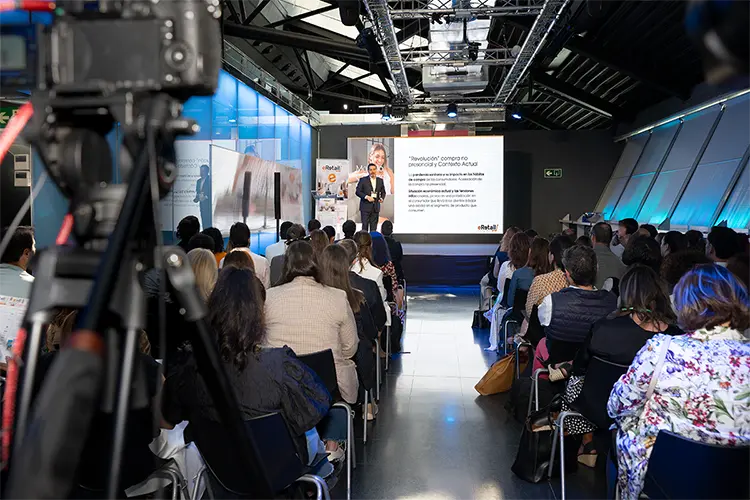
More than 400 professionals have registered for #eRetail2024 to successfully tackle the challenges of the future.
Professionals have registered for eRetail Congress 2024 to share the latest trends in eCommerce and Retail, optimize processes, anticipate, and design differential strategies. The event was also streamed live to provide access to professionals interested in attending the presentations.
The future of the retail sector lies in offering an innovative and differentiated value proposition. To achieve this, it is crucial to manage the emotions of the omnichannel customer. Today's consumer not only seeks products and services but also desires an authentic connection and personalized empathetic service. In this sense, the integration of channels and simplicity in interaction, along with the strategic and secure implementation of technologies like AI, enhance rewarding experiences, reinforcing the customer's sense of belonging.
The opening presentation was given by Pascual Campos, General Manager of Supermercados Plaza, who delved into a vision of proximity food retailing in service of the OmniCustomer.
In the 'Shop as You Want' model, it is essential to place the customer at the center of all strategies to ensure value contribution, prescription, and differentiation. The evolution of non-face-to-face commerce presents an opportunity, being the tool to optimize time scarcity in modern life. It is time to maintain the essence, the origin of who we are, and adapt to the present and future.
He also shared that, in the new purchasing model, "the customer decides where and how they want to acquire the product, and in this sense, automated processes will improve the shopping experience in the retail of the future. Having an omnichannel strategy is strategic in the business model. Additionally, data analysis is key to optimizing processes, anticipating needs, and designing successful commercial strategies."
Towards an innovative value proposition
Consumers aspire to a more human connection in their interaction with brands, especially valuing personalized, empathetic, and practical service. For this reason, having an omnichannel strategy and using valuable data as part of the business model is fundamental. This allows optimizing processes, anticipating needs, and designing effective commercial strategies.
"Retail Media is a strategic commercial asset in organizations that will make the business more profitable", noted Víctor Aubeso, Retail Rocket's Retail Media Product Manager, who focused on market trends and how to focus Retail Media to increase business results. "Retailers must attract brands' investment through an innovative value proposition. Since they are professional eCommerce experts, this will turn them into active revenue generators through their own means." In this sense, he pointed out that "technology is the core to be able to use well-defined eCommerce analytics that connect the company's efforts with advertising ROI and revenue".
On the other hand, Brigitte Boehm, Global Chief Marketing & Commercial Officer of UNOde50, explained the keys to UNOde50's omnichannel transformation to create a coherent brand image. "To have a robust omnichannel strategy, it is very important to work on the brand image and do a previous rebranding. It is essential to adopt a personalized approach, invest in online advertising, and be present on social media, as they are the main sources of product search and information for all generations of users. Additionally, physical stores continue to have a very valuable weight as a purchasing channel, and consumers always value the advantages of omnichannelity".
To become the best in the basics of commerce, it is key to consider these aspects: product catalog; competitiveness; customer service; shopping experience; brand and loyalty. In order to achieve transformation, Leroy Merlin focuses on focusing on the customer experience, developing an omnichannel school, investing in digital transformation, and maintaining a continuous innovation attitude, all accompanied by AI as the focus of evolution, pointed out Fernando Herranz, Digital Experience & eCommerce Director of Leroy Merlin.
On his part, Fernando Gutierrez-Cabello, Account Manager of MicroStrategy, focused his presentation on the benefits offered by contextual information and chatbots in improving the customer experience and personalized product recommendation and gave a live demonstration of the platform's operation. "Hyperintelligence is a concept that allows indexing information from one or several sources in the browser, offering relevant contextual analysis to enrich the workflow. Likewise, our tool integrates AI with precision and confidence, placing it at the center of the user experience".
Challenges of the retail sector
The changing needs of consumers require retail leaders to simplify and make shopping experiences more convenient, both online and in physical stores. Innovation is a key differentiator, and brands that adopt new ideas and approaches will position themselves as benchmarks to maintain relevance and competitiveness in a dynamic context.
This was the theme of the first panel discussion of eRetail Congress moderated by Ignacio Llanos, Sales Director of TTEC, in which Marco Rocha, Director of Communication and Digital Strategy of Getafe Club de Fútbol; Fernando Velasco Sales and Retail Director of Visionlab; Irene Martín, Customer Experience & Operations Strategy Manager of Makro; Rocío Rua, Retail General Manager of HOFF; Marc Carpio, Spain Sales Director of Veepee, and Ramiro Bresler, Director of eCommerce and Marketing of 123ink, participated.
The executives shared that the starting point of any strategy must be to understand the customer and their needs in order to personalize the experience. They agreed on common challenges such as integrating all channels and achieving omnichannelity, offering simplicity in interaction with the brand, or the importance of ensuring product traceability for agile availability. Likewise, they emphasized that possible internal frictions require educating teams about the value of omnichannelity. "We must ensure reliability and evolve towards a customer-centric approach, investing in experience management, and maintaining coherence in brand actions".
On the other hand, they highlighted that technology must be integrated purposefully, centralizing data and managing information efficiently. In this line, they mentioned trends such as AI as a great ally to improve processes and costs. They also specified that, to enhance the customer experience, it is vital to have trained profiles and invest in continuous team training.
Key factors to drive an effective growth strategy
In the competitive world of eCommerce, companies must adopt innovative strategies to ensure sustained growth. Personalization, omnichannelity, data optimization, and exceptional customer experience are fundamental pillars for an effective growth strategy.
Around this central theme, the second panel discussion of eRetail Congress powered by Splio has been developed. With the aim of analyzing the key foundations for driving growth in the digital retail sector, the roundtable has featured the participation of Benedicte Deigat, Longchamp's Country Manager Spain; Maxence Cano, Splio's Sales Director; Juan Garrido, Game's eCommerce Director; Lourdes Ferrer, CEO & Founder of Percentil; Marta Tamayo, General Manager of Le Secret du Marais; and Juan Carlos Peña, Cash Converters' Ecommerce and Growth Director, moderated by Juan Carlos Lozano, CEO of Dir&Ge.
Executives have agreed that the true value of omnichannelity lies in achieving proximity with the customer and ensuring a shopping experience without any kind of friction. In this line, they emphasized the significant challenge companies face in unifying and refining data from different channels to access a single view of the customer, and the importance of establishing a clear strategy and having specialized partners to carry it out successfully. "A loyal customer becomes the best brand ambassador, so it is key to manage their expectations correctly".
They have also shared the numerous functionalities of AI and specified that the challenge for companies is to find ways to integrate this technology into areas that provide greater value. Sustainability, omnichannelity, or the evolution towards efficient eCommerce models to promote sustainable economy have emerged as the main trends that will shape the sector.
Agility and personalization
Digitalization has become a central theme in industries, and eCommerce is no exception. Advanced technologies transform processes, ways of analyzing data, and daily operations, while raising customer expectations, who are increasingly informed and demanding.
Veronika Nikolaeva, Director of eCommerce at Alcampo, has highlighted the trends shaping eCommerce evolution.
AI provides personalized recommendations, enhancing the shopping experience and fostering loyalty. Likewise, automation improves efficiency, reduces preparation costs, increases productivity, and drives scalability, agilely adapting business growth without compromising efficiency. A personalized digital experience is built by listening to the customer, and for this, it is key to consider security and privacy, compatibility and agility, offer personalization, efficiency and productivity, and omnichannelity.
Eduardo Saiz Lekue, Founding Partner of Cervezas La Salve Bilbao, and María Moreno, Inbound Marketing Strategist at Cyberclick, have focused their presentation on the power of segmentation and automation strategies through the practical case of La Salve Bilbao. "The keys to understanding your customer database and selling more are: defining relevant data for the business, segmenting different user profiles and identifying their preferences, resorting to personalization to extract intelligence from information and micro-segmentation, and finally, tracking, reviewing, and periodically optimizing campaigns", pointed out María Moreno. Eduardo Saiz Lekue highlighted: "For La Salve, a local beer from Bilbao with the goal of creating value in the market and doing things differently, direct customer reach, conveying the brand's values, is a rough diamond that is giving us countless joys".
Carlos Baranda, Co-Founder and Director of Glent, highlighted during the closing presentation of the day the innovative concept of digital craftsmanship. "In our company, we offer custom-made artisan shoes using 3D technology that allows precise measurement of the length, width, and height of the instep, achieving a perfect fit of the footwear". Furthermore, he explained that their technology, integrated into a comprehensive ERP package, "covers everything from point-of-sale management, business KPIs, and business intelligence report generation, to total integration and traceability of the supply chain. We combine technology with craftsmanship, which is true sustainability, and with personalization. Achieving effective personalization requires the supply chain to adapt to the individual needs of each customer".